


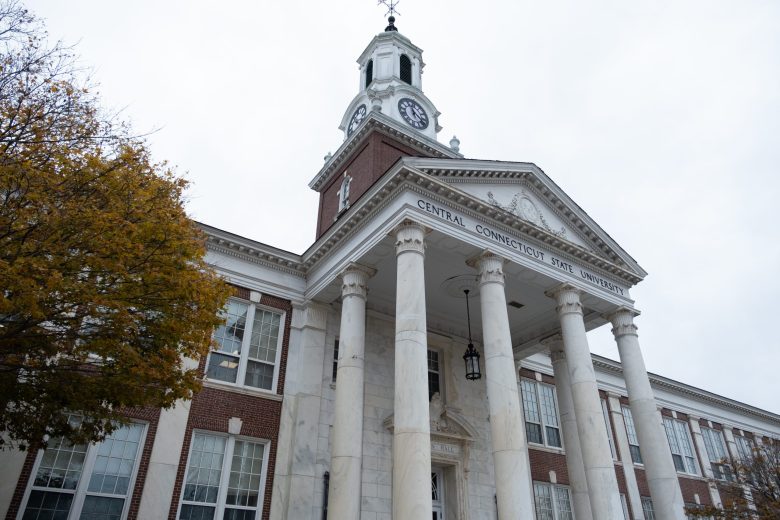
Grand River Solutions issued an excoriating report Thursday of the circumstances surrounding Interim Chancellor John Maduko’s abrupt departure from the Connecticut State Colleges and Universities system earlier this year.
Maduko resigned in late April in response to a sexual harassment complaint against him. It turns out this wasn’t the first sign of trouble: According to the report, evidence surfaced in October 2022 that Maduko may have behaved inappropriately toward women at two of the state’s community colleges. A series of systemic failures meant those concerns may not have reached the full Board of Regents and certainly failed to prevent Maduko’s appointment as interim chancellor in 2025, according to the report.
CSCU retained Grand River Solutions in June to conduct an independent review into its handling of Maduko’s case. The review found CSCU systematically failed to support impacted parties, lacked clear processes for addressing sexual harassment complaints and allowed private information to leak.
One woman left CSCU in 2025 after alleged harassment from Maduko; another had her contract nonrenewed after a high-level administrator allegedly showed Maduko a complaint she had filed against him, according to the report. (The nonrenewal has since been reversed.)
“The Grand River Solutions review identifies serious issues involving accountability, reporting responsibilities, leadership decision-making, and institutional response. The Board of Regents and CSCU System Office accept these findings and are moving forward with a series of reforms to address them,” said Sam Norton, a CSCU spokesperson, in a written statement.
State legislators responded to the report shortly after its release.
“What we see in this report exemplifies gross misconduct and a severe lack of leadership at the CSCU Board level,” Sen. Gary Winfield, D-New Haven, wrote in a press release.
“Needless to say, the next legislature should weigh the possibility of changes to the state Board of Regents.”
The Democratic members of the Committee on Higher Education and Employment Advancement issued their own press release the same day.
“This is indicative of systemic failure to protect staff, and culpability extends past the former Chancellor. If, as indicated, the Board of Regents Chair and Vice Chair were aware of prior complaints and moved forward with his appointment, that is deeply troubling,” they wrote.
However, they expressed confidence that current interim chancellor Natalie Braswell and interim Board of Regents Chair Ari Santiago “take this seriously and are committed to making changes.”
Both Braswell and Santiago assumed their roles as a direct result of the scandal involving Maduko.
The report also fills in details about the complaint that ultimately led to Maduko’s resignation. It states that in May 2024, Maduko began sending inappropriate sexual messages to a woman identified as Impacted Party 1. The woman allegedly told CSCU General Counsel Karen Buffkin in June 2025 the board should not appoint Maduko, but that information was not passed along.
Buffkin, who has been placed on paid administrative leave, told Grand River Solutions she did not recall Impacted Party 1’s comments.
On Apr. 13, 2026, Maduko sent several text messages soliciting Impacted Party 1 to “participate in or observe him engaging in a sexual act,” according to the report. This prompted her to approach Buffkin with evidence of Maduko’s conduct, setting an investigation in motion. Despite that, no measures were immediately put in place to protect or support Impacted Party 1. The next day, she had to speak with Maduko for an hour, during which, the report states, he continued making sexual comments.
Maduko submitted his resignation on April 24. On April 29, CSCU Title XI Coordinator Alphonso Atkins announced he was dismissing the complaint because Maduko’s resignation was “the highest-level sanction available” CSCU could have enacted.
The report took issue with the dismissal. Dismissing Title XI complaints because someone leaves the system “prevents the institution from fully addressing its obligations under Title IX to prevent future harm resulting from the same or similar circumstances, and provide appropriate remedy to the complainant,” the report’s authors wrote.
The report also identified a degree of confusion, or at least poor communication, around who had the authority to investigate Maduko. Under state law, agency heads must be investigated by Connecticut’s Commission on Human Rights and Opportunities, not the agency itself; however, the Title XI coordinator never told this to the impacted parties or offered to assist them in that process, according to the report.
Instead, the impacted parties “were left with the belief that the CSCU system dismissed or would dismiss their allegations against the Chancellor simply because the Chancellor was no longer employed by CSCU,” according to the report.
The report includes a series of in-depth recommendations for CSCU. These include remedies for the women impacted by Maduko’s alleged conduct, as well as changes to a wide range of specific CSCU policies and procedures.
Investigations relating to the report’s findings are ongoing.
“The report provides a clear roadmap for change. Our responsibility now is to implement those changes, hold ourselves accountable, and restore confidence in the systems that are intended to protect our students and employees,” Norton said in a statement.
Maduko could not be reached for comment.
