


IN THIS GUIDE: KEY DATES FAQ CANDIDATES GENERAL ASSEMBLY COVERAGE
Connecticut voters go to the polls on Nov. 3 to cast ballots for governor and the other statewide constitutional offices, the General Assembly and U.S. House. Many will have questions about where to vote, how to vote and for whom to vote when Election Day rolls around. The Connecticut Mirror, a nonprofit and nonpartisan news organization, is here to help with this voter guide — a look at the key dates to know ahead of Nov. 3, a one-stop-shop for election-related information.
November 3: Election Day! Polls open 6 a.m. to 8 p.m.
Same-Day Registration is available to all residents eligible to vote.
KEY DATES FOR THE 2026 GENERAL ELECTION
Oct. 2
First day absentee ballots are issued.
Oct. 16
Last day to register online, by mail, at DMV or Registrar of Voters.
Oct. 19
First day of early voting.
Nov. 1
Last day of early voting.
Nov. 2
Last day to request absentee ballots. Last day to return them in person.
FAQ
Any questions we haven’t answered here? Send us an email and we’ll try to answer them for you.
Am I eligible to vote?
Connecticut residents are eligible to vote if they are a U.S. citizen and turn 18 on or before Nov. 3, 2026. If a person has been convicted of a felony, they must also have completed confinement.
Voters do not need to be affiliated with a party.
How do I register to vote?
Those eligible to vote can visit the state’s online voter registration portal to check their registration or sign up. The deadline to register online, by mail, in person at your town’s Registrar of Voters or at the DMV was Oct. 16.
Or, voters can use Same-Day registration.
What if I miss the deadline? What is Same-Day Registration?
Same-Day Registration is available to everyone eligible to vote who is not already registered by Oct. 16. or has moved to a different town since last registering.
Voters can register during early voting by visiting their town’s early voting location to cast their ballot. On Election Day itself, voters can also register and cast their ballot at their town’s Same-Day Registration location. To find out where to go, contact your town’s Registrar of Voters.
Tell me about early voting. Who can vote? When does it begin? Where do I go?
Anyone eligible to vote can vote during the early voting period. Early voting begins on Oct. 19 and runs through Nov. 1. Early voting locations will be posted on a rolling basis on the state’s Early Voting Locations page.
What time are the polls open on election day?
Polls will be open from 6 a.m. to 8 p.m. If you are in line at 8 p.m., you will still be able to vote.
Do I need to bring an ID to vote?
No, but you can. Before you receive a ballot at the polls, you will be asked to provide a government-issued ID, a different ID with your name and photo, or a document such as a utility bill or checkbook that has your name and address. You may use your current driver’s license at the polls even if it is marked “not for federal identification.”
If you can not provide any of these, you will be asked to sign an affidavit instead.
Can I vote by using an absentee or mail-in ballot?
Anyone eligible to vote can request an absentee ballot. Voters can submit requests through the Online Absentee Ballot Request Portal, or mail or hand-deliver a printed ballot to their town clerk. Voters do not need to specify a reason for requesting an absentee ballot. The deadline to request an absentee ballot is Nov. 2.
Absentee ballots will be issued and mailed to voters starting Oct. 2. The ballot must be returned to the voter’s town clerk by using the United States Postal Service, in person at the town clerk’s office or in a drop box in their town. The deadline to return an absentee ballot in person is Nov. 2. Voters must return their absentee ballot in the same envelope that housed the ballot and ensure that they print and sign their name on the envelope.
All ballots must be received by 8 p.m. on Nov. 3 to be counted. Voters can check if their ballot has been received on the state’s Voter Registration Lookup and should contact their town clerk if their ballot has not been received.
For additional questions about absentee voting, contact the state Legislation and Election Administration at LEAD@ct.gov or (860) 509-6100.
I’m a college student. How do I vote?
Students eligible to vote can do so in one of two ways: vote by absentee ballot in your home town or register to vote in your college town.
GUBERNATORIAL CANDIDATES
Gov. Ned Lamont, a Democrat seeking a third term that could make him Connecticut’s longest-serving governor since statehood, is challenged by Republican state Sen. Ryan Fazio of Greenwich. Both appear on two ballot lines, with Lamont cross-endorsed by the Working Families Party and Fazio by the Independent Party.
Lamont, 72, of Greenwich, is running as a fiscal centrist who has presided over eight years of budget surpluses and a social progressive who has signed legislation creating a paid family and medical leave program and produced one of the nation’s highest minimum wages.
Lamont is waging his fifth statewide campaign and his fourth for governor. He challenged U.S. Sen. Joseph I. Lieberman over the war in Iraq in 2006, winning a Democratic primary but losing the general when Lieberman continued as an independent. Lamont lost a gubernatorial primary to Dannel P. Malloy in 2010 then won an open race in 2018 and a second term in 2022.
Fazio, 36, is the youngest major-party gubernatorial nominee since John G. Rowland won the GOP nomination as a 33-year-old in 1990. Fazio was elected in a special election to the 36th Senate District of Greenwich, New Canaan and Stamford in 2021, getting national notice as the first Republican to flip a Democratic seat after Joe Biden won the White House. Fazio was reelected in 2022 and 2024, difficult cycles for Republicans in Connecticut. To win in the presidential year, Fazio had to outperform Donald Trump by 17 percentage points.
He is the ranking Republican senator on the legislature’s Finance, Revenue, & Bonding Committee and the Energy & Technology Committee, perches Fazio has used to advocate for lower taxes and electric rates. In 2025, he contributed to a bipartisan energy bill that lowered rates by authorizing state borrowing to cover the costs of some public benefit programs that had been borne by rate payers.
OTHER STATEWIDE CONSTITUTIONAL CANDIDATES
All six of Connecticut’s statewide constitutional officers are seeking reelection, but they occupy only five lines on the ballot. Voters cast a single vote for governor and lieutenant governor and vote separately for secretary of the state, treasurer, comptroller and attorney general.
Lieutenant Governor
Susan Bysiewicz, a Democrat from Middletown, is a former state representative and secretary of the state whose career to seemed to end in a misstep: running in 2010 for attorney general, only to be deemed ineligible by the state Supreme Court over a lack of a courtroom experience. She lost a U.S. Senate primary to Chris Murphy in 2012. Bysiewicz rebounded in 2018, ending a gubernatorial campaign to become Ned Lamont’s running mate.
Her opponent, Republican Matthew Corey of Manchester, is a Navy veteran and businessman and six-time electoral loser. With the exception of 2022, Corey has been on the ballot every two years since 2012, losing races for the U.S. House against Congressman John B. Larson in 2012, 2014 and 2016, two for U.S. Senate against Murphy in 2018 and 2024 and one for the state Senate in 2020.
Secretary of the State
Stephanie Thomas, a Democrat from Norwalk and former non-profit adviser and small business owner, was elected in 2022 after a single term as a state representative from the 143rd House District. She won the convention endorsement in a five-way race and then a two-way primary. Thomas is the first Black person to hold the office, which oversees elections and business filings. The Democrat is on three ballot lines, cross-endorsed by the Working Families Party and Independent Party.
Her opponent, Republican Peter Lumaj of Fairfield, is a real estate investor and former immigration legal adviser born in Albania who has run unsuccessfully for statewide office four times, twice for U.S. Senate, once for governor and secretary of the state. His only time on November ballot came as the GOP nominee for secretary of the state in 2014.
Treasurer
Erick Russell, a Democrat from New Haven, made history in 2022 as the first Black openly gay person elected to any statewide office in the United States. He is a lawyer who specialized in issues related to municipal financing and pension issues prior to his election. Connecticut is the only state where the treasurer is the sole fiduciary with control over pension investments. In fiscal year 2026, the state reported returns of 15.1% on its investments, better than three quarters of other states. He is on two ballot lines, cross-endorsed by the Working Families Party.
His opponent, Republican Fred Wilms of Norwalk, is a senior banking executive and former two-term state representative who lost his seat in 2018 and failed to win it back in 2020. He previously served as a city councilman and chair of Norwalk’s Board of Estimate and Taxation. Wilms is on two ballot lines, cross-endorsed by the Independent Party.
Comptroller
Sean Scanlon, a Democrat from Guilford, was elected comptroller in 2022 after four terms as a state representative from the 98th House District. He won the Democratic nomination for comptroller without opposition. By working on healthcare reform and other issues, Scanlon has raised the profile of an office responsible for monitoring state finances, payroll and retirement benefits. Scanlon is on the three ballot lines, cross-endorsed by the Working Families Party and Independent Party.
His Republican opponent is Jennifer Tooker of Westport, a retired reinsurance executive who was that community’s first selectwoman from 2021 to 2025 and previously served on its Board of Education and Board of Finance. Tooker is a former global marketing and communications manager at Gen Re.
Attorney General
William Tong, a Democrat from Stamford, is a litigator who was elected attorney general in 2018 after six terms as a state representative. He has filed or joined more than 40 lawsuits challenging federal policies since Donald Trump returned to the White House, including the president’s efforts to end birthright citizenship. Tong is the son of immigrants, the first Asian American elected to state office and the first Chinese American elected as an attorney general in the U.S. Tong is on two ballot lines, cross-endorsed by the Working Families Party.
His opponent, Republican John Bolton, is a lawyer with a solo practice in his hometown of Westport, where he formerly served on the Planning and Zoning Commission. His campaign bio highlights his representation of 40 teachers who objected to required vaccinations during the COVID-19 pandemic.
CT CONGRESSIONAL DISTRICT CANDIDATES
Connecticut’s congressional map is little changed since revisions after the 2000 Census, which resulted in the state losing one of its six U.S. House seats. The oddly shaped 5th District was drawn in a bipartisan deal to accommodate two incumbents, a Danbury Democrat and New Britain Republican, running for the same seat after the downsizing. Republicans won three of the five seats in 2002 and 2004 but lost two of them in the 2006 midterm and the last one in 2008. Democrats since have won every congressional race.
The respected Cook Political Report rates all five seats as safely Democratic this year. Based on voting in the past two presidential elections, 4th Congressional District of Fairfield County is deemed the most Democratic, closely followed by the 1st of Greater Hartford.
1st Congressional District
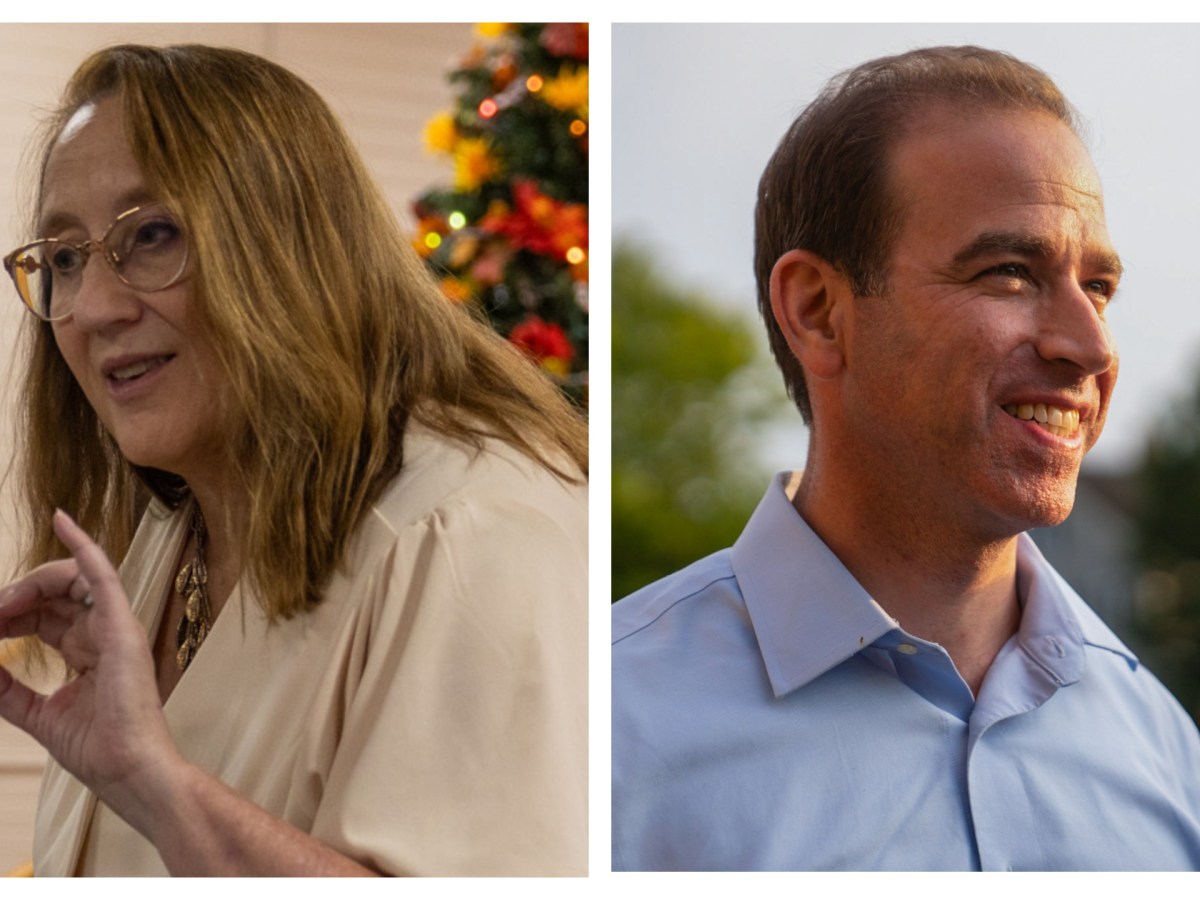
The district is centered on Hartford but reaches awkwardly around a hammer-shaped portion of the 5th towards Torrington in the north and Bristol in the south. It is the only open seat, a consequence of Luke Bronin defeating Congressman John B. Larson in a Democratic primary, the first primary challenge to an incumbent congressman in Connecticut.
Bronin is the former mayor of Hartford, elected in 2015 to the first of two four-year terms. He served as an intelligence officer in the U.S. Navy Reserve and was deployed to Afghanistan in 2010. Before becoming mayor, he worked in the Obama administration and was general counsel to Gov. Dannel P. Malloy.
Amy Chai, the Republican nominee, is a physician who lives in North Haven, outside the 1st District. In a questionnaire, she described government or political experience as a liability: “Representatives are supposed to represent people, not the government. When people do nothing but rise through the ranks from dog catcher to organizer to mayor, they are entering a bubble that actually excludes them from the reality of the people that they serve.” She registered as a Libertarian candidate for the seat in 2021 and as a Republican in 2025. She was unopposed for the GOP nomination.
Mary L. Sanders of the Green Party also is on the ballot.
2nd Congressional District
The 2nd District encompasses Eastern Connecticut and has been represented by Democratic U.S. Rep. Joe Courtney of Vernon since he unseated Republican Rob Simmons in 2006. Courtney serves on the House Armed Services Committee and is the ranking Democrat on the Subcommittee on Seapower and Projection Forces, an important assignment for a congressman who represents a district with a submarine base and the Electric Boat shipyard.
His challenger, Republican George Austin of Suffield, is a first-time candidate. Austin is a contractor and the son of Mexican immigrants. He says his campaign is about “standing up for families, protecting the unborn, defending the Second Amendment, and pushing back against oppressive taxes that make life unaffordable.” He was unopposed for the GOP nomination. Austin is on two ballot lines, cross-endorsed by the Independent Party.
3rd Congressional District
Democrat Rosa L. DeLauro of New Haven, who began her career as adviser to a New Haven mayor and then to a U.S. senator, is the senior member of the congressional delegation, representing a district centered on the city, winning an open seat in 1990. She is the ranking Democrat on Appropriations Committee and stands to return as chair if Democrats retake control of the House, as expected.
Her Republican challenger, Christopher J. Lancia of Milford, is a former Coast Guardsman and police officer at the Naval Submarine Base New London who now is a manager at TNI, a provider of fiber networks. He says he is running “to give the people of Connecticut a voice — and to help President Donald Trump finish what he started: putting America First.” He won the nomination on a roll call vote at the convention.
Thomas Egan of Ansonia also is on the ballot as a nominee of the Independent Party. He is a lawyer who has run unsuccessfully for mayor and state representative.
4th Congressional District
The compact 4th District of lower Fairfield County includes the state’s two largest cities, Bridgeport and Stamford, and some of the nation’s richest suburbs, including Greenwich and Darien. Once a Republican stronghold represented by a succession of maverick GOP moderates, it has become the state’s strongest Democratic district, as judged by the Cook Political Report.
Democrat Jim Himes unseated Republican Chris Shays in 2008, ending the GOP’s 40-year-old hold on the seat and leaving Connecticut without a Republican in Congress. Himes is the ranking Democrat on the House Permanent Select Committee on Intelligence and on the House Financial Services Committee. As a key member of the Intelligence Committee, Himes is part of the “Gang of Eight,” members of Congress who are briefed on classified intelligence matters.
His Republican challenger, Michael Goldstein of Greenwich is running for Congress for the third time. He is a physician and a lawyer. He says on his campaign site, “In surgery, you can’t fake it. You diagnose the problem. You fix it. You take responsibility for the outcome.” He lost a primary in 2022 but won the GOP nomination in 2024 and this year.
Benjamin Wesley of Norwalk also is seeking office as the nominee the Independent Party for the second time in two years. He is a mechanical engineer.
5th Congressional District
Democrat Jahana Hayes of Wolcott, a national teacher of the year in 2016 in the Waterbury public schools, won the open congressional seat in 2018, running with the encouragement of U.S. Sen. Chris Murphy. She is the first Black woman elected to Congress from Connecticut and the first of two from New England. She had a close call in 2022, winning with only 50.39% of the vote. The district sprawls from Danbury on the New York border to Litchfield County on the Massachusetts line. Hayes is on two ballot lines, cross-endorsed by the Working Families Party.
Her Republican challenger, Chris Shea of Cheshire, is a North Haven firefighter and retired Navy Seal. In his acceptance speech at the GOP convention, Shea talked about his military service, his Christian faith and an experiment with “imaginative prayer” that helped inspire him to run. He said, “I actually had an experience with Jesus Christ himself sitting next to me in a chair.” He won the nomination in a primary.
CT GENERAL ASSEMBLY CANDIDATES
COVERAGE


PROJECT CREDITS
Reporting: Mark Pazniokas and Angela Eichhorst
Project Management: Stephen Busemeyer
Data Visualizations: Angela Eichhorst
Editing: Stephen Busemeyer

