



Physicians in Connecticut have long flagged low Medicaid reimbursement rates as a barrier to providing treatment to low-income people seeking medical care. For specialty care, the issue is exacerbated.
WSHU’s Ebong Udoma spoke with CT Mirror’s Katy Golvala to discuss her article, “CT kids with Medicaid coverage can face long waits for eye care,” as part of the collaborative podcast Long Story Short. Read the story here.
WSHU: Hi, Katy. What prompted you to get into this story?
KG: Hi, Ebong. I’ve covered health at the Capitol for several years, and every year one issue comes up as the most important to address: Medicaid reimbursement rates. And Medicaid reimbursement rates refer to how much the state pays doctors for seeing patients who are on the state’s Medicaid program, which is, you know, the government health insurance program for people with incomes that fall below certain limits. And every year we hear legislators and doctors come to the capital and say the state does not pay us enough. We’re actually, in some cases, losing money every time we see them, and that results in doctors opting out of seeing these patients, which in turn means they have fewer options available for where to receive care, and so I wanted to take a look at this issue through the lens of one specialty, pediatric ophthalmology, where that shortage is, you know, particularly dire.
WSHU: Now, tell us about Cassidy Friedl and her son Luca.
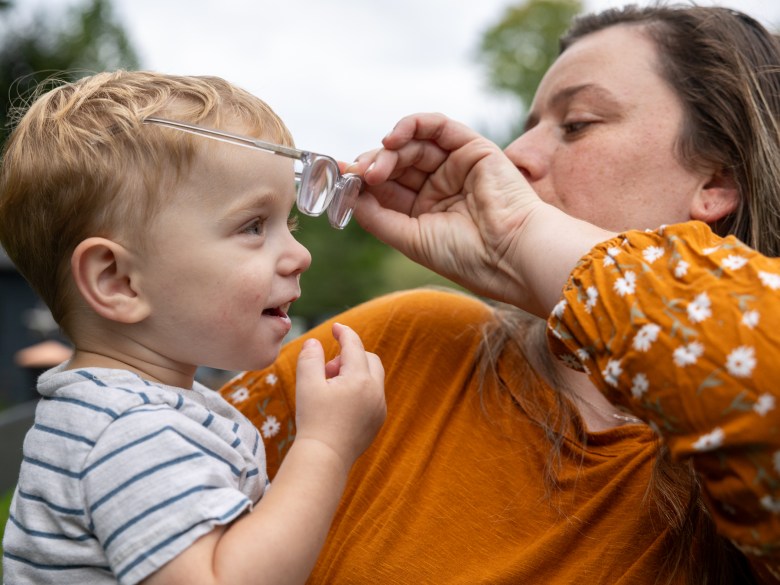
KG: Yeah, so Cassidy, when Luca was about six months old, started noticing that one of his eyes was drifting inwards, and she took him to his pediatrician. And the pediatrician recommended that he go see a pediatric ophthalmologist. And these are specialists who go beyond what optometrists can do. They are M.D.s. They can perform surgery, and you know, if your child is dealing with a particularly acute issue with their eye, these are the doctors that you typically want to see. And Cassidy called around, and she was just hearing that the wait times were very long. And eventually, in March, she got an appointment with a doctor who we also spoke with, Cara DeBenedictis, and she was told that the wait was going to be about nine months because Doctor DeBenedictis only had a certain number of slots available for patients with Medicaid, which is the coverage that Cassidy and Luca have.
WSHU: Now, Cassidy and Luca pretty much fall into a group that is the larger number of children in Connecticut who are on the HUSKY program. Correct?
KG: Yeah. So HUSKY covers about half of kids in the state, which, you know, are overrepresented. So Medicaid HUSKY covers about a quarter of people in the state, but half of children.
WSHU: Three-quarters of them are Black and Hispanic children.
KG: So actually, it’s that three-quarters of Black and Hispanic children in Connecticut are covered by Medicaid.
WSHU: Three-quarters of Black and Hispanic kids are covered. Wow. So we’ve been trying to grapple with this problem; what are the solutions? And when you talked with the Lamont administration, what did they say?
KG: So the Lamont administration first said that this is a national problem, not a Connecticut problem, and this is true. There are shortages of pediatric ophthalmologists all over the country. I believe one study found that 90% of counties do not have a pediatric ophthalmologist. There are states without a pediatric ophthalmologist at all, and so you know Connecticut is lucky in that we do have some providers. The state says that there are 21 ophthalmology groups enrolled in Medicaid in Connecticut. They did not clarify whether those groups see children or whether they’re currently accepting new Medicaid patients, and so the pediatric ophthalmologists I spoke to said that the number of pediatric ophthalmologists is around 10 in the state overall, but only five of those accept Medicaid patients. So basically, the Lamont administration said, you know, this is an issue with a national shortage of pediatric ophthalmologists, and what the doctors said was that yes, that is true, but that problem is worse in Connecticut for people who are covered by Medicaid because, you know, people with private insurance presumably have 10 options for doctors to go see, whereas people with Medicaid only have about five.
WSHU: And also, the Lamont administration seems to want to pressure private industry to cover more of their employees, and say that will make it possible for the state to reimburse more. Could you just explain what the thinking is?
KG: So basically, what the Lamont administration is saying, and this is part of Governor Lamont’s campaign, is that businesses need to offer comprehensive health coverage to their employees so that they don’t have to rely on the state Medicaid program, and so the big businesses need to provide comprehensive health insurance for their employees, so that taxpayers aren’t footing the bill for health coverage for those employees.
WSHU: And advocates are also pointing to the fact that the state brings up the pay for doctors.
KG: Yes, what advocates are saying is the state needs to increase the amount that it pays to doctors to see patients with Medicaid, and then more doctors, they say, will accept Medicaid, and then that will help to address some of the shortage.
WSHU: And now Medicaid itself takes funding from both the federal and the state, and the federal government has been cutting back on how much it’s spending on healthcare.
KG: Yeah, so it does seem like legislators have an appetite to again propose legislation to increase the Medicaid reimbursement rates, but Medicaid is definitely going into the session facing some pretty big hurdles. One is that the program has had massive overruns, so it’s gone over budget every year for the past several years, and legislators are also trying to address that. And while it might be good to pay doctors more, that would mean the state spends more on the program instead of finding areas where it can cut back.
WSHU: In the meantime, Connecticut children on Medicaid will have longer and longer wait times to see a specialist.
KG: I think that is what you would hear from doctors and advocates who say that the rates need to increase. Yes.