


This story has been updated.
Federal election monitors visited several New Haven polling places on Tuesday.
The monitors spoke with some voters exiting the polls but remained outside the 75-foot boundary around polling places, according to New Haven Mayor Justin Elicker. He said there had been “no incidents” involving the monitors.
“Given the current administration, who has been actively trying to undermine elections and intimidate people, it’s not productive to have election monitors here,” Elicker said. “At the same time, they have so far abided by all the rules that we’ve set out.”
Randi Rubin Rodriguez, a volunteer election moderator with the secretary of the state’s office, said two federal election monitors arrived at the polling place in New Haven’s Annex neighborhood around 8:30 a.m. She estimated that the monitors stayed for an hour and a half to two hours.
“For the most part, they really just stood here,” she said, gesturing toward the parking lot outside the polling place. “Very friendly, very personable, not aggressive, assertive in any kind of way.”
Rubin Rodriguez, a Westville resident, said the monitors were wearing plain clothes. She said she didn’t ask to see any credentials, and they didn’t offer them up.
The U.S. Department of Justice informed state and local officials on Oct. 21 that it would send two teams of monitors to the polls in the city on Election Day. No other city in Connecticut was set to receive such visits, according to the secretary of the state’s office.
Rubin Rodriguez said she wasn’t surprised when she learned of that plan, citing the Trump administration’s criticisms of the city’s and Connecticut’s “sanctuary” policies toward undocumented residents.
Around 12:30 p.m., Gov. Ned Lamont delivered remarks at the polling place alongside a host of Connecticut politicians, including Elicker, U.S. Rep. Rosa DeLauro and U.S. Sen. Richard Blumenthal. Addressing a crowd of around 60 voters and campaign workers, the officials urged attendees to vote and expressed their hopes for a nationwide “blue tsunami.”
Blumenthal condemned the presence of federal election monitors, describing their visits to local polling places as “federal interference” from the Trump administration.
“We don’t need you in New Haven. We don’t need you in Connecticut,” Blumenthal said. “We know how to run fair, accurate elections.”
Lamont also rebuked the presence of the election monitors.
“They’re not needed here,” Lamont said. “Elections are local. We’ve got it under control.”
Encountering the monitors
Two federal election monitors stood outside Ross Woodward Classical Studies Magnet School in New Haven for about an hour on Tuesday afternoon.
Both declined to provide their names but confirmed they were with the U.S. Justice Department and directed reporters to call the agency’s press office with further questions. One of them said they had been sent to monitor compliance with the Americans with Disabilities Act, or ADA.
Alesia Ricks-Harris, the polling location’s moderator, said she hadn’t been aware of their presence. They hadn’t made any attempt to come inside, she said, and she hadn’t stepped outside in several hours.
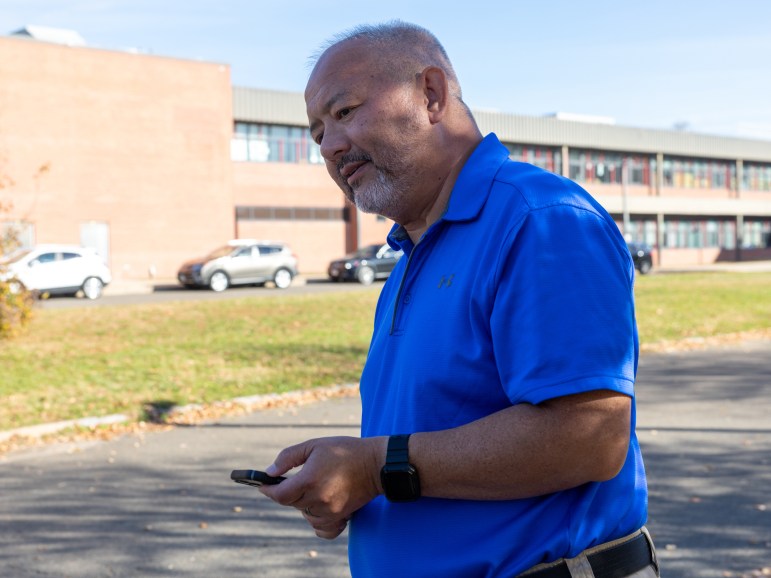
But Ricks-Harris said moderators were notified that DOJ officials — as well as U.S. Immigration and Customs Enforcement personnel — might be at polling locations on Election Day.
Moderators were trained regarding what federal officials could and could not do at polling locations, Ricks-Harris said. She was worried their presence might deter people from voting, but the steady stream of voters throughout the day suggested otherwise, she said.
“Turnout has been awesome,” she said.
The federal monitors were present outside Ross Woodward school from around 1 p.m. to 2 p.m, and they spent most of their time observing voters entering and exiting the building.
Earlier in the day Tuesday, Zachary Denver — an election monitor and assistant U.S. attorney based in the New Haven office — was outside Davis Street School in New Haven. He approached voters in the parking lot and interviewed several, according to Ward 26 Alder Amy Marx and Democratic Ward co-Chair Laura Cahn.
Marx said his “presence was quiet and not obtrusive,” but it sent “a chilling message that we’re being watched by the federal government.” She said the monitor did not enter the polling place.
Aly Fox, a voter, said she encountered Denver at the Mauro-Sheridan polling place Tuesday morning.
“He was asking about accessibility, if there were stairs, any issues getting to the polling place, asking if there was adequate signage,” Fox said. He also asked if there were signs “in multiple languages, then asked about physical accessibility” of the polls. He also asked if he could have Fox’s email address in case he had any follow-up questions.
A DOJ email identified Denver as the “team lead” in Tuesday’s monitoring operation in New Haven. According to his LinkedIn page, Denver joined the New Haven office in May and graduated New York University law school in 2013.
In an emailed comment on Tuesday morning, DOJ spokesperson Kiersten Pels told the Independent that DOJ “will be in all 50 states doing the routine election monitoring the department has done for decades.”
She said DOJ will have around 1,000 monitors in counties throughout the country. “Every monitor will merely observe and report any potential violations of federal law to the Department, which will be reviewed after Election Day.”
She continued, “All monitors must meet the same legal and ethical requirements, including that they not interfere with the voting process. Every monitor has the same role: observe for potential violations of federal law and report concerns to the Department, which the Department will review after Election Day and act where appropriate.”
Asked why the DOJ singled out New Haven as the only municipality in Connecticut to have monitors, Pels responded: “The monitors are there to help ensure voting rights for Spanish speakers, as well as help the distribution of translated election materials in both languages.”
She continued, “New Haven, Connecticut was chosen for compliance with Sections 11(b) and 203 of the VRA, 52 U.S.C. §§ 10307(b), 10503, and Section 302 of HAVA, 52 U.S.C. § 21082(a).” She said that New Haven has a voting age population of 104,185 people and “is covered for Spanish language pursuant to Section 203.”
New Haven Independent’s Thomas Breen and Paul Bass contributed reporting.