


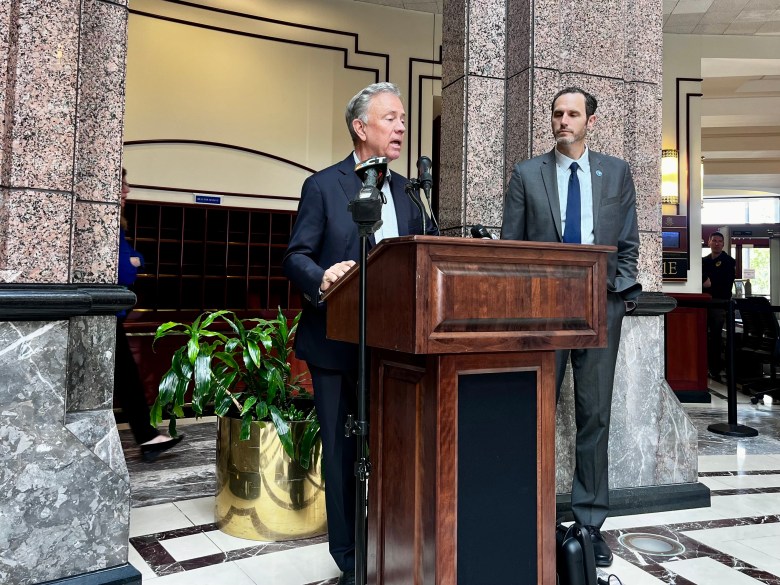
Gov. Ned Lamont will have extra help managing state finances to start his third term, even as lawmakers seek more dollars for cities and towns, education, childcare and middle-class tax relief.
Citing strong income, business and sales tax receipts, Lamont’s budget staff and the legislature’s nonpartisan Office of Fiscal Analysis said Connecticut’s coffers can expect an extra $1 billion over the next two-year budget cycle.
Those same trends also mean the current fiscal year can expect more than $750 million in additional revenues, according to the new consensus revenue forecast. And state coffers — already on pace for a robust finish — now are on pace for a $2.65 billion surplus on June 30, the second-largest financial cushion in state history.
In the context of a state budget that spends more than $28 billion annually, having $340 million extra next fiscal year and another $690 million in 2028-29 appears modest.
But the latter figure exceeds the extra investments in town aid and affordable childcare officials made last summer and hailed throughout the just-completed state campaign season as transformative.
And because Connecticut is on pace now for its largest surplus since the $4.3 billion windfall recorded in 2022 — when Connecticut received billions in federal pandemic grants — lawmakers also could carry some of this year’s surplus into the next biennial budget to open more spending and tax-cutting options.
Still, Lamont was restrained Tuesday in his assessment of the revenue growth.
“These latest revenue projections reinforce the progress Connecticut has made,” Lamont said late Tuesday afternoon. “Over the past eight years, we have strengthened our fiscal foundation and built an economy that attracts innovative companies, supports good jobs, and helps communities and schools thrive. Connecticut is on a stronger path, and I am confident we can keep building on that momentum.”
His budget director warned the good news is not a license for legislators to spend.
“These projections are estimates and should be viewed with care,” said Office of Policy and Management Secretary Josh Wojcik, who added that the results, while encouraging, also are subject to federal policy decisions and a volatile global economy.
Investment-related tax receipts continue to grow
Much of the projected growth comes from two sources: capital gains and other investment earnings from wealthy Connecticut households, and payments from certain business partnerships that are not major corporations — a category that includes hedge funds.
Analysts now say these two categories will generate an extra $500 million this fiscal year, beyond what the administration projected last month, thanks to a robust stock market. They also upgraded forecasts for these sources by $223 million for next fiscal year and $415 million for the second half of the next biennium.
Analysts also foresaw steady growth in the sales tax, Connecticut’s second-largest revenue engine after the income tax. Though receipts are matching projections this fiscal year, they should climb by nearly 3% in each of the next two, approaching $5.9 billion by 2029.
Competition for surging revenues is fierce
How much of this revenue will be invested in programs or used to fuel tax cuts hinges on one key question: Will the governor and the legislature’s new Democratic super-majority revise the caps that have blocked much spending and forced huge surpluses since 2017?
Lamont, a fiscal moderate, has allowed mostly temporary cap workarounds and exceptions over the past two years. But many Democratic legislators want ongoing reforms and have a long list of potential uses for those extra dollars.
For example, officials have invested an average of $356 million over the past two years to expand affordable childcare, and many want another similar payment made next summer.
The governor and legislators carved out a one-time spending cap exception to expand municipal aid by more than $280 million this past July and will be looking for options to sustain that assistance in each of the next two fiscal years.
State officials still have $263 million in a special response fund they created to mitigate big cuts to federal human services programs. But those dollars are expected to be exhausted over the next year, backfilling Medicaid and other healthcare program cuts. Lawmakers may be looking to dedicate more state funds to this effort.
A citizens’ assembly organized by the Connecticut Conference of Municipalities has challenged the governor and legislature to shift billions of dollars in special education costs off struggling local school districts and into the state budget.
And the private, nonprofit agencies that deliver the bulk of state-sponsored social services to clients with disabilities and those suffering from mental illness or addiction insist they lose hundreds of millions yearly because state payments have lagged inflation for decades.
In addition, many legislators and policy groups insist Connecticut must cut state taxes further to assist low- and moderate-income households. Lamont and lawmakers face appeals from coalitions seeking to create new income tax credits for households with children and for renters.
Most legislative leaders still were reviewing the revenue projections late Tueday afternoon.
But House Minority Leader Vincent J. Candelora, R-North Branford, whose caucus has pushed hard for deep state tax cuts for the middle class in recent years, said that has become an imperative both parties cannot ignore.
“I think, universally, people ran on the notion of affordability and the things that are making Connecticut unaffordable,” said Candelora, whose caucus pitched hundreds of millions in relief last April, chiefly by reducing income tax rates. “We have a problem that has to be addressed. We’ve got to provide tax relief for the residents.”
