


It’s the light, falling over the red and yellow brick of Bristol’s Main Street, that draws in the viewer. Beneath a cluster of low-hanging gray clouds, three brick buildings line the road, quiet as cars trundle past. From a smear of blue sky above, mid-afternoon light spills down, making the brick glow.
And yet, it’s too quiet here, in what’s supposed to be the beating heart of a Connecticut city. The hustle and bustle of a self-sustaining Main Street is conspicuously absent.
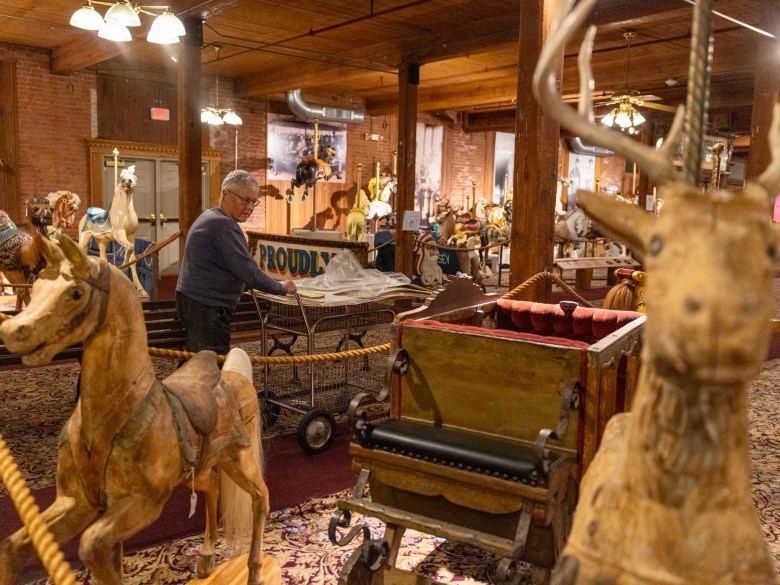
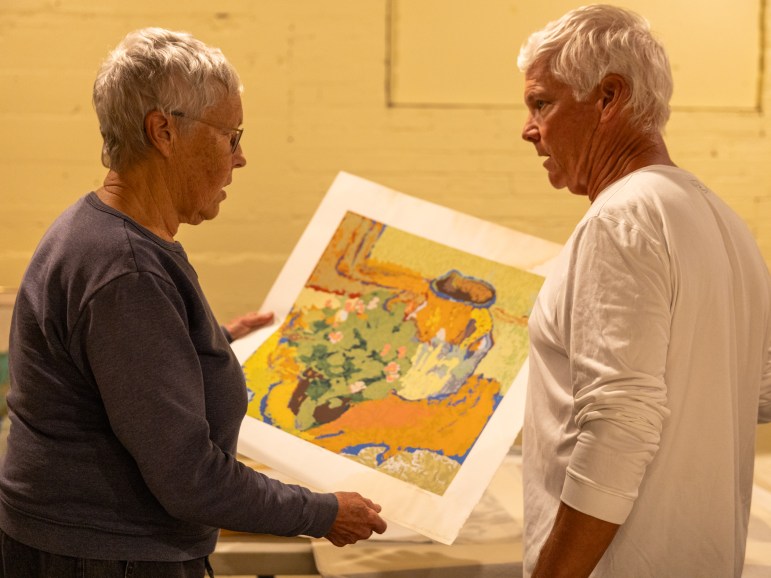
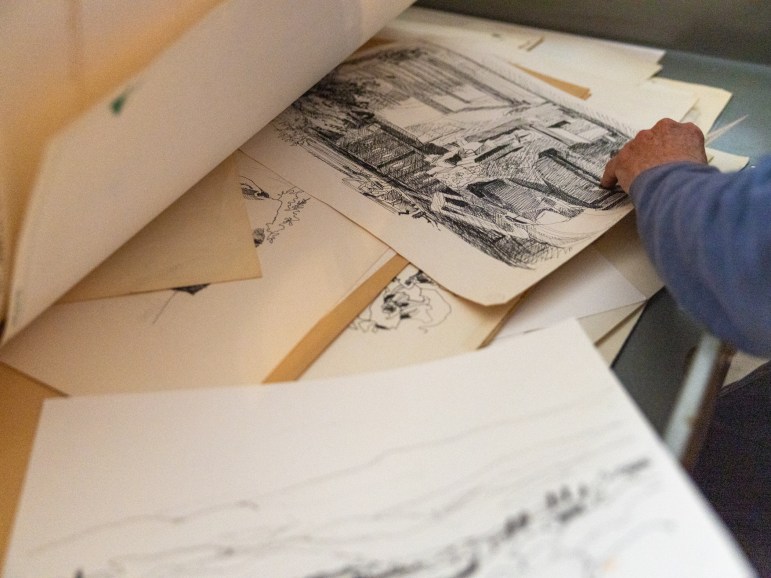
Gloria “Glo” Sessions’s undated “What’s Left of Main Street” is one of hundreds of canvases, etchings, pen-and-ink drawings, and watercolor compositions that build “Glo Sessions Returns to Bristol,” an exhibition at the Carousel Museum running through Dec. 31 of this year.
A retrospective of Sessions’s work that becomes a vibrant celebration of her life, the show paints a portrait of an artist, mother, educator and Bristol resident who was deeply curious about the world around her, and eager to document a city and its people over half a century of change.
It marks Sessions’s fourth exhibition at the museum, where she was an active volunteer for years, and the second since her death in November 2011.
“I think what’s most impressive about her work, that I also love the most, is that she really picked this [practice] up in her 30s,” said Jenny O’Connor, director of development at the museum. “I think because of that, her study of people is different. She appreciated the everyday moments, the mundane, and that is so beautiful.”
She motioned to a painting of Sessions’s youngest daughter, Molly, wearing a striped shirt and stretched out on a couch. “It’s not just people doing fantastic things. It’s just people. I find that timeless.”
Sessions’s work, and the decades of life she spent in Bristol, are very much intertwined. Born and raised in Waltham, Mass. (her son, Don Sessions, said that her name came from the phrase “Gloria in Excelsis Deo,” which her father proclaimed after a long and complicated birth), Sessions’s early creativity led her to study visual art at Skidmore College, a path that brought her to New York City after graduation.
From the early to the mid 1940s, she worked for Macy’s New York offices, using her art background in the advertising department. Then she met Lt. James (Jim) Sessions, with whom she would have and raise five children across multiple cities, and ultimately make a home in Bristol. Within a year of marrying in 1945, they had moved across the country to California, and welcomed their first son, Paul. They were there for just roughly a year before James returned fully to civilian life.
In the late 1940s, the growing Sessions family returned to James’s native Bristol so he could take over the long-running family business J.H. Sessions & Son, where six generations of his family produced the small, indispensable parts for trunks and foot lockers from 1854 into the 1990s. Years later, she would document every detail of the building for an anniversary catalogue, from its timekeeping fixtures to the equipment that made its machinery run.
What no one expected, perhaps even Sessions herself, was the degree to which her work would become a record of a city in the midst of a transformation. In the mid 1960s, as urban renewal projects were gaining speed across the country, Bristol began a demolition of its Main Street district to make space for a shopping mall that — after several fits and starts — materialized in 1969, changed hands in 1973, and struggled under multiple owners for the next two decades.
Sessions, who had come to love her adopted home, became — quite by accident — both an artist and an activist. By then, she had expanded her practice to the family’s J.H. Sessions building, where she had both a studio and taught classes to other local artists and art students. Her daughter Ruth, who by that time had followed in her mother’s footsteps at Skidmore and then studied ceramics at UConn, remembered how deeply her mother opposed the development, and mourned the city she loved as it changed before her eyes.
“She was so angry and so involved with what happened to Main Street,” Ruth said, remembering multiple letters her mother wrote to a local newspaper, most likely the Bristol Press. “She would walk all over Bristol” and chronicle the city, creating a historical record in the process. In the 1980s, she did a number of paintings of the city’s Main Street for the Bristol Historical Society which still live in the organization’s collection.
Before that, she raised her children, and figured out how to make a way for her artistic practice. Even as Sessions became a mother five times over — after Paul came Don, then Tulis, Ruth, and Molly — “she found the time to draw,” Don remembered as he helped install the show with his sister Ruth and wife Roxanne last week. At first, the drawings came in fits and starts as she raised her children, the eldest of whom was in college while the youngest was in diapers. And then, when she was in her late 30s, Sessions started to hit her stride.
“She would just draw all the time,” said Ruth, remembering the excitement with which her mother reacted to the first magic markers, which became widely available in the 1960s. As she built her practice, Sessions kept a notebook of the artists who inspired her, from the French Impressionists to American neoclassicists like Maxfied Parrish and his contemporaries. “She was a consummate draftswoman.”
As Sessions found more time to dedicate to her practice, she became especially interested in picturing the world around her, especially the small, pedestrian details of life in a small Connecticut city. It was not uncommon, Don Sessions remembered, for his mother to scale Bristol’s South Mountain and paint the city from above, or to pull over on the side of a street to jot down a quick study, sometimes for a work that became a painting or, slightly later, an etching that she produced at home.
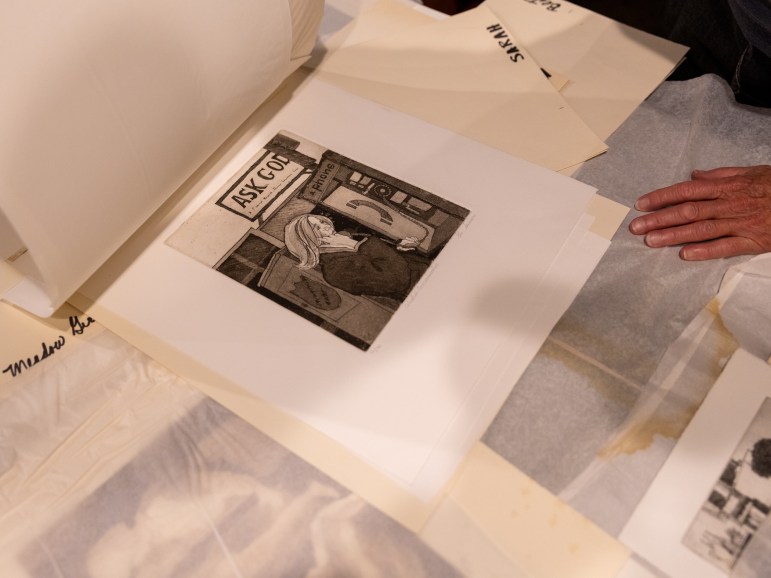
Etching, which falls under the umbrella of intaglio printmaking, is a process in which an artist covers a metal plate in wax, creates a design with their etching implement (usually a needle), and then submerges the plate in acid, which eats away at the parts of metal that have been exposed. The artist then inks the plate, a process that must be done in precise and meticulous detail multiple times for a color print, aligns it with the paper or substrate on which they are printing, and passes it through the press. Everything is done in mirror image, so that an artist essentially has to be thinking in reverse when they create the design.
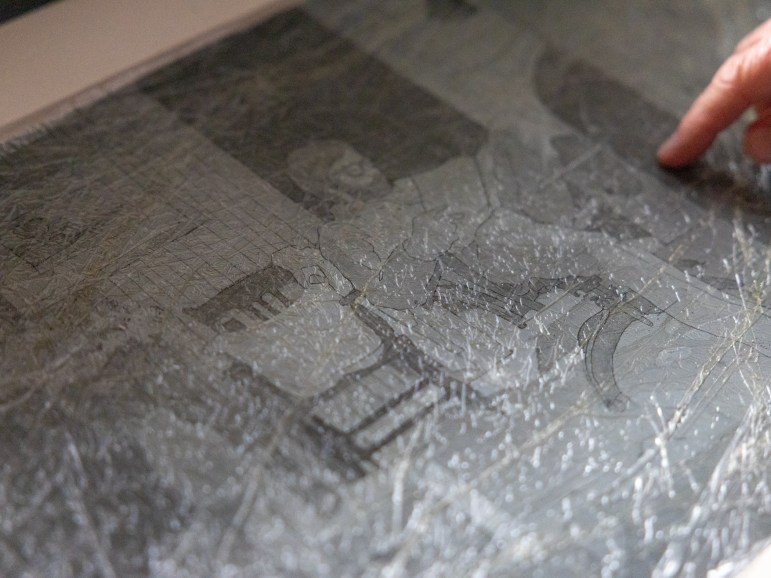
Often, Sessions carried around a camera, and “would just take pictures of people” she found interesting, Don said. They came from all walks of life: waitresses, store attendants, staff and visitors at bed and breakfasts she stayed at on her travels, homeowners and the houses they lived in, her own children. Last Thursday, both Ruth and Don Sessions gravitated toward one such image, a quickly-dashed-off study that became a subject of her etching practice as it deepened.
In the initial drawing, done in charcoal that has smudged with time, two women — or maybe it’s the same woman, pictured twice — stand back to back, their hair pulled up into messy chignons. One, on the right, leans over a pad of paper, scribbling something down quickly. Sessions, even in her haste, has captured fine details: the crinkle of her apron, a row of round buttons beneath it, the flyaway bangs that hang over her eyes. Beside her, a woman tilts her head just slightly to the right, hands clasped at her waist.
Don said it came from her travels. His mother was just like that — she loved drawing people, and found them inherently interesting simply because they were there.
By the time Sessions was in her 40s, she had drawers full of thousands of photographs, some of which she returned to over and over again. Around that same time, she took a class in printmaking at the Farmington Arts Center, “and she was bitten by the bug.” Ruth’s smile as she spoke suggested that the etching pun was fully intended.
Within years, Sessions’ home studio space included a Charles Brand printing press, a massive piece of hardware on which she created both black-and-white and color etchings for the remaining decades of her life. One, of a hairdresser named Rose, channels the whimsy and quirk of artists like Henri de Toulouse-Lautrec, with clementine-colored hair and a patterned, burnt orange background that seems to set the print ablaze. Another features a woman leaning back, her face rendered in blue and orange inks that highlight her tight crown of curls.
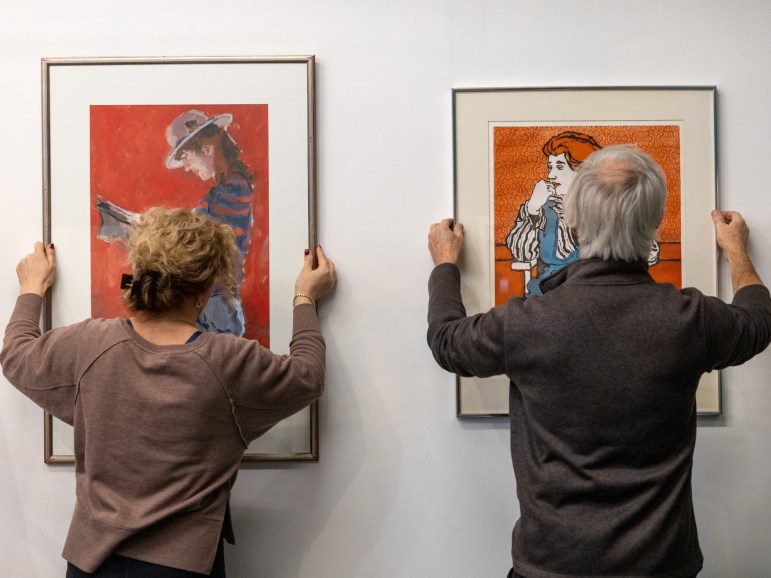
As she installed the exhibition last Thursday, Museum Manager Marita Damenia said that she’s excited for attendees to experience not just the breadth of Sessions’ work, and the intimate journey that it takes through Bristol’s history, but the care that she poured into her artistic process.
In the gallery that welcomes visitors to the show, for instance, several of Sessions’ old paintbrushes fill mugs that she molded herself. Nearby, there’s a poster showing the progression of a single oil painting, which Sessions photographed obsessively as she worked on it.
“It’s very interesting!” Damenia said. “Definitely she has a very unique technique. My goal is to show people her technique, and to show her as a person.”