


Ellen Creane still remembers the first time she heard about Shaumpishuh, a female sachem of the Menunkatuck Band of the Quinnipiac Tribe. She was in the audience at a book talk, and the story of Shaumpishuh’s life resonated with Creane, who often thinks about the long arc of Guilford’s history, and the people who lived there long before 1639.
Four years later, she’s working to make sure friends, neighbors, educators and students know that name too — and that Shaumpishuh receives some of the historical due she is owed.
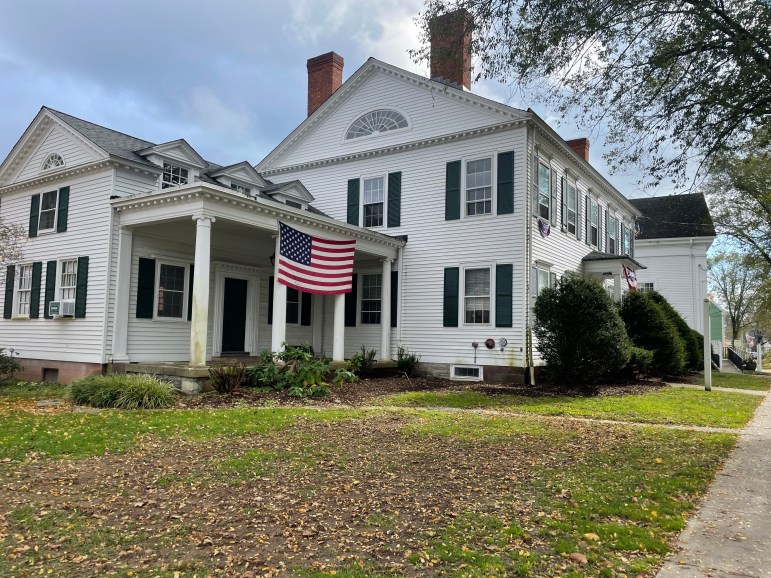
That’s the goal of the six-member Shaumpishuh Statue Committee, a Guilford-based crew of retired educators, local historians, cultural workers, writers, and tribal leaders that in May received unanimous approval from the Guilford Board of Selectmen to install a sculpture at 55 Park St., beside the Jedediah Lathrop House and directly across from the Guilford Town Green.
This fall, the committee has launched its first fundraising campaign and released a call for artists that ends Jan. 31 of next year. While the group does not yet have a formalized budget, it has set a fundraising goal of $60,000, and is applying to the Mellon Foundation for grant funding.
Committee member Kevin “Red Eagle” Brown, who served as chairman of the Mohegan Tribal Council from 2013 to 2019, said that the Mohegan Tribe has pledged support to the campaign but that the specifics are not yet public.
“It’s about reconciliation, respect, knowledge, and learning,” he said. “And about recognizing that these were among the first peoples here.”
“We want this to be a permanent message, not only to people of the shoreline, but nationally,” added Creane, a longtime educator and writer who is now the committee’s board secretary. “We expect this to be as nationally important as the story of Pocahontas or Sacajawea.”
Shaumpishuh, of whom an actual likeness is not known, lived and died in the 17th century, and in that time became a persuasive advocate for the Quinnipiac people. Her brother, Momauguin, was a grand sachem, or chief, who lived in what is now recognized as New Haven and East Haven. Her uncle, Qussuckquansh, was a sachem in the villages of Kuttawo and Totoket, or what is now recognized as Branford, according to maps from the Massachusetts Historical Society.
By the 1630s, she had become the sachem of the Menunkatuck Band, a fact that Creane is still often amazed by when she thinks of it (Shaumpishuh also mothered three children, including a daughter who became a chief sachem, according to John Menta’s 2003 book “The Quinnipiac: Cultural Conflict in Southern New England”). In 1638, she advised Momauguin on what historians now widely call the New Haven Agreement, in which white, English colonial settlers — likely benefitting from the fear and fallout of the Pequot War — offered ostensible military protection and material possessions such as hatchets, knives, and bowls in exchange for land.
The following year, Shaumpishuh helped broker a trade agreement with the Rev. Henry Whitfield that would become a founding and foundational document of the Town of Guilford. In the deed, Shaumpishuh granted settlers access to land in exchange for goods including stockings, shoes, hats, and cutlery, according to the 19th-century account of librarian and professor Bernard Christian Steiner. Between the scribbled words “squaw” and “sachem,” her signature is a bow and arrow.
How much agency she had in this decision isn’t directly known: a smallpox epidemic in 1633 devastated Indigenous communities across the state, wiping out what historian James “Jim” Powers estimated was 85 percent of the Indigenous population. Then from 1636 to 1638, the Pequot War showed the militarized violence of which colonial settlers were capable: hundreds of Pequot were killed, and others were enslaved, a practice that historian Margaret Ellen Newell explores further in her book “Brethren by Nature: New England Indians, Colonists, and the Origins of American Slavery.”
In between, “the Pequot attempted to subjugate other tribes throughout Connecticut and the islands offshore,” according to the Mashantucket Pequot Museum & Research Center’s resource “Battlefields of the Pequot War.”
By the time Shaumpishuh was navigating negotiations with Whitfield, she would have been keenly aware of the potential violence that could follow an unwillingness to negotiate and sign an agreement, as English colonists encroached on Quinnipiac land. Or as historian and professor Nathan Braccio recounts in a 2023 essay for the Massachusetts Historical Society, “when Shaumpishuh sold rights to her land to the English two years later, it was to a people who had amply demonstrated their penchant for violence.”
The deed itself seems to reflect this imbalance of power: it is written in English in Whitfield’s neat script (read a transcription here), with the signature that confirms her presence.
“She played an incredible role in the history of protecting the rights of her people,” said Powers, a retired high school history teacher who now serves as the committee’s president. “I’ve always been an incredible fan of hers, especially at a time when the English Puritans considered women to be the property of their husbands.”
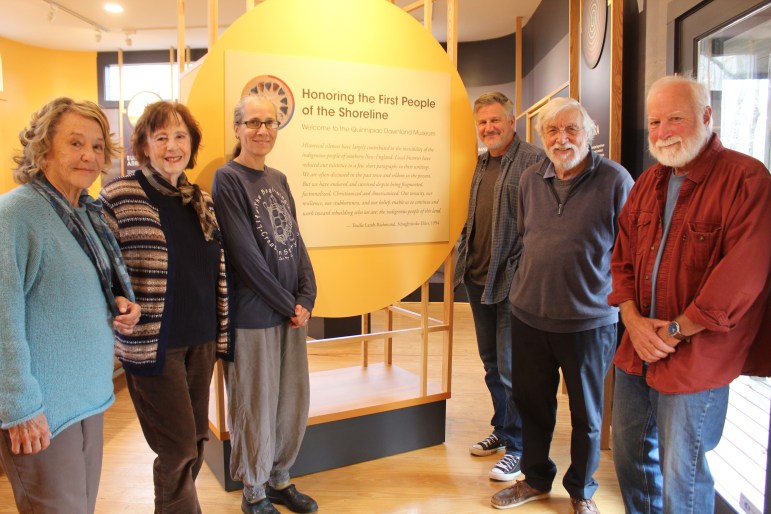
The committee, which officially incorporated as a nonprofit in May of last year, started with that history. In 2021, Powers published “Shadows Over Dawnland,” a work of historical fiction about the culture, land stewardship, and ultimate displacement of the Quinnipiac people, using the very real and equally calamitous 1633 smallpox epidemic as a launchpad into millennia of history.
In the book, Powers follows a Quinnipiac boy named Ponaim, whose parents have both died of smallpox, as he becomes the student of a Quinnipiac shaman named Commossuck (the main characters are fictionalized, but the name “Ponaim” comes from Whitfield’s historical records). Those years of research, through which he also became a founding member and advocate of the Quinnipiac Dawnland Museum, also gave him an education on Shaumpishuh.
In 2022, Powers gave a book talk that Creane attended, and at which she learned that West Lake, an area of the town that she calls home, “is the last known place the Quinnipiac lived,” Powers said. That same year, she was part of a small group that began meeting to discuss the possibility of a statue or memorial in the town. By last year, those efforts had grown into the formalized committee, which sought nonprofit status as a way to begin its fundraising efforts.
During that time, it also became increasingly clear that the committee needed to have Native voices. Brown, who currently lives in Guilford, and Courtney Cucinotta, a Branford-based herbal therapist and gardner who has Nipmuc and European ancestry, now sit on the committee. In addition, the committee reports to an advisory council comprising roughly 20 people.
When the committee initially brought its request for a statue to the five-member Guilford Board of Selectmen in the fall of 2025, the biggest question became not whether the statue would ultimately materialize (the committee has yet to select an artist; more on that below), but where the artwork might go. While the town is not providing financial support for the statue, Guilford First Selectman Matthew T. Hoey III said that the board is in agreement that the project contributes to the rich and complex history of the town.
“It feels wonderful for us to have been able to accommodate what was a really great idea that ties our current community to the foundation of Guilford, and the role that this woman played as the sachem, the chief, of the Menunkatuck Band,” Hoey said in a phone call Tuesday morning. “This can serve as an educational statue, so that more of our youth, and our adults, can learn about the role this woman played in allowing Guilford to become what Guilford is today.”
Selectmen debated different locations: the historic Town Green itself, which houses monuments to Guilford residents lost during the Revolutionary, U.S. Civil, and Korean Wars; the “Great Plain” of Guilford, which sits beside the Long Island Sound and which the Menunkatuck Band once considered vital to their way of life; the Henry Whitfield House itself, where Whitfield began to make a home for himself following the 1639 signing.
Across the street from that house, there is also a spot memorializing the 1639 Guilford Covenant, which acknowledges the beginning of a colonial settlement known as Guilford. None of them felt right.
Then “we were looking for other properties around the Green,” and ultimately landed on the Major Jedediah Lathrop House, remembered Hoey. That location felt significant to both committee members and the Board of Selectmen: the Lathrop House is home to several municipal offices, and owned by the town.
It is right next to the town’s public library, a building dedicated to the pursuit of knowledge and curiosity, and close to the town’s First Congregational Church, which does a fair amount of social justice work. It also sits just across the street from the Town Green.
“It satisfied and fulfilled what the committee felt would be the most appropriate location, with Shaumpishuh looking West across our beautiful Town Green,” Hoey said.
In May of this year, the Guilford Board of Selectmen unanimously approved their request. By then, the committee had secured an outpouring of support that came from university professors, museum curators, Connecticut town and city historians, and State Rep. Moira Rader and State Sen. Christine Cohen, both of whom represent the district.
In addition, and perhaps most movingly, members of the Native American Cultural Heritage Council — that includes representatives of the Eastern Pequot Tribal Nation, the Mashantucket Pequot Tribal Nation, the Mohegan Tribal Nation, the Golden Hill Paugussett Indian Nation, and the Schaghticoke Tribal Nation — voiced their strong support for the project.
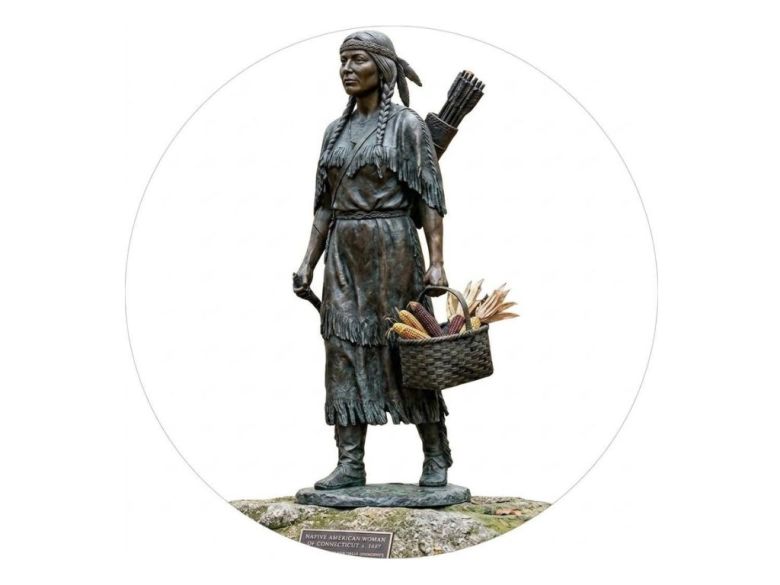
Last month, committee members released a request for proposals open to artists of all backgrounds requesting sketches for an adult, life-sized representation of Shaumpishuh, which they plan to ultimately cast in bronze. According to the request for proposals, the rendering should “reflect the time period (1630’s) (Northeast Woodland Culture)” and “reflect a welcoming and healing community.” It closes January 31; Powers said in an email Tuesday that no artists have submitted to date.
Because there is no known image of Shaumpishuh that exists, committee members said they are open to artistic interpretation; the committee currently has an AI-generated image as its logo on social media. In each application, they have also requested a proposed budget, and materials, including an artist’s statement and statement of purpose (read the full request through the National Sculpture Society here). The request does not specify whether or not having a Native artist is a core principle of the project, although both Creane and Cucinotta expressed interest in that at a recent committee meeting.
During a committee meeting at Guilford’s Dudley Farm (the Quinnipiac Dawnland Museum sits on the property), Cucinotta sketched out a rendering showing Shaumpishuh kneeling gently on the ground, hands out in a gesture of offering and gratitude. When asked, she smiled and said she doesn’t consider herself an artist, and simply had turned out the sketch as one potential direction an artist might go in. But as she passed it around the table, she spoke about the context in which she images the statue.
“I’m thinking about her spirit,” she said. “That prayer of offering, of listening to receive.”