


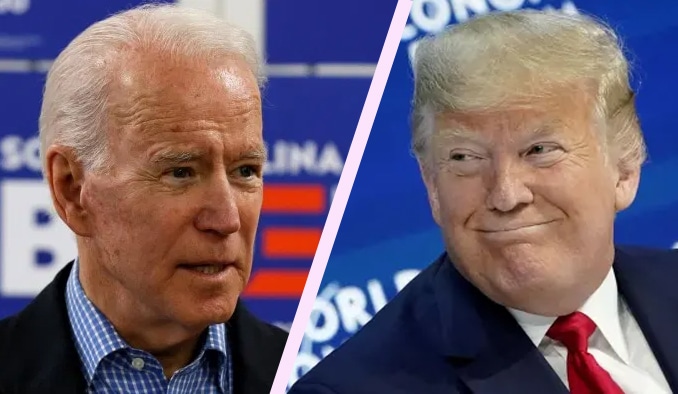
Reshaped by a virus, the strangest race for the White House in U.S. history kicked off in practice if not officially when Sen. Bernie Sanders ended his campaign and endorsed former Democratic rival Joe Biden in his challenge of President Donald Trump.
American politics, since its inception, has been driven by interaction with people – from rallies and town fairs to door-to-door canvassing. Even in the electronic age with the rise of social media, the coin of the realm is largely in-person contact, something that’s forbidden during the coronavirus crisis.
So what kind of presidential campaign can you even run if key in-person visits to battleground states are off the table? The coronavirus shutdown has left presidential campaigns struggling for solutions in Connecticut and everywhere else.

“Think of all the door-knocking that can’t happen. Think of all the events that can’t happen,” said J.R. Romano, the head of the Connecticut Republican Party. Trump supporters used to hold “MAGA meetups,” Romano said. But no more.
He said state efforts to promote the president now center on different ways to “educate the public on the president’s accomplishments.” That means “blasting out” through email the White House’s latest release of Trump’s executive orders and other actions, Romano said.
He also said Trump’s Connecticut volunteers are making campaign calls to state voters and — perhaps more importantly – to voters in key swing states. “They are stuck in their homes, so they are making calls,” he said. The Connecticut Republican Party is also preparing to do “virtual” conventions next month.
For his part, Trump has had to give up the rallies that have been central to his campaign and that he has held throughout his presidency. Lately he appears to be using his daily coronavirus press briefings to sell himself to the American people and promote his accomplishes. Trump took heat, for instance, for airing a campaign-style video defending his handling of the coronavirus emergency and criticizing the media at one of his press conferences.
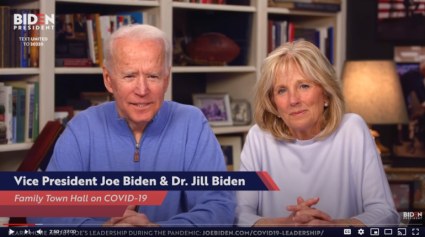
Biden, for his part, from his basement in Delaware home, is trying to broaden his following through YouTube, a platformed mastered by right-wing figures like Ben Shapiro, but previously not used as much by the left.
Instead of large-scale rallies and community events, the Democrats are producing virtual town halls, where Biden will take questions from voters through digital platforms.
“Our fundraisers are becoming virtual as well, and will still be pooled for press coverage,” the Biden campaign said. An emailed statement from the Biden campaign. “While the scale of the crisis has created new challenges, we are confident that the creativity and skill of our operation will also use this as an opportunity to pioneer new ways to campaign.”
Still, the coronavirus crisis has completely overshadowed a presidential race that normally would be heating up right now and beginning to dominate the news.
Presidential politics are in “uncharted territory,” said Martin Dunleavy, a former Democratic National Committee member coordinating the Biden effort in Connecticut.
“Things are moving along, but not how they would be,” Dunleavy said.
He said the Biden campaign in Connecticut is putting together a steering committee and participating in conference calls to the Democratic National Committee to coordinate efforts.
The Biden campaign has also created a couple of Connecticut-focused Facebook pages and Twitter accounts to attract supporters and engage those already committed to their candidate.
“We can’t just stop,” Dunleavy said.
Primary issues
The coronavirus hit before all the states, including Connecticut, could hold their presidential primaries. Once scheduled for April 28, Connecticut’s Democratic and Republican primaries are now set for June 2.
State law says there must be a presidential primary if there is more than one candidate on the ballot. As of Tuesday, there were three on the Democratic ballot: Biden, Sanders and Rep. Tulsi Gabbard, who dropped out of the race earlier this year and has not asked the Connecticut Secretary of the State to remove her name.
Trump and perennial presidential candidate Roque “Rocky” De La Fuente, are on the GOP ballot.
Gov. Ned Lamont, who used emergency powers to change the date of the primaries in response to the pandemic, may use that authority to cancel them completely or to change the rules for using absentee ballots so all can vote by mail. But for now, even though both parties’ nominees have been for all practical purposes selected, Connecticut’s presidential primaries are on and voters will have to go to polling stations to cast their votes.
There’s another problem, too. Although Biden and Trump are both their party’s presumptive nominees, their candidacies are not official until delegates approve them at a national convention. But how can either national party hold a safe convention, or create a new kind of “virtual” event that accomplishes anything a convention is supposed to do?
The DNC has postponed its presidential convention, moving it from mid-July. It is still planned for Milwaukee the week of Aug. 17, just a week before Republicans plan to gather in Charlotte, N.C., to renominate Trump.
Biden said he’s open to an idea of a “virtual” convention. Trump said he’s not.
To Dunleavy, there are several drawbacks in holding a virtual Democratic convention. He is concerned about how the party can unify without being able to bring any of its factions together for face-to-face negotiating. “There still needs to be a process in which Biden and Bernie and others hold to unify the voters,” he said.
And there’s also a need for the socialization that goes on at every convention. “Two weeks ago, the guy who was for Bernie and the guy who was for Biden hated each other,” he said. A convention would allow these political rivals “to have a hamburger or a drink together” and have a better understanding of each other.
Did the virus give Biden an edge?

More than impeachment, or healthcare, or immigration or any other issue, the coronavirus and its effect on the economy will now be the key issue in the presidential campaign. Which candidate will be able to better use it in the 200-day stretch that still stands between now and November 3?
Marjorie Hershey, professor of political science at Indiana University, Bloomington, said Biden may have the edge.
Since the onset of the social media revolution about 20 years ago, she said, campaigns have been using micro-targeting in increasingly sophisticated ways. The micro-targeted information is then used by canvassers to identify the voters most likely to support their candidate.
That targeting depends on massive databases the parties have compiled on the great majority of Americans — including information on voting habits, consumer preferences, internet viewing, television choices and a lot else – to determine which voters are most open to which types of appeals.
“We’ve learned that canvassing is most effective when it’s done face to face; phone calls can be screened, and neither phone nor mail appeals are as persuasive as face-to-face contact,” Hershey said. “But of course that’s not possible at a time of social distancing.”
Hershey said that puts the Trump campaign and the Republican National Committee at a disadvantage because they have invested huge sums in building these databases and using micro-targeting, but can’t use them as canvassing tools to their full impact right now.
“The Biden campaign and the DNC have lagged behind the Republicans in this area, but that isn’t as much of a problem for them as it would be if the Trump people were using it full-out,” Hershey said.
She also said the coronavirus has had a major impact is on the issues featured in the campaign.
“Political scientists find that each party “owns some issues — Republicans with terrorism, Democrats with health care — and each party does best when it can focus a campaign on the issues it owns,” Hershey said. “Clearly, the issue of health care is on a lot of people’s minds as a result of the pandemic. And the damage done to the economy undercuts the claim that the president’s campaign hopes to rest its appeal on: the strong economy.”
While Hershey said “Democrats are running in a slightly more favorable environment now than they would have otherwise,” she also said “that doesn’t mean things will remain the same in November.”
“President Trump has a remarkable ability to make all politics about him, and there really aren’t a lot of people who are uncertain how they feel about him,” Hershey said. “So the task for both campaigns is not much different from what it would have been without the pandemic — getting their existing supporters to turn out to vote.”
