

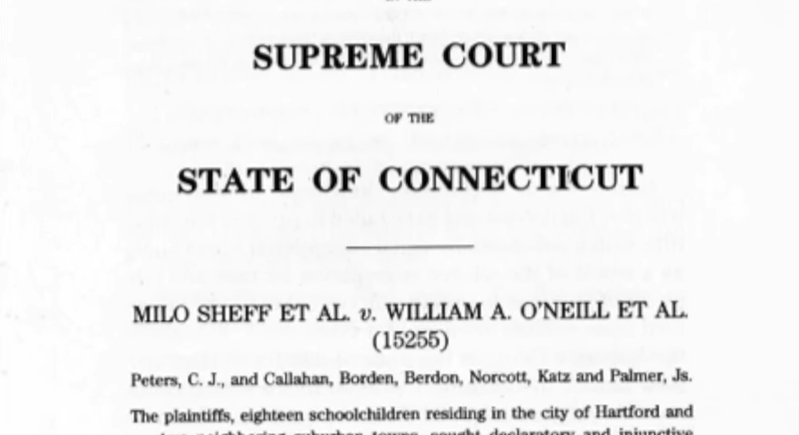

The state of Connecticut is once again trying to avoid its constitutional obligation to provide every Hartford child with a high-quality, integrated education. Just days before kids returned from their summer breaks, the state’s lawyers suggested that the court should withdraw from oversight of the implementation of Sheff v. O’Neill, the case that has created Connecticut’s award-winning two-way voluntary integration system. Here are six reasons why Superior Court Judge Marshall K. Berger should never agree to end court supervision of the case:
CT Viewpoints
We welcome informed and responsible commentary about local, state and national public policy from all Connecticut residents and organizations. Submit one here.

Posted inCT Viewpoints
CBIA paddling against the current on climate change
The fall meeting of the Connecticut Business and Industry Association’s Energy and Environment Council features a keynote address by Yale professor and former DEEP Commissioner Dan Esty, sharing “his insider’s perspective on where climate policy is headed.” The event will also include a tour of Wallingford-based Proton Onsite, a global leader in gas generation and renewable energy storage. So why does the promotional description of the event in CBIA’s recent newsletter call for a reconsideration of Connecticut’s existing commitments to climate protection?
Posted inCT Viewpoints
Cutting civil engineering tech at Three Rivers — a big mistake
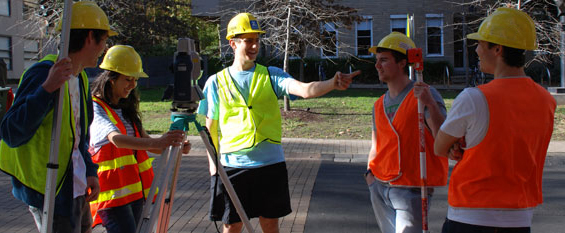
A letter to the Board of Regents: It has come to our attention that the Civil Engineering Technology program at Three Rivers Community College is in grave danger of being terminated. Also, the Environmental Engineering Technology program is being threatened by being changed to an “Environmental Science” program. These changes will be a huge mistake for the TRCC administration to make. Here’s why:
Posted inCT Viewpoints
CT juvenile centers must operate with understanding of trauma
The recent report from the Office of Child Advocate states that the vast majority of children and youth at the Connecticut Juvenile Training School and Pueblo have “histories of trauma, abuse, neglect, complex psychiatric disorders and special education needs.”
It then goes on to detail the use of isolation and restraints as behavior management strategies or for discipline even in non-emergency situations. I want to start by saying those charged with rehabilitating and treating this vulnerable population face difficulties and challenges. But are cycles of punishment that go nowhere and only harm our youth any better? I say no, and I offer an alternative: operating from an understanding of the impact of trauma.

Posted inCT Viewpoints
Connecticut charter school work is not done
Almost everyone remembers the first day of school. Families rush to get all the necessary back-to-school supplies and new-school clothes. There’s the anticipation of a new teacher, and new friends. There’s a chance to start fresh and put your best foot forward. And this new school year brings significant excitement for more than 1,000 new Connecticut charter school students just months after their families fought and won a battle for a spot in these schools of choice.

Posted inCT Viewpoints
Colleges and universities critical to Connecticut’s economic stability and growth
As Connecticut continues to engage in a yearly struggle to balance its budget, some pundits question the long-term benefits of continuing to invest in our private colleges and universities. Typically the debate drifts to costs, property values, traffic congestion, post-graduate job prospects and cultures of drinking and partying. It’s easy in this chaos of misdirection to not see the books for the library, metaphorically speaking. In reality, the overall value a college or university provides to surrounding communities and its host state are innumerable.

Posted inCT Viewpoints
A battle for the soul of juvenile corrections shapes up in Connecticut
At the end of a grueling three-hour hearing on Aug. 21, state Rep. Toni Walker, chair of Connecticut’s Juvenile Justice Policy and Oversight Committee, laid the issue on the table. Referring to the Connecticut Juvenile Training School, Connecticut’s only state-run youth corrections facility for boys, she asked, “The real question is, does Connecticut need CJTS? [Does the facility provide] the level of care that we really require in this state? Is CJTS the best method of delivering the needs for that population?” These questions are being hotly debated in Connecticut thanks to new revelations of a rash of suicide attempts and pervasive use of physical restraints and seclusion, both at CJTS and in the small Pueblo unit that opened nearby last year to serve troubled girls.
Posted inCT Viewpoints
The refugee crisis in Europe: What can Connecticut do?
Over the Labor Day weekend, a group of religious leaders, representatives of non-profit organizations, and regular concerned citizens gathered at a town hall meeting in Berlin, CT, to discuss the refugee crisis in Europe and to ask what we can do as a Connecticut community to help those refugees who are fleeing wars. Here’s what we came up with.
Posted inCT Viewpoints
Unions in Connecticut — and the need for them — thrive

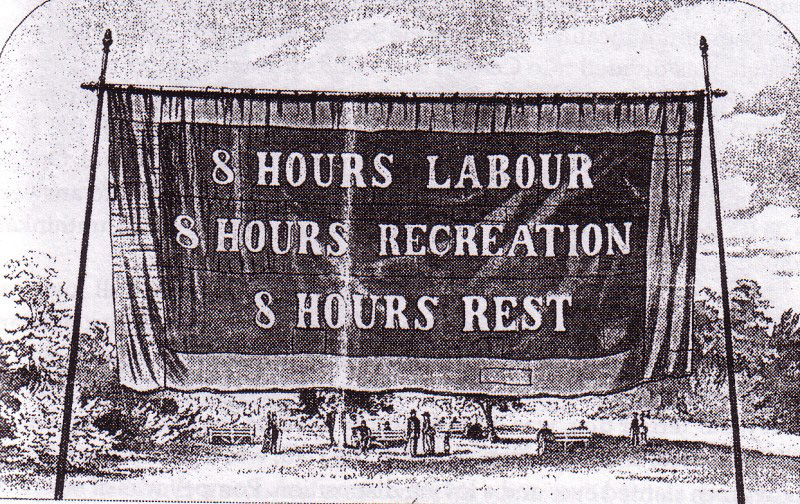
If there is dignity in all work, why isn’t there dignity for all workers? It’s a question worth considering this Labor Day. Throughout history, when working people have become “sick and tired of being sick and tired,” they have organized unions. This is how they broke the back of sweatshops in this country. And how they forced the end of child labor, so 10-year old kids could attend free public schools instead — another successful labor demand. It’s how they cleaned up dangerous workplaces and the surrounding neighborhoods that suffered from toxic pollution. And it’s how minority and women workers have been able to successfully fight income inequality.
Posted inCT Viewpoints
Good leadership, collaborative board, create academic excellence in Bloomfield
As chairman of the board for Bloomfield Public Schools, which our data indicates is the most improved school district in Connecticut over the past four years, I’m often asked what contributed to our academic resurgence. For example, our high school graduation rate increased 16 percentage points from 2011 – 74 percent to 90 percent now. Our middle school registered four consecutive years of academic growth and was recently recognized by the education reform group ConnCAN as a “Success Story” school. Third grade reading, writing and math scores in 2013 were above the state average.

Posted inCT Viewpoints
A death penalty hypothetical for the Connecticut Supreme Court
Appellate judges are famous for asking hypothetical questions. They are a very important part of the oral argument process, as they help the judges understand how their decisions in particular cases may apply to future cases. Advocates rarely get to ask judges hypothetical questions, but I’m going to ask one anyway. It is directed to the esteemed justices of the Connecticut Supreme Court who [recently], in a 4-3 decision, abolished the death penalty. (I don’t expect an answer of course. This is just a thought experiment.)

Posted inCT Viewpoints, Talking Transportation
With Metro-North, some things never change

Train crashes, passenger deaths, grade-crossing accidents, derailments. These are not just the recent history of Metro-North, but events dating back decades. A friend of mine loves reading the microfilms of our town’s weekly newspaper and has been feeding me clippings of all the stories about the New Haven line. The news reports sound all too familiar.
Posted inCT Viewpoints
SBAC scores: The beginning of the end
So what did we learn from the release of the SBAC scores? What did we learn after spending more than $2 million of state money and countless millions at the district levels to get these scores? Not much. We did learn that the achievement gap has not been in any way affected by implementation of the Common Core. We also learned that SBAC scores tell us nothing about students’ real competencies.
Posted inCT Viewpoints
Two tiers in Connecticut higher ed: UConn and everyone else
I have the hard-earned privilege of being a professor at Southern Connecticut State University — a major regional educational institution whose research and teaching provide an immediate and enduring benefit to New Haven and the whole state. I am proud of my students, colleagues, and school; at the same time, I am disappointed with system politics and Connecticut’s willingness to construct a two-tiered system for its students in higher education: The University of Connecticut and everyone else.

Posted inCT Viewpoints
Smarter Balanced test is validation for CT’s hardest-working teachers
I respectfully disagree with the Ann Policelli Cronin’s recently published opinion, “SBAC: Failing most Connecticut children in more ways than one.” I am currently a high school English Language Arts teacher, and I take issue when people who are no longer in the classroom teaching students each day “advise” the rest of us on what to do for kids. I take issue with administrators and consultants constantly seeking to stay relevant by disrupting the educational process in classrooms, with an approach that is long past its prime. The truth is that our students do not measure up, and neither do many teachers, frankly. It’s a nationwide epidemic. Ms. Cronin reports that Connecticut students have some of the highest NAEP scores in the country, but she’s ignoring the real story: namely, that Connecticut is not really servicing all students equitably.