


It was a big deal at John Dempsey Hospital when a housekeeper stopped a doctor from entering a room where a procedure was taking place.
“We presented the housekeeper with a ‘good catch’ award, and balloons, and went up to her and put it in our newsletter,” said Ann Marie Capo, the hospital’s chief quality and patient safety officer.
Because having a person enter a room during a procedure increases the risk of contamination, the hospital had adopted an imperative: If you’re not already in the room during surgery, stay out.
The effort to reduce infections was part of a broader campaign at hospitals across Connecticut to improve patient safety and eliminate medical errors.
Doing so requires developing standardized procedures, examining how patients can fall through the cracks, and acknowledging and learning from mistakes, experts say.
It also requires changing the hierarchical culture that’s long dominated health care, making it acceptable for anyone to speak up on behalf of a patient — even if it’s a housekeeper who sees a doctor about to do the wrong thing.
Aviation, nuclear power and hospitals
The hospitals’ patient safety efforts are built on “high-reliability” strategies similar to those used in aviation and nuclear power — other fields of great complexity in which even small errors can have dire consequences.
The aviation industry embraced the concept as far back as the 1950s, but the push for similar safety strategies in health care didn’t begin until the 1980s and took even longer to gain momentum, said Dr. Mary Cooper, vice president and chief quality officer at the Connecticut Hospital Association, which is coordinating the high reliability initiative in the state. The association took it on at the urging of Susan Davis, the former president and CEO of St. Vincent’s Medical Center in Bridgeport, which had adopted a high-reliability approach.

Nationwide, there’s still variation in the extent to which hospitals have focused on reducing errors, but experts say it’s increased significantly since 1999, the year a report by the influential Institute of Medicine suggested that as many as 98,000 people die in hospitals each year because of preventable errors.
“Fifteen years ago, people would say, ‘We don’t have errors here,’” said Dr. Tejal K. Gandhi, president of the National Patient Safety Foundation. “You’ll never hear that now.”
Some of the motivation to change is financial. The federal government has stopped paying hospitals for care related to preventable errors and now penalizes those with high rates of preventable patient readmissions. And increasingly, government and private insurance programs are tying payment to care quality.
A ‘new safety science’
But those leading the patient safety efforts say the motivation isn’t just financial.
To Dr. Setu Vora, medical director of critical care and performance improvement at Backus Hospital in Norwich, focusing on patient safety is an antidote to the many stressors people in health care face as the industry changes. It is a way to give back to providers a sense of purpose.
“This is a whole new safety science,” he said. “Instead of going from the idea that health care is a complex system and stuff happens, [it recognizes] that yes, it’s a complex system, but by adapting certain safer behavior habits, we can minimize the serious safety events.”
Part of the shift in hospital cultures, Gandhi said, is a recognition that when errors occur, they’re often the result of systems that need to change, not just isolated incidents or individuals doing the wrong thing.
Still, she said, often, front-line workers don’t feel empowered to point out problems.
Hand-washing secret shoppers
Some of the changes hospital officials say are paying off are seemingly simple procedures, like hand-washing.
It’s considered a critical way to reduce hospital-acquired infections, but studies indicate that health care providers fall short of doing it consistently.
The Hartford HealthCare system, which includes Backus, began tracking hand-washing rates through “secret shopper” observations. Then officials showed staff the data. Vora said that alone was enough to make people more likely to wash their hands.
“You show them the data and that changes behavior,” he said.
Small things that add up to patient harm
But not everything is as clear-cut as getting people to wash their hands. Often, problems are the result of what Capo called “Swiss cheese,” a series of holes that, when aligned, leaves patients vulnerable.

“A lot of times, it’s all these small things that add up,” she said.
When problems occur, hospital staff look for the root cause. If a patient falls, was it because the alarm wasn’t turned on correctly, or a problem with the bed?
One hospital reduced the number of surgical-site infections by having doctors use a separate set of sterile equipment to sew up patients, decreasing the risk of contamination, Cooper said.
Another hospital now uses the phonetic alphabet during overhead pages to avoid having someone mistake “neurology” for “urology.”
Nearly all hospitals in Connecticut hold a daily “safety huddle,” where hospital leaders talk about what happened the day before and any potential concerns in the day ahead. Is an area short-staffed? Is some piece of equipment down?
Because catheters pose a risk of infection the longer they stay in, Dempsey Hospital’s huddle includes an update from the infectious diseases director on how many patients need to have their catheters removed that day.
In the past, Capo said, someone working on the sixth floor might never find out about a problem that happened on the seventh floor, and if changes occurred as a result, they were isolated. In the huddles, people from across the hospital hear about problems and concerns.
So far in Connecticut, more than 10,000 people have been trained in high-reliability practices and behaviors through the hospital association’s program.
Asked for data to show how effective the changes have been, a spokeswoman for the association said federal policy prohibited the group from giving out data until it had been validated by the federal Centers for Medicare and Medicaid Services.
A tackle box and ‘cookbook medicine’
A big part of high-reliability is standardization: Using checklists in patient care or having a cart with all the supplies needed for surgery in the room before the operation begins.
Ten or 15 years ago, many people in health care resisted the idea, calling checklists and other standardization tools “cookbook medicine,” Gandhi said.

“I actually hear that a lot less,” she said. “I think people get it.”
She advises clinicians to use a checklist for “stuff that you shouldn’t be spending any brain power on,” like remembering if a patient got her mammogram. That lets them use their brains for the more complicated things like understanding patient goals or why they’re having trouble with depression.
At Dempsey Hospital, which is part of UConn Health, standardization was key to reducing the amount of time it takes for a patient arriving in the emergency room with a heart attack to receive a cardiac catheterization to open the blood vessel. It’s supposed to happen in under 90 minutes, but historically, the hospital only hit that mark about 60 percent of the time.
To reduce the time, a team of people involved in each stage of the process developed a tackle box with all the supplies that would be needed.
“Everything is standardized,” said Dr. Scott Allen, the hospital’s medical director for clinical effectiveness and patient safety. “Everybody knows what to do because they just open up the box and boom, boom, boom, it all happens.”
And each time it’s used, an emergency medical technician, emergency room nurse and cardiac catheterization lab staffer meet to discuss what went right and wrong.
At first, the idea of meeting after every case drew push-back from busy clinicians. But Allen said they’ve bought in.
“And having them there at those meetings shows the investment, it shows the other staff how important this process really is,” he said. “And that’s the culture.”
Telling the boss there are problems
At many hospitals, patient safety efforts begin with a couple of people. Making it part of the culture, something everyone on staff buys into, is one of the tough parts.
Another challenge, Gandhi said, is making sure front-line staff feel comfortable reporting problems.
One of the most effective ways, she said, is to make sure clinicians see that if they report something, it will make a difference.
Seeing change is critical to getting buy-in, Vora said.
“Otherwise, we could talk and talk, and physicians who complain about certain staffing issues or technology issues, and they still face the same a year later, they’re going to think this is just another business jargon buzzword in health care right now,” he said.
Hospital leadership can also help set the tone, Gandhi said. At Brigham and Women’s Hospital in Boston, where Gandhi spent a decade leading efforts to reduce medical errors, leaders did “walk rounds” weekly, visiting different parts of the hospital. The CEO would ask a unit coordinator about the problems there and, after hearing them, would say thank you.
It’s a powerful message for clinicians and other staff, Gandhi said, showing them that, “Wow, I can say that we have problems to the head of the hospital and they’re happy that I told them.”
‘Distracted doctoring’
As part of their high-reliability initiative, Connecticut hospitals have adopted five safety habits meant to encourage people to anticipate and mitigate problems. They’re referred to as “CHAMP”: communicate clearly, hand off effectively, attention to detail, mentoring each other, practice and accept a questioning attitude. The idea is on anticipating and mitigating problems.
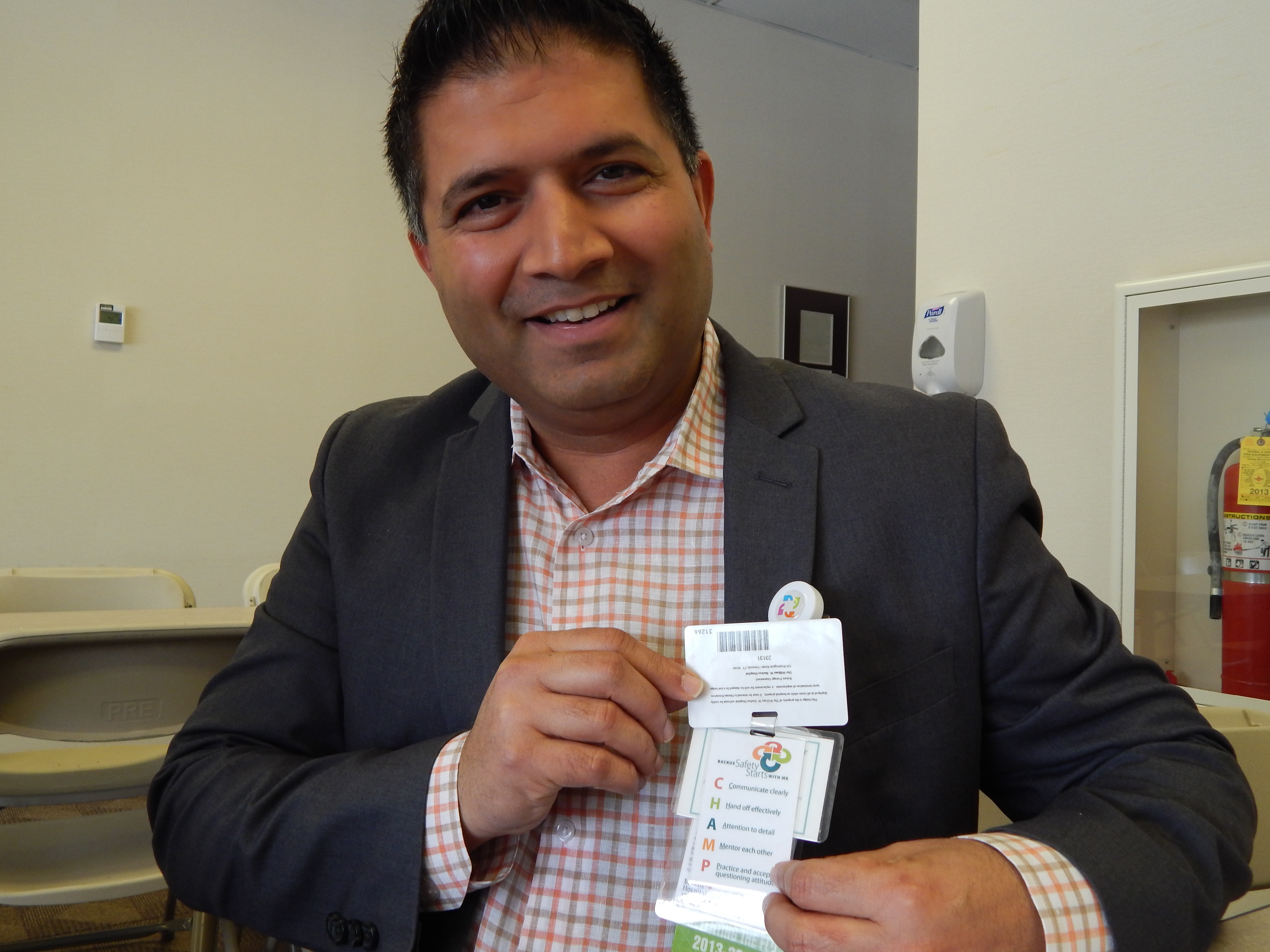
Vora keeps a card listing them on his hospital badge.
Although dramatic errors like surgeries done on the wrong limb tend to draw attention, Vora said one of the most common causes of malpractice settlements are diagnostic errors — cognitive mistakes.
And to address them, Vora is trying to promote something he calls “mindful medicine,” minimizing distracted doctoring or nursing.
No one would ever think to interrupt a surgeon working on an open spine, he said. But when a doctor is trying to piece together a diagnosis, reviewing lab work or entering patient orders, there’s no similar sign to say “do not disturb.”
It’s not uncommon for someone to interrupt and ask for a medication order for another patient. And to be a team player, the doctor often does. But if he had another patient’s electronic file open before, Vora said, he might accidentally enter the new order in the same file, for the wrong patient.
“Happens all the time,” he said.
To minimize those kinds of errors, he advocates the “STAR” technique: Stop, think, act and review. It was developed by teachers decades ago and later, by the nuclear navy.
“We’re late to the game,” Vora said, “but it’s time.”
