


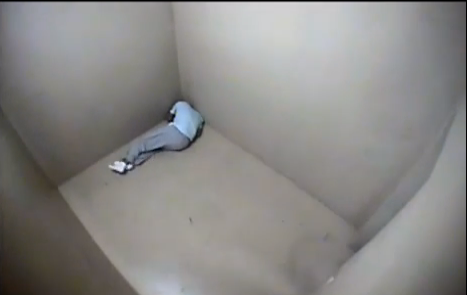
A range of human rights advocacy groups and mental health experts decried the practices shown in videos released Tuesday of youths being restrained and secluded at jails operated by the state Department of Children and Families.
The videos were made public by the state Office of the Child Advocate and followed critical reports by that office and others about the conditions of incarceration in the state’s juvenile jails.
A coalition of six juvenile justice, children’s and mental health advocacy organizations called the Connecticut Juvenile Training School a “boondoggle” and called for closing the jails that house about 70 adjudicated youths on any-given day.
The American Civil Liberties Union of Connecticut called the videos “disturbing.”
An official with the state Office of Protection and Advocacy for Persons with Disabilities said the videos show “all kinds of legal violations.”
Dr. Julian Ford, a psychiatry professor at the University of Connecticut Health Center, said the videos “show adults using force and coercion in ways that worsen — or actually create — conflict by provoking and escalating youths’ stress reactions.”
The Senate minority leader said the videos caused him, “shock, worry and alarm” and reiterated his call for the resignation of the agency’s commissioner.
A spokesman for DCF responded to release of the videos by saying the department is working to improve the conditions of confinement.
“The Department has already taken action,” said DCF spokesman Gary Kleeblatt.
The state panel responsible for overseeing juvenile justice in Connecticut will meet Thursday at the state Capitol complex, and will have a chance to react then.
Watch the videos and read the story about their release here.
Read the reactions
Here are the texts of statements made Tuesday in response to the videos.
Joint statement from the Connecticut Juvenile Justice Alliance, the Center for Children’s Advocacy, the Keep the Promise Children’s Committee, the Connecticut chapter of the National Alliance on Mental Illness, Youth First! and the National Juvenile Justice Network:
“The videos released today by the Connecticut Office of the Child Advocate (OCA) provide a critical element that was missing from the discussion about the Connecticut Juvenile Training School (CJTS) and the Pueblo Unit – the experience of youth themselves. The videos allow us to see and hear young people in distress and staff who have not been given the tools or training they need to help. Indeed, whistleblowers working within the facility alerted OCA to many of the harmful practices seen here. Most suicides in juvenile facilities happen in isolation. Restraint is a counterproductive way to address most adolescent behaviors – and not a therapeutic or effective approach for young people who are trauma survivors, as most in CJTS and Pueblo are. Restraint and isolation are the tools of a correctional environment, which can never be an appropriate place for children. Despite claims that some youth need to be restrained or benefit from seclusion, all evidence shows that restraint and seclusion worsen behaviors they are intended to address and increase the risk of injury and other harms for youth and staff. Mental health programs around the country and right here in Connecticut have shown marked success in reducing reliance on restraint for youth and adults with significant mental health disorders. The practices depicted on these videotapes are decades behind best practices and underscore the urgent need for expert assistance and outside monitoring to support youth and staff.
“By pairing the videos with case files produced by the Department of Children and Families (DCF), this addendum to the OCA report demonstrates that CJTS and Pueblo are not therapeutic facilities. The addendum and the report that preceded it are not an indictment of any individual or agency, but of juvenile correctional facilities themselves. It is widely agreed that CJTS is a badly planned facility that arose from Rowland-era corruption. These videos underline the urgency for Connecticut to develop better options. We owe it to youth in state care to protect their safety. We owe it to taxpayers to close down this boondoggle that is so ill-equipped to help young people become productive, law-abiding members of our communities.”
Statement from David McGuire, legislative and policy director for the American Civil Liberties Union of Connecticut:
“The goal of our juvenile justice system is rehabilitation not punishment. These disturbing videos show children with trauma and mental health issues being physically restrained and assaulted for attempting suicide or not listening to commands. This is not how children with mental health issues should be treated by their guardian. We must provide clinical services for children with health issues rather than punish them with force.”
Statement from Jacob Ham, a licensed clinical psychologist at Mount Sinai Beth Israel Medical Center and director of the Center for Child Trauma and Resilience.
“If the United States was a parent, I would call child protective services on ourselves for the way we treat our most vulnerable and needy children. These videos are a haunting reminder of how urgently we need trauma-responsive practices in the juvenile justice system. In every video, there are many opportunities to de-escalate or at least avoid escalating the situations in ways that might actually help these youth feel that adults care about them and resect them–this is the foundation of trauma-responsive care. I also worry about the well-being of the staff who experience these situations firsthand. We are failing them too if we don’t provide them with the skills to be effective in and proud of their jobs, which is turning young lives around.”
Statement from Senate Minority Leader Len Fasano, R-North Haven:
“I am glad to see government transparency respected with the release of these videos in full disclosure. As I watch these videos today I feel the same sense of shock, worry and alarm as I did when I first watched these videos weeks ago. As I’ve said before when I called for the resignation of DCF Commissioner Joette Katz in July, this is not about politics. This is about protecting kids. The commissioner knew about these problems yet continued ahead with blinders on. She has refused to implement common-sense reforms universally supported by independent child advocates and used successfully at other state juvenile facilities to improve conditions of confinement, program efficacy, transparency and outcome accountability for these children. That is unacceptable. Democrats offered no objections to reappointing Commissioner Katz nor did they question her past opposition to needed reforms. Now that the extent of the problem is undeniable, it is my hope that together we will take strong affirmative action to improve the system. These kids deserve better.”
Nancy Alisberg, an attorney with the Office of Protection and Advocacy for Persons with Disabilities:
“Among other things, this is a violation of the state’s restraint and seclusion law. There are all kinds of legal violations that the [office] are concerned about.”
Statement from Dr. Julian Ford, psychiatry professor at the University of Connecticut Health Center and director of the Center for Trauma Recovery and Juvenile Justice:
“The addendum to the CJTS/Pueblo investigative report, like the full report that preceded it, shows that the physical environment and the approach to supervision and rehabilitation in these facilities are not designed to protect and meet the needs of the adolescents they serve—nor to guide, protect and support staff in their efforts to safely assist youth in healing, growing, and taking their place as productive members in our communities. Meaningful change in these facilities will require a fundamental systemic shift that demonstrates a genuine recognition of the impact that trauma has on youth through the creation of an environment, an approach to programming, and a culture at every level that ensures safety, respect, and healing from traumatic stress for every youth and all adults who care for them.
“In one of the report’s videos, a young woman tearfully begs a police officer not to remove her handcuffs, because she knows that she will be left alone in her cell once she is unfettered. Isolation is difficult for anyone, and even more so for people with mental health challenges and for the very young. The American Academy of Child and Adolescent Psychiatry has taken a strong position against solitary confinement for anyone under 18, warning that it is likely to inflict permanent psychological harm. I recognize that the practices seen in the report are not technically considered solitary confinement, but that distinction means nothing to these young people, who are in great emotional pain and as a result experience further rejection and isolation when locked away without human contact… Isolation is a poor—and dangerous—substitute for trauma-informed and humane practices and procedures, that only perpetuates and exacerbates the risk of suicide and self-harm.
“Some incidents in the addendum, however, show adults using force and coercion in ways that worsen—or actually create—conflict by provoking and escalating youths’ stress reactions. We see girls wrestled to the ground for transgressions such as not getting off the phone or refusing to go to bed on time. Restraint and seclusion work against self-regulation. They say to the youth: “You cannot be trusted to control yourself, so we will control you at the most basic level.” Rather than being mindful of their own responsibilities, young people can buy into the view that they are out of control and become focused on breaking free from the shackles or the closed door that confines them. Force and coercion do not calm young people; instead they escalate conflict in the short term and fail to teach self-regulation in the long term.
“The data and videotapes of incidents at CJTS and Pueblo indicate that staff have not been given adequate training in these techniques and that leadership do not reinforce their importance.”
Statement from the Department of Children and Families:
We have begun the process of posting full-length versions of video taken at the facility of events that have specifically raised concerns. A link to them is as follows: http://www.dir.ct.gov/dcf/cjts-pueblo%20surveilance/index.htm. Additional videos will be uploaded on a rolling basis.
In addition, we have already taken the following steps pertaining to the facility:
1) Developed a comprehensive action plan to address issues identified internally, by an external national consultant and advocates
2) Expanded the roles of the clinician, allowing for additional hours spent at the facility during the evening hours and the weekends
3) Established formalized multi-disciplinary de-briefings after significant behavioral incidents with youth
4) Staff at all levels continually receive training, supervision and coaching pertaining to more effective interventions
The statement below reflects the Department’s current position on restraints and seclusion at the facility, which you may use on the videos that have been posted:
“The Department has already taken action by banning the use of prone restraints and phasing out the use of mechanical restraints. We have already begun more effective use of clinical staff to prevent restraint and seclusion whenever possible consistent with safety. We are now implementing additional comprehensive action steps that will significantly improve the care and treatment of the youth at both the boys and girls programs while also reducing the use of interventions that we all want to avoid.”
