


As recent events in Wisconsin have reminded us, this is an important year for elections, but one where we will have to explore new paradigms for political activity.
Before the coronavirus pandemic hit and we all began social distancing, election activities had been ramping up. And one cooperative effort in Connecticut is managing to keep going stronger than ever, despite physical isolation.
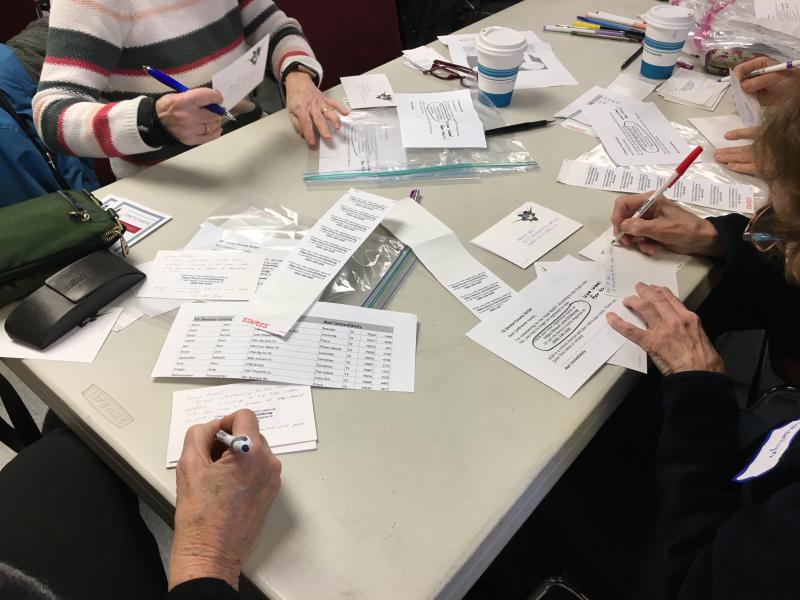
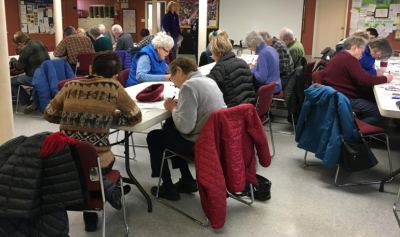
A few short weeks ago in the basement of the First Congregational Church in Guilford, upward of 50 people were seated at long tables, chatting as they worked, writing and sorting piles of small white postcards.
“It’s so heartening to come into this church basement and see 50 to 100 people doing what they can to make a difference,” said Howard Brown.
For months, he had been a regular there. He came each Saturday morning to work alongside his friends and neighbors. Most are members of progressive organizations, and in heavily Democratic Connecticut in a presidential election year the idea was to find a way to make a difference elsewhere — in states on the other side of our blue-red divide.
“It’s one thing to sit home and feel completely hopeless, it’s another thing to be able to come out and complete a bunch of postcards and reach across the country to people and say, ‘I’m in this fight, you know, and join me in the fight,’” said Kathryn King.
That day in February, the group was writing postcards to people they’ve never met in rural Texas, most of them African-Americans.
They’re voters who have been recently removed from the rolls. The postcards tell the voters how to check their registration and how to get back on the rolls so they’re able to cast a ballot in the next election.
“One of the things I’m really worried about coming up in this election is the integrity of our election,” said volunteer Netty Long. “And I think it is at risk. I think that they will try to do things that aren’t fair. This is a small act that I can do to let people know we’re watching. It’s an act of vigilance.”
Maintaining accurate voter rolls is emerging as the latest battleground over the right to vote. The way that states maintain their rolls, and the way they remove voters from them, made it all the way to the Supreme Court in 2018. There the justices upheld Ohio’s procedures for removing voters from the rolls if they fail to vote in two consecutive elections.
Conservative groups like the Heritage Foundation see inaccurate rolls as a potential source of voter fraud, and they have sued some municipalities to get them to take action.
“It is absolutely true that there are millions of people who are on more than one list,” said Denise Merrill, Connecticut’s secretary of the state. “Largely because people just don’t change their voter status when they move. It’s not the first thing on your mind, let’s face it.”
But, she says, some of the ways that states have chosen to flag voters and remove them from the rolls en masse — sometimes in groups of hundreds of thousands at a time — are problematic.
“A lot of these checking systems have proven to be wildly inaccurate. And they’ve ended up taking literally millions of people off voter rolls in other states inaccurately,” said Merrill, a Democrat.
Progressive groups allege that cleaning up the rolls in some states has become an excuse for voter “purges” — targeted removals of voters in certain counties and communities.
That’s the issue that a Virginia-based nonprofit, Center for Common Ground, chose to address. It’s not the only progressive group working on voter registration, but it does have a very specific focus.
“I know the importance of turnout. And most importantly I know the importance of turnout of the community of color voters,” said Andrea Miller, co-founder of Center for Common Ground. “In Alabama and Mississippi and Georgia, where the population of a county is more than 50% community of color, often African American, I will see up to 30% of the residents deregistered, and those become prime targets.”
Prime targets for her Reclaim Our Vote initiative, which calls, texts — and sends postcards — to people who are no longer registered to vote. She began the project in 2016 largely with voter turnout efforts and now has some 27 postcarding groups like the Connecticut one, mostly in West Coast and Northeastern states, reaching into specific counties in the black belt of the South in the reregistering campaign.
In Connecticut, community organizer Carol Rizzolo facilitates the local postcarding group. She said back in February it was the most popular project she’d ever been involved in.
“People are picking up postcards from my door, they’re asking for postcards to be left at my office, I’ve been delivering postcards. It’s been unbelievable, the level of energy and excitement and enthusiasm,” Rizzolo said.
But that was then, and this is now. The church basement in Guilford, like church basements everywhere, has fallen silent, and no one is gathering in groups of 50 or a hundred people for a volunteer election activity.
But in fact, Rizzolo says, with people trapped at home in social isolation, the project is going stronger than ever. Since mid-March she’s distributed, and people have completed and sent, more than 4,500 postcards.
“It has been nonstop — nonstop,” Rizzolo said. “So, we’ve moved it from the church to now people are doing a grab-and-go from my porch. I’m getting email constantly, or phone calls or texts, saying, ‘I’ll pick up 100 of them, I’ll pick up 120, I’ll pick up 50.’”
She said many of her volunteers, filling in postcards by themselves in their homes, see the effort as more relevant than ever, as the pandemic looks likely to make voting even harder.
“All of this is getting people very engaged with how to continue this incredibly important work of having the people who represent us in D.C. look like this country,” she said.
State officials in many parts of the country continue to debate just how we will go to the polls this fall. They’re also trying to strike a balance between maintaining clean lists and potentially disenfranchising voters.
And activists say they’ll continue to leverage that friction as an opportunity to bring people together — even if, for now, it can only be by mail.