


Amid a national surge in new cases, Gov. Ned Lamont took little comfort Wednesday in the daily rate of positive COVID-19 tests in the state falling to 4.76% from 6.74% the previous day, saying all trends point to a need for Connecticut residents to adhere to the recently tightened COVID restrictions.
“It’s not just the infection rate, but it’s the hospitalization rate,” Lamont told reporters after a Veterans Day observance in Middletown.
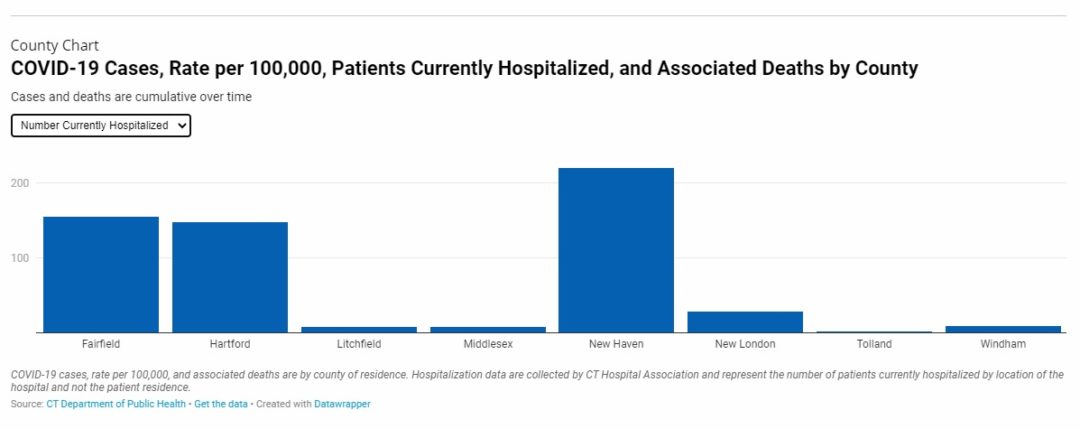
With 36 new hospitalizations, there now are 584 COVID-19 patients in Connecticut hospitals.
“You want to know what the metric is as we think about what we do in this state? It’s hospitalizations, because if we run out of capacity, then we’re in trouble,” Lamont said. “We never let that happen in the spring. We’re not going to let it happen now.”
Lamont said he saw no immediate need to begin creating emergency hospital space, as the state did in the spring with mobile Army hospitals that were deployed but never used. He said the state learned then how quickly those mobile units can be deployed.
With the current surge hitting increased numbers of the young and otherwise healthy, hospitals are finding that hospital stays for COVID are shorter now than in the spring.
“We still have a lot of capacity. We have better than 50% capacity, probably more capacity than just about any state in the country,” he said. “But the trend line’s not good.”
The U.S. reported more than 140,000 new cases Wednesday, a record that public health officials fear will be regularly broken in coming weeks and months.
Earlier this week, the University of Connecticut at Storrs announced it would place over 500 students living in five residence halls under quarantine after officials identified 34 new cases, the highest number reported in a day since the onset of testing.
To date, 84,741 people have contracted the virus in Connecticut. More than 4,700 have died.
Earlier this week, a study published in the research journal Nature found that cafes, gyms and restaurants accounted for 80% of new coronavirus infections in the pandemic’s early months, from March to May.
Lamont answered sharply when asked if he would consider amending his restaurant restrictions, which require closing by 10 p.m., to allow anyone to be seated if they arrived before 10.
“No,” he said. “I’m sorry. I mean, we’re ramping up. I’m looking at other places where they have closed the restaurants down totally. We’re doing [everything] we can to keep our restaurants open.”
Lamont said he currently saw no need to return to the stricter days when all businesses except essential retail were closed. The stores have not been shown to pose a high risk, given that patrons wear masks and their stay is limited, he said.
An outlier among state correctional facilities
The Department of Correction reports that 84 of its staff members are recovering from the virus. Four incarcerated individuals have COVID-19 and are currently showing symptoms. Eleven inmates are infected with the virus but are asymptomatic, the bulk of whom are at Osborn Correctional Institution.
The department’s web page says there are “no social visits until further notice” at Osborn, making it the only of 14 correctional facilities in the DOC system that hasn’t yet resumed visitations. All other correctional facilities have resumed social visits, even Hartford Correctional Center, where 58 incarcerated people tested positive for the virus last month. Non-contact visits resumed at the jail on Oct. 29.
Osborn has had the biggest outbreak in the state’s prison system, with 345 incarcerated people testing positive for the virus. The facility with the second-highest number of cases is Carl Robinson Correctional Institution, with 288 cases.
According to figures provided to the ACLU of Connecticut, in line with the terms of the state’s settlement agreement in its COVID-19 prison lawsuit, 46 people incarcerated at Osborn tested positive for COVID-19 during October.
The confusion over why Osborn hasn’t resumed visits has left families with loved ones incarcerated there frustrated. In an email sent Monday to a member of the Connecticut Prisoner Advocacy Network, a group of around 40 people who have incarcerated loved ones in state correctional facilities, agency spokesperson Karen Martucci said the DOC is monitoring units at Osborn under quarantine and that a symptomatic inmate left the facility on Friday.
“We will be sure to note on the public website to inform families once we are able to safely resume,” Martucci wrote.
“It’ll be eight months tomorrow since we’ve been allowed to see their face in any capacity,” said Ashley Turner, founding member of the advocacy network who has a loved one incarcerated at Osborn. “It’s almost like you’re grieving someone that’s no longer there.”
Turner said she was disappointed the DOC had not yet announced video visitations, a priority of the newly named commissioner, Angel Quiros. The lack of in-person and video visits has left those with loved ones incarcerated at Osborn to rely on phone calls to maintain their ties. Incarcerated people can make two free phone calls each week, but dialing their friends and family is a costly way to stay in touch — an expense that for some could be more financially painful because of the pandemic.
“You’re not able to see that person, to see them laugh or have any connection other than talking on the phone, which costs us over $4 for 15 minutes,” Turner said. “These are people’s fathers, people’s husbands, people’s loved ones, and they matter.”

