


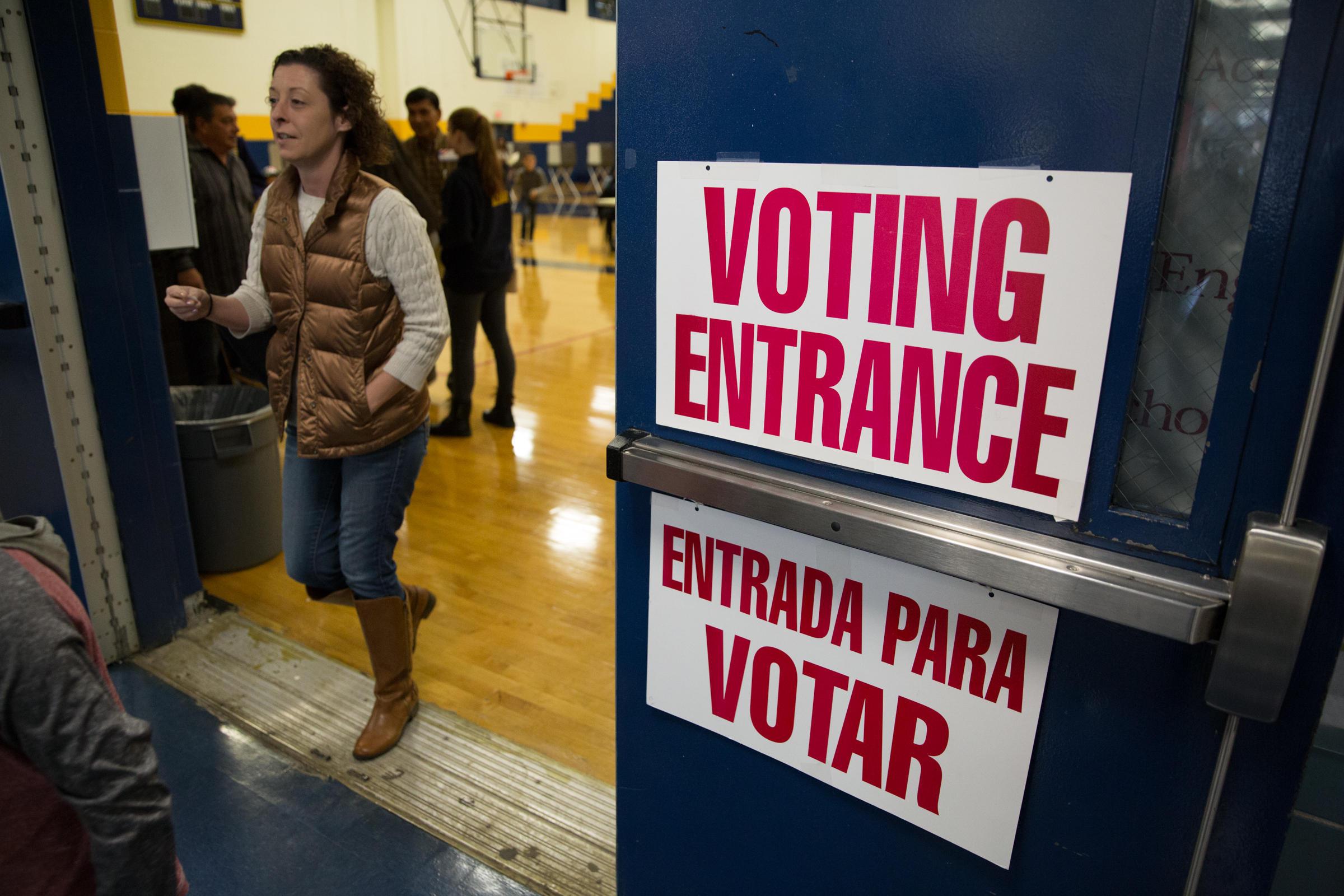

The Democratic majority on a General Assembly committee that oversees state election law voted Monday to endorse bills that would create a state voting rights act and increase voter registration and ballot access.
At the last scheduled meeting before its deadline for reporting bills to the floors of the House or Senate, the Government Administration and Elections Committee approved nearly a half-dozen bills that divided Democrats and Republicans.
Republicans voted as a bloc against several high-profile measures, but there was little debate. Only the ranking Republicans, Sen. Rob Sampson and Rep. Gale Mastrofrancesco, both from Wolcott, spoke to raise questions or objections.
Sen. Mae Flexer, D-Windham, the co-chair, said some of the partisan divisions over elections laws that are evident nationally are reflected in Connecticut, but she said there are rank-and-file Republicans open to easing ballot access and voter registration.
Senate Bill 5, a priority of the Senate Democratic majority, would authorize the secretary of the state to expand the successful “motor voter” program that registered voters at the Department of Motor Vehicles to other agencies, including the Department of Social Services.
It also would end Connecticut’s status as one of the few states outside the Deep South that bars parolees from voting until they pay all fines owed.
Secretary of the State Denise Merrill said during a public hearing last month that the bill would clarify when criminal offenders regain the right to vote. The standard, she said, would be simple: When they leave prison.
Senate Bill 820 would create a state voting rights act, giving people the right to sue municipal legislative districts that are drawn in ways that undercut the influence of racial minorities.
If the bill comes to a vote in the Senate, one question will be whether the same standard suggested for municipalities also should apply to the General Assembly, whose districts will be redrawn this year in response to population shifts found by the 2020 Census.
Sampson and Mastrofranceso objected to the voting act’s explicit references to race.
“In my opinion, this is all wrong,” Mastrofranesco said. “We’re trying to tell people that you must vote, you know, we’re going to divide this up to ensure that you vote for a certain person based on their race,” she said.
“I certainly would never vote for or against someone based on their race. I believe that people’s political ideology far outweighs their concern over someone’s skin color,” Sampson said.
House Bill 6205 would slightly expand the use of absentee ballots, capitalizing on a Supreme Court decision during the COVID-19 pandemic that interpreted a constitutional reference to sickness more broadly than a voter’s illness.
The court found that Gov. Ned Lamont’s executive order allowing any voter to use the ongoing pandemic as a reason to vote by absentee was consistent with the Connecticut Constitution, which lists “sickness” as one of the few acceptable reasons to use an absentee ballot.
Lamont — whose emergency powers during the pandemic allowed him to temporarily change state laws, but not the Constitution — suspended a law that goes beyond the constitutional language and says that an individual voter must be ill to use sickness a reason to vote by absentee.
The Connecticut Constitution says the General Assembly “may provide by law the means to vote in cases of absence from the city or town of which they are inhabitants or because of sickness, or physical disability or because the tenets of their religion forbid secular activity.”
In response to a challenge by Republican congressional candidates last year, the court concluded that sickness as used in the constitutional provision “is not limited to an illness suffered by the individual voter that renders that person physically unable to travel to the polling place.”
The bill endorsed Monday would eliminate the statutory reference to an illness suffered by an individual voter and instead mirror the more ambiguous constitutional language that refers to “sickness” without elaboration.
So, if the bill becomes law, what might that mean in a practical sense?
Rep. Matt Blumenthal, D-Stamford, said after the meeting that it could give a family member who cares for a sick relative the ability to vote by absentee, something that is not now an acceptable excuse under Connecticut’s unusually restrictive rules.
What about an older person’s fear of getting sick if he goes to polls in flu season?
Blumenthal said that would be up to the voter: If the fear were rational, the answer would be yes.
“You have to have a rational basis for whatever the sickness is interfering with them voting in person,” Blumenthal said. “But ultimately that’s the question: Does sickness interfere with your ability to get to the polls?”
Sampson said he believed the Constitution clearly was referring to an individual voter’s illness, despite the Supreme Court’s clear opinion to the contrary.
