


Health leaders across Connecticut are warning state legislators about the dangers of dirty air. But the head of the state Senate said Monday the Transportation and Climate Initiative will not be on the agenda during a special session expected to occur within the next two weeks.
“I’m hoping we can do this in a special session, but it won’t be in the September special session,” said Senate President Martin Looney during a phone interview. “It’s not fully put together as of yet … [In the] September session that we will do within the next two weeks. I think the sole agenda will be extending the governor’s emergency powers.”
TCI would place a declining cap on emissions and charge certain producers “allowances” for pollution from the fuel they sell. The charge would likely raise the price of gas by a few cents, but a portion of that money would be reinvested in some of the state’s neediest communities, which are disproportionately hit by air pollution and associated health problems like asthma.
Still, the bill’s likely impact on gas prices effectively killed TCI last legislative session.
Looney said that while his caucus backs the basic idea of TCI and its goal of reducing fossil fuel consumption and emissions, he’s concerned about potential financial impacts.
“I think our caucus is strongly supportive of environmental initiatives, but at the same time strongly supportive of shielding low- and moderate-income people from a disproportionate burden on the tax side,” Looney said. “We are actively engaging in trying to find a somewhat more progressive way to package it.”
Looney said those ideas may include gasoline tax credits for low-income families or an overhaul of electrical rates, which could benefit lower-income customers.
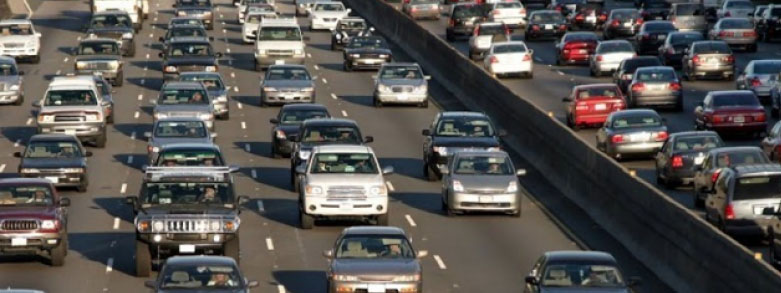
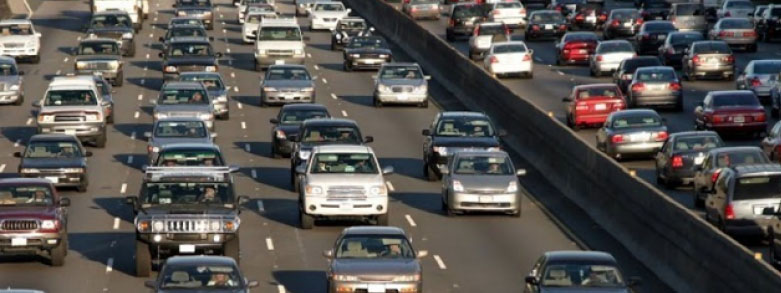
While debate about implementing TCI continues, the state’s traffic pollution problems are only getting worse.
Speaking to students and environmental advocates at Gateway Community College on Friday, Katie Dykes, commissioner of the Department of Energy and Environmental Protection, said it’s largely because of rising emissions from transportation that Connecticut is now on track to miss its clean air targets.
“We are falling behind,” Dykes said. “We’re actually not going to meet our target for 2030.”
“Our target is not … an exceptional target.” Dykes said. “It’s actually the minimum of what we should be doing, to do our share to reduce emissions. And it’s because emissions in transportation and buildings are still increasing.”
While Connecticut’s overall emissions are dropping compared to pollution rates in 1990 and 2001, year-over-year data from 2017 to 2018 show emission levels are actually going up.
And since 1990, state data show transportation-related emissions have actually increased and now exceed the combined emissions of the electrical and residential sectors.
Dykes said dirty air from vehicles disproportionately hits the health and wallets of people in cities.
“If you live next to [Interstate] 95, 91, 84, you’re breathing air that is, on average, about 20% more polluted than the air in suburban or rural parts of our state,” Dykes said. “Chances are you’re suffering a lot of challenges from that air pollution: higher levels of asthma, which means health care costs, calling out sick, kids missing school, parents missing work.”
A coalition of health care professionals, advocates and students is urging legislative leaders to pass TCI, saying the proposal would save lives and money.
“Working in a busy pediatric clinic nestled along the I-95 corridor, I see countless cases of poorly controlled asthma and allergies each year,” said Cheryl Anderson, a practicing pediatrician and the Connecticut chapter climate advocate of the American Academy of Pediatrics, in a statement. “We know that transportation and vehicle emissions account for the majority of air pollution and contribute to increases in greenhouse gases.”
“There is a strong association between air quality and pollution and childhood asthma,” Anderson said. “Many of my patients live in neighborhoods directly adjacent to the highway, increasing their exposure and therefore their risk.”
Still, it’s not entirely clear to what extent the potential health impacts of a climate-related bill will resonate among lawmakers debating TCI’s financial impact.
Looney said that passing TCI could “potentially” have positive impacts on human health.
“I don’t know to what degree,” he said, “but certainly everything that helps, incrementally, is important.”