



As summer arrives I’m reminded of one of Metro-North’s greatest “fails” of all time, recounted in this column I wrote days after it happened…
Friday, July 22, 2011 was the hottest day I can ever remember. The pavement in Manhattan was 147 degrees and I could tell that my commute home was going to be awful. Luckily, I wasn’t on the 1:34 p.m. train to New Haven.

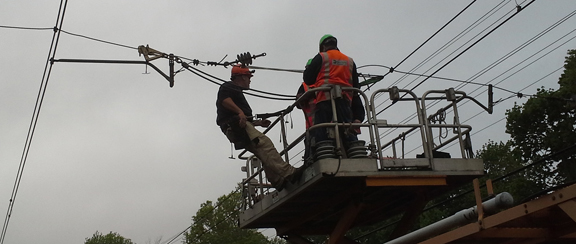
Three cars on that train lacked good air conditioning, so the remaining cars were standing room only. Just past the Westport station, an aging pantograph snared the overhead catenary (power) line, sagging in the heat, and the train lost power. No electricity meant no AC, no radio and no PA system.
Eyewitnesses on the train told me people started panicking as the temperature rose. They asked a conductor to open a window or door, but he refused. Finally, two passengers opened emergency evacuation windows, pried open the doors, jumped out and walked down onto the tracks.
Realizing that they faced what they felt was an emergency and with no aid or communications from the railroad, people pulled out their phones and dialed 911. Metro-North wasn’t going to rescue them, so maybe the police could. People were crying, fainting, throwing up. At least three pregnant women were in distress.
When their 911 screens “lit up,” Westport Police called Metro-North headquarters asking the location of the train. At first they were told the train was empty, which delayed an EMS response. After almost an hour in these unbearable circumstances, the train limped into the Greens Farms station where rescue workers from Fairfield and Westport tended to the sick and handed out water. On the platform, the digital displays mocked the crisis by reading “Good Service.”
About the same time, the 12:07 p.m. from Grand Central Terminal became disabled between Stratford and Bridgeport. The 3:27 p.m. from New Haven suffered the same fate nearby, also because of the pantographs snagging the drooping power lines.
At 4:45 p.m. I arrived at GCT, having heard of “wires down” delays from Clever Commute. I asked my conductor what he knew, hearing the Metro-North radio crackling on his hip. “They haven’t told us anything,” he said.
Though a commuter using Clever Commute first reported the wires problem at 3:23 p.m., it wasn’t until 4:15 p.m. that Metro-North’s e-mail alert system finally posted a vague message of “heat related instances” and “35 – 45 minute delays” from Stamford to New Haven.
“Instances?”
Rush hour was screwed. Dozens of trains pouring out of Grand Central would be delayed. And because New Haven to New York City trains had been totally suspended, needed equipment could not arrive at GCT in time to take folks home.

It’s not Metro-North’s fault that our catenary is so fragile… snapping in the bitter cold of winter and sagging in the summer’s heat. And it’s not Metro-North’s fault that the pantographs on our 40-year-old trains can’t be adequately maintained.
Anybody who has ridden Metro-North over the years knows that “stuff” happens.
But Metro-North is responsible for its horrendous, potentially life-threatening lack of communications. On the trains, at the stations and via e-mail, their silence and ambiguity about this crisis were just the latest in a litany of disregard for the commuter, their customer.
That time, the hottest day in recent memory, thousands sweated and were delayed, but nobody was hurt. Next time, we may not be so lucky.
UPDATE TO 2023:
The old rail cars are gone, replaced by more reliable M8s. Work continues on replacing the old catenary (overhead power lines). Communications from Metro-North are vastly improved.