


Warning: This story contains graphic videos.
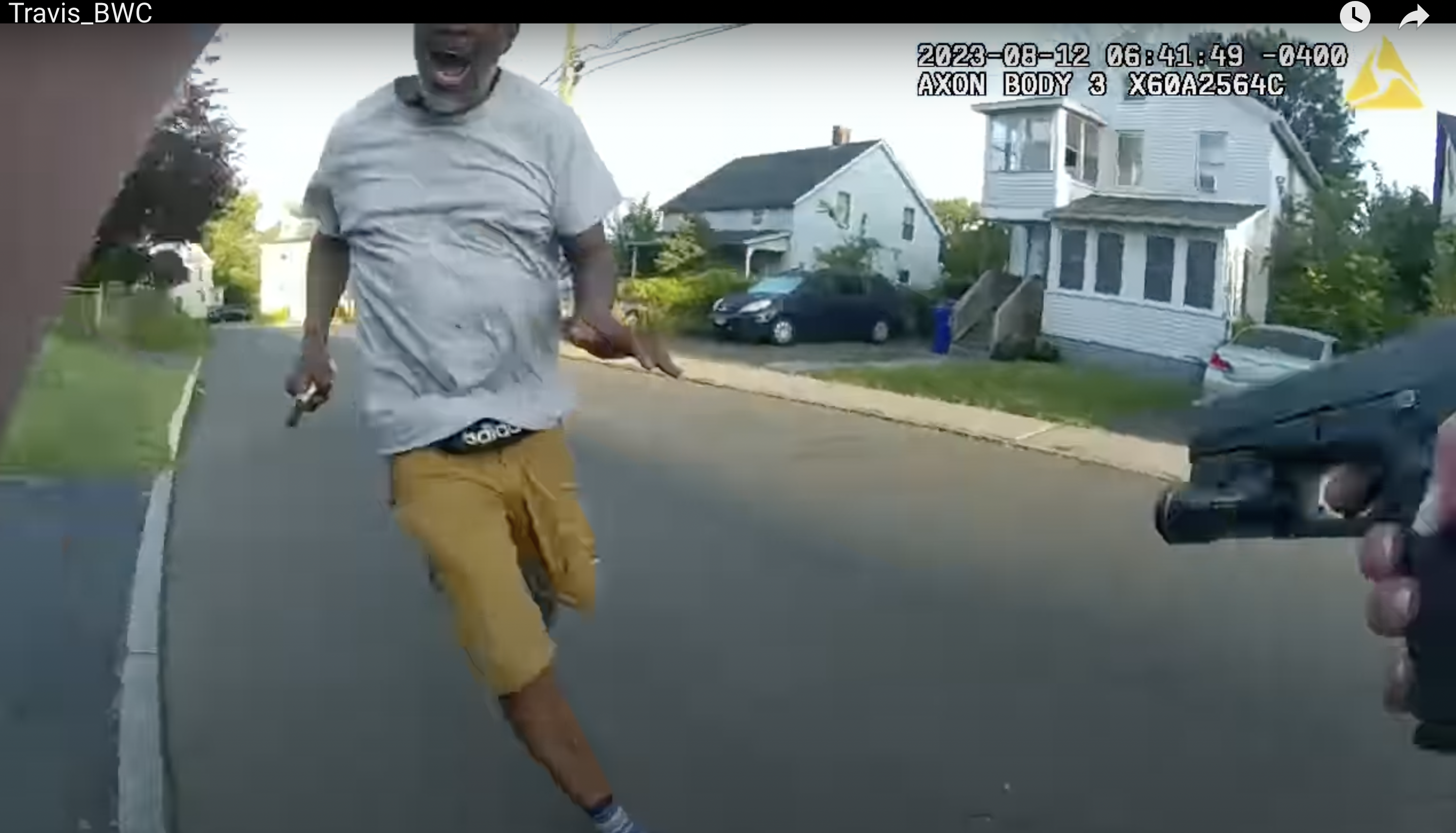
The call of a domestic disturbance came at 6:39 p.m. As Officer Haylee Ouellette approached the apartment in Manchester, a body-worn camera recording a cop’s-eye view of her arrival, a man inside could be heard screaming, “Shut your mouth!”
“Hey, hey, hey! What’s up? What’s happening?” Ouellette called out, her voice casual. She opened a screen door and leaned in. “Why are we yelling at each other?”
Joseph Diloreto was profanely berating a woman inside the apartment. He did not directly answer Ouellette until she stepped inside. Then his attention shifted from his female acquaintance to the officer, anger coming to a rapid boil.
In quick succession, he slapped at the officer, dodged a shot from a non-lethal Taser, grabbed a knife and advanced on Ouellette.
“Oh, my God,” said Diloreto’s companion.
Ouellette backed from the apartment to a courtyard, now aiming her handgun, not the Taser. Diloreto called her a “wimp.” Ouellette told him to drop the knife, or she would shoot. Diloreto hesitated by the door, then came out. He waved his arms and yelled, “Hit me. Hit me. Hit me.”
He kept coming. Ouellette fired.
“Shots fired,” she radioed, her voice tight. “Multiple shots fired.”
Ouellette was the first of three Connecticut police officers to shoot someone this summer. Shootings in Manchester in July and West Hartford and Middletown in August left one man dead and two wounded.
Two incidents involved men who seemed impaired — the one with a knife in Manchester, another with a claw hammer in Middletown — as they inexplicably attacked armed officers.
In the other, a car chase and brief manhunt preceded a K-9 officer in West Hartford shooting and killing a suspected car thief in a chaotic, claustrophobic confrontation involving the cop, his dog and the suspect on the front seat of a moving car.
All three shootings were recorded by the body-worn cameras that police call BWCs. Each time, public release of the videos came quickly and without prodding from the press, transparency mandated by a 2020 police accountability law.
Introduced elsewhere a decade ago, BWC use in Connecticut has evolved from a voluntary pilot project authorized by the General Assembly in 2015 to their required use, effective July 1, 2021. Every use of deadly force by a local or state police officer since then has been captured by an unblinking camera.
“It’s transformative,” said Robert J. Devlin Jr., a former prosecutor and judge who is approaching the midpoint of a four-year term as Connecticut’s first inspector general, responsible for assessing every police use of deadly force.
Centralizing use-of-force investigations in the Office of Inspector General is one of the reforms in the 2020 law, Connecticut’s reaction to the citizen video of a handcuffed George Floyd dying while a Minneapolis police officer knelt on his neck for 9 minutes while other cops watched without intervening.
The Connecticut law requires police to intervene when witnessing brutality by fellow cops, mandates body and dash cameras, bans chokeholds in most circumstances and clarifies that deadly force can be used only when police exhaust all reasonable alternatives.
And it resolves any question about when or whether to release BWC and dash-cam videos after critical incidents. The law mandates release within four days, and Devlin generally has posted them online even faster, accompanied by brief summaries identifying the officers involved.
The practice and clear legal requirement stands in contrast to other states.
In Cambridge, Mass., as the Boston Globe reported last week, officials have yet to identify the police officer who shot and killed a college student on Jan. 4, saying the legal authority for disclosure is unclear. There was no requirement to wear a BWC, and Cambridge officials had not provided one.
Connecticut is one of at least seven states mandating the statewide use of body-worn cameras, according to the National Conference of State Legislatures. Regardless of state laws, most larger police departments now employ them throughout the United States.
There is a consensus that body-worn cameras are game changers, at least in assessing police on their worst days, when a firearm is unholstered and fired, as well as resolving complaints. Was a cop rude? Did they really use a racial epithet? Did they strike someone without cause?
“Well, now you watch the body cam,” said Paul Melanson, the chief of police in Avon and current chair of the Connecticut Police Chiefs Association.
BWC videos are downloaded and logged at the end of every shift, a cinematic record of everything from the most mundane of police interactions with the public to confrontations involving deadly force, like the ones from Manchester, Middletown and West Hartford.
The one thing that hasn’t happened is we haven’t seen a major reduction in some kinds of use of force with body-worn cameras.
Chuck Wexler, Police Executive Research Forum
Most of the devices have automatic triggers. When an officer activates a cruiser’s lights or siren responding to call, the body and dash cams begin recording, Melanson said. In other situations, the BWC must be manually activated, a habit most officers have developed, he said.
Michael P. Lawlor, a criminal justice professor and former prosecutor, lawmaker and gubernatorial adviser who sits on the New Haven Police Commission and the state board that sets police training standards, said the videos are neutral witnesses, allowing quicker resolutions of complaints.
Research has found that complaints drop when the cameras are used.
Harder to assess is how the BWCs are changing policing.
Early studies are inconclusive, said Chuck Wexler, the executive director of the Police Executive Research Forum, a Washington, D.C., group that advises police on everything from training and tactics to how to best recruit and retain police in a tight labor market.
“The one thing that hasn’t happened is we haven’t seen a major reduction in some kinds of use of force with body-worn cameras,” Wexler said. “And I think that the answer to that is that body-worn cameras by themselves will not change policing — body-worn cameras with new training, new policies and new oversight will.”
Wexler said BWC videos already have been a training tool, showing real-life examples of police shootings that could have avoided with different tactics, especially when confronted with someone acting irrationally.
“From our standpoint, it has been an epiphany in how you think about force and how you train police to prevent unnecessary force, so that ultimately everybody can go home safe,” Wexler said.
The Police Executive Research Forum has developed a use-of-force protocol for handling people who are behaving erratically and dangerously but do not possess a firearm. It is dubbed ICAT for “integrating communications, assessment and tactics.”
ICAT preaches against moving quickly when a subject is safely confined but showing signs of mental illness.
“The last thing they want is a police officer aiming a firearm at them and barking orders. But that’s how police have been taught,” Wexler said.
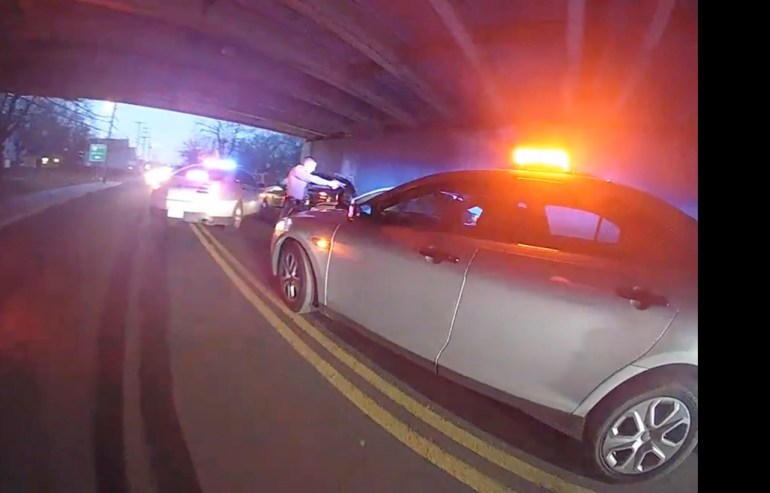
It is the scenario that unfolded on Jan. 15, 2020 when 19-year-old Mubarak Soulemane of New Haven was shot to death by State Trooper Brian North after an on-and-off chase on I-95 from Norwalk to West Haven.
As recounted by Devlin’s investigative report, Soulemane led police on a chase at speeds reaching 100 miles per hour before police boxed him in just off I-95 in West Haven. He sat alone behind the wheel of the car he had stolen from a Lyft driver after acting erratically at a cell phone store.
His eyes were closed, and he ignored shouts to exit the car. Soulemane’s family says he was diagnosed with schizophrenia at age 14.
North stood outside the driver’s door, aiming his handgun at Soulemane’s chest through the closed window. A West Haven officer, Robert Rappa, broke a passenger side window. At North’s urging, another trooper fired his Taser, which failed to penetrate Soulemane’s jacket.
“He’s reaching,” Rappa yelled.
Soulemane pulled a serrated knife from his pocket and pointed it at the roof of the car. North fired seven times.
Devlin took over the investigation in November 2021, two months after becoming inspector general. His task was to assess whether North’s use of force was “objectively reasonable,” a legal standard that gives police the benefit of the doubt.
To find an officer criminally culpable, the state must prove beyond a reasonable doubt that police did not act in defense of themselves or others. In a scathing report issued in April 2022, Devlin concluded that North’s actions could not be justified, nor were they reasonable by any measure.
He charged North with manslaughter, the first officer to be criminally charged under the new accountability law.
“At the time Trooper North fired his weapon, neither he nor any other person was in imminent danger of serious injury or death from a knife attack at the hands of Soulemane,” Devlin wrote. “Further, any belief that persons were in such danger was not reasonable.”
North told investigators that he believed that Rappa was about to enter the car, and he feared that Soulemane might stab the West Haven officer.
There is body and dash camera video from various angles of the shooting, but the images from North’s BWC may be of limited use in resolving whether North saw anything justifying that belief.
James W. Borden, a retired Nevada police officer and court-certified expert witness in use-of-force cases, said in an interview that not every BWC video will show precisely what an officer saw and reacted to in a matter of seconds.
“They have to make sense of what’s occurring in front of them. And at that point that starts to drive a decision,” said Borden, who reviewed North’s shooting and concluded the trooper could have had a reasonable belief of an imminent threat.
Because North was leaning forward, the camera worn on his chest aimed slightly lower than his actual line of sight, and the view was further obscured by his outstretched hands that held his pistol. But Devlin’s reported noted that Rappa told investigators that North was mistaken. He was not entering the car and had no intention to do so.
“Rappa told Inspectors that he broke the window to communicate with Soulemane, and facilitate the use of less lethal means to gain control of him,” Devlin wrote. “A reasonable police officer would have realized that the police were in control of the situation and the opportunity existed to take a tactical pause to explore the use of methods other than deadly force.”
Having body camera footage and having the ability to quickly see a situation as it actually unfolded, and then having the ability to share that video with the community as quickly as possible, has been vital.
Hartford Mayor Luke Bronin
It would have been the approach recommended by Wexler’s ICAT protocols.
Devlin’s report went beyond an assessment of North. He faulted a more senior trooper for failing to take command and all the officers for barely communicating with each other or Soulemane.
“There was no plan. This is why events took on a life of their own after the window shattered. Somebody needed to assert leadership, take a tactical pause, and examine the best course to accomplish safely the arrest of Soulemane,” Devlin wrote.
Claudine Constant, the public policy and advocacy director of the ACLU in Connecticut, is generally a critic of the accountability law, saying the standards for judging police are too lax. But she said she appreciates Devlin’s willingness to take a broader view of the tactics behind use of force incidents
“It’s welcome reading,” she said.
In an interview, Devlin downplayed his role in offering critiques.
“My office can’t impose change on police agencies in Connecticut. We would never presume to do that,” Devlin said. But, he added, “I’ve tried to make what I thought were common-sense recommendations in some situations for their consideration, in terms of whether they think is a good idea or not.”
There has been no broader assessment of the accountability law, but there is a consensus from police, policy makers and politicians that the BWCs and clear rules for the release of the videos are worthwhile.
After Hartford police fatally shot Alphonso Zaporta while struggling to pull him from a car in July 2019, it was unclear what BWC video would be released. Hartford Mayor Luke Bronin pressed for immediate release, knowing the view from inside the car would show what some witnesses could not see: Zaporta had taken hold of an officer’s gun.
Bronin was relieved when the investigating prosecutor complied.
“Having body camera footage and having the ability to quickly see a situation as it actually unfolded, and then having the ability to share that video with the community as quickly as possible, has been vital in the wake of tragedies in this community and so many other communities,” Bronin said.
In contrast to Cambridge, there were no lingering community complaints in Hartford over a lack of transparency.
To the surprise of some experts, police have embraced patrolling with a digital big brother that sees and hears most public interactions.
“The conventional thinking 10 years ago was cops won’t want this. This is another intrusion,” said Wexler, whose organization wrote the original guidelines for their use. “Today, if you tried to take away those cameras, the cops would actually be upset.”
Melanson said that has been the case since Connecticut made the cameras mandatory. “It is not only embraced, I mean, I know that they won’t go out without it. It has become just a part of what they’re doing.”
Rep. Greg Howard, R-Stonington, a police detective, ultimately voted against the 2020 police accountability law, but for provisions unrelated to the camera mandate.
“The truth is told right from the beginning,” Howard said. “So I think that from a perspective of transparency, certainly it’s a great thing.”
