



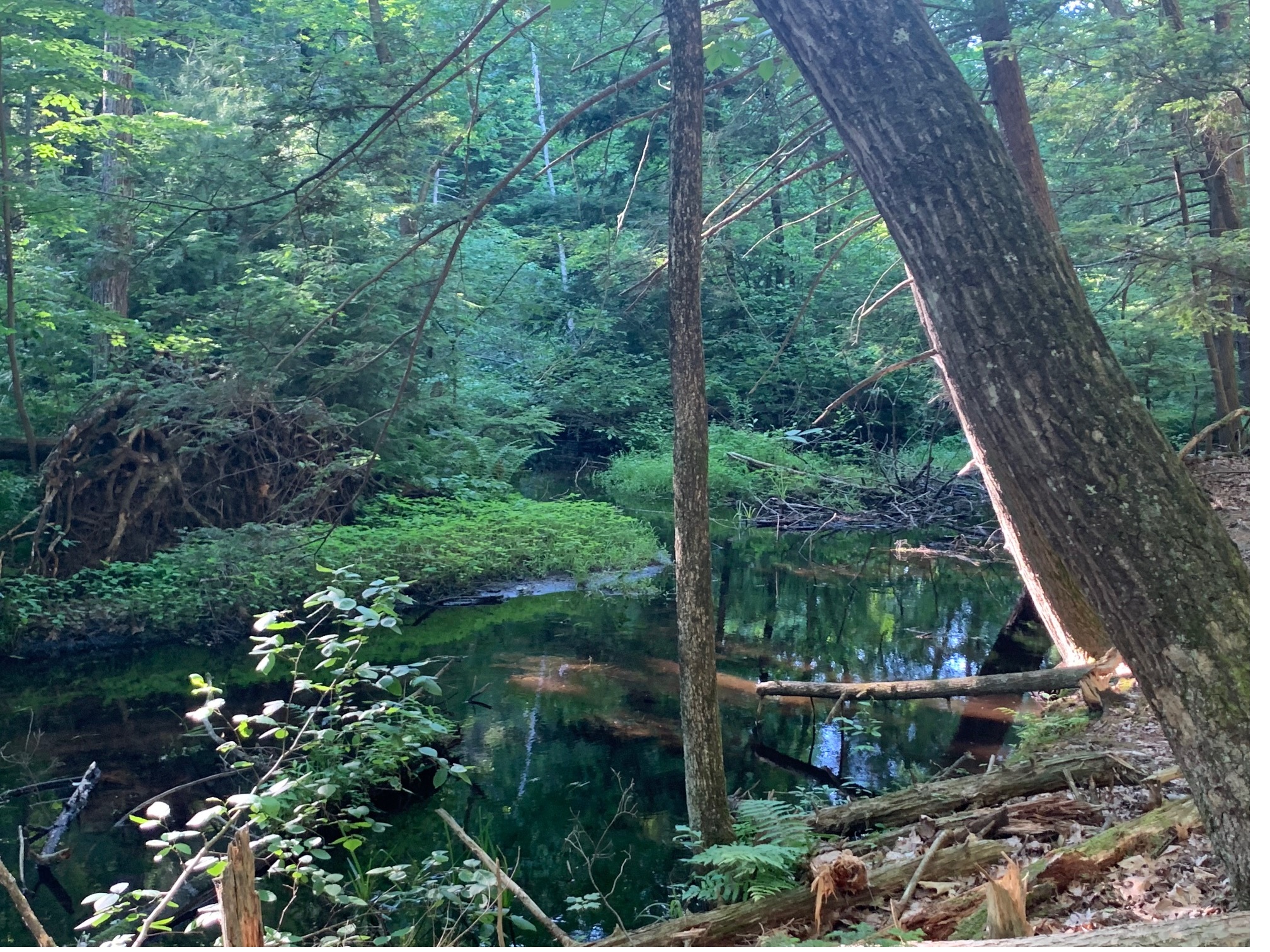
Did you know Connecticut has a “Green Plan?” The official name is Connecticut’s Comprehensive Open Space Acquisition Strategy, and per Connecticut General Statute (CGS Ch. 439, Sec. 23-8) the “strategy” intends to guide land conservation and safeguard 21% of Connecticut’s land as “open space” by 2023.
Now, as the Department of Energy and Environmental Protection (DEEP) updates the Green Plan, we should focus on identifying, protecting and connecting a small but vital network of nature, i.e. “Wildlands.” In these spaces, from urban to rural, Mother Nature can adapt, flourish, and protect us — thereby aligning science, fiscal responsibility, justice, and public opinion.

The good news is most people love nature and want more. Even before the pandemic, in November 2018, voters overwhelmingly passed a Connecticut Constitutional Amendment to protect public land. DEEP is charged with conserving, improving and protecting Connecticut’s natural resources, and, per CGS Ch. 439, Sec. 22a-15, there is a public trust in the state’s air, water, and other natural resources. Furthermore, each person is entitled to their protection, preservation, and enhancement.

Even with mandated open spaces, however, the vast majority of Connecticut lacks wildlands. This is because most protected land is dedicated to specific uses (i.e., farming) or available for multiple uses (i.e., timber production, habitat experiments). All of these are important — and all conserved land has value — but nature is the foundation. Recently the history, science, and current status of wildlands was outlined in a first-of-its-kind report co-led by Harvard Forest, Northeast Wilderness Trust, Highstead, and Wildlands, Woodlands, Farmlands, and Communities titled “Wildlands in New England: Past, Present, and Future.”
In the report, wildlands are defined as:
“ . . . tracts of any size and current condition, permanently protected from development, in which management is explicitly intended to allow natural processes to prevail with “free will” and minimal human interference. Humans have been part of nature for millennia and can coexist within and with Wildlands without intentionally altering their structure, composition, or function.”
In short, wildlands can welcome people, and can be managed, but the intent is letting nature prevail. Making wildlands, i.e. “Mother Nature,” an explicit focus of the updated Green Plan can optimize natural solutions across Connecticut and beyond. This supports and complements initiatives on climate (Governor’s Council on Climate Change (GC3) Science and Technology Working Group Phase 1 report), recreation (Statewide Comprehensive Outdoor Recreation Plan ((SCORP)), wildlife (State Wildlife Action Plan (SWAP)), and water (State Water Plan). Wildlands also prevent flooding, an increasing climate-related risk.
Wildlands are for everyone, and a statewide network of wildlands can connect us to each other. Before extensive clearing by settlers, some land was burned and cleared by native people, mostly near rivers and along the shore. However, based on charcoal and pollen records, New England’s cultural heritage was predominantly with a wildland landscape. Co-existing with nature is our common lifeline — “green infrastructure” for all species, and a repository of support for our working lands.
The wildlands report includes resources like an interactive map, a checklist (“What Makes Land a Wildland”), and a summary for each state. Although Connecticut has few Wildlands, and very few with “strong” protection, we have a tremendous opportunity to take simple, low (or no)-cost actions:
- Keep wildlands as wildlands: permanently protect existing wildlands with weak protection. This is less than 1% of the state.
- Add public and private land with existing (implicit) wildland intent. Suitable town, land trust and other properties can “get on the map,” and, per DEEP forestry, at least half of state-owned forestland is managed as a wildland. These wildlands could add ~5% of the state and include precious public trust assets like headwaters, wetlands, ridges, and critical habitats.
- Prioritize wildlands in open space acquisitions unless the intent is something else – i.e. a farm, a meadow, wood production, experiments. Without a major investment, wildland acquisitions will be less than 1% of the state.
In sum, wildlands are and will be a fraction of the landscape — but wildlands matter. Wildlands play an outsized role in climate stability, resilience and wellness. Forests managed as wildlands are older, cooler, wetter, and carbon-dense. Older forests are also rated as more beautiful, and arguably best able to promote awe and compassion — and thereby bridging across divisions and generations, within the state and beyond.
Nature in Connecticut is a major economic driver even while we are one of the most densely-populated states (in a densely-populated region). We will continue to use and reuse our land for energy, resources, experiments, housing, and more — and we must also plan for nature. Solving our lack of wildlands by putting Mother Nature in the Green Plan is an opportunity and a legacy we should not squander.
Susan Masino is a Professor of Applied Science at Trinity College and a member of the Connecticut Scholars Strategy Network.