


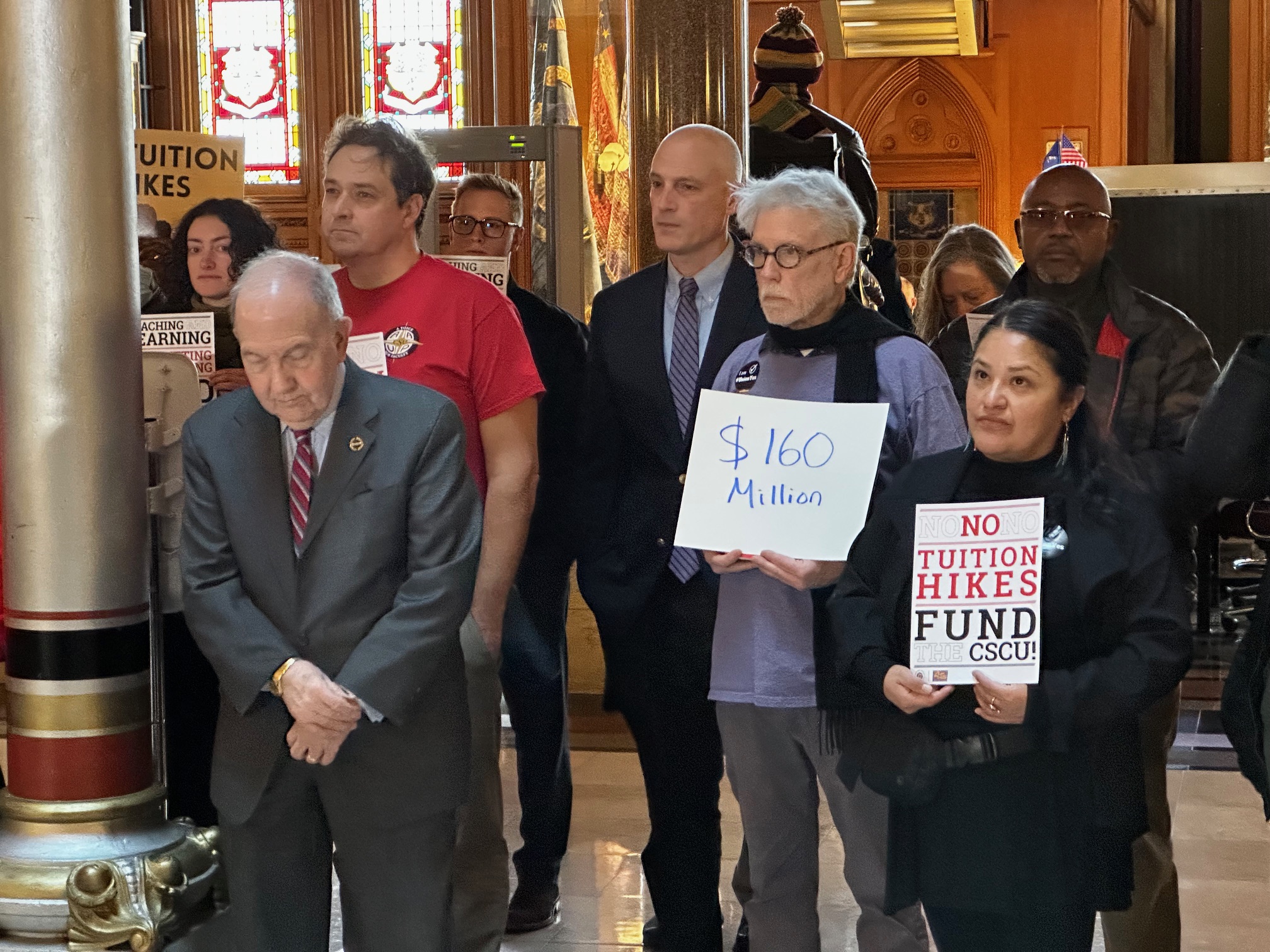
Students and faculty from state colleges chose a spot within earshot of Gov. Ned Lamont’s office to mock his commitment to the spending caps he sees as crucial to Connecticut’s newfound fiscal stability.
“It seems that the worship of abstractions, of spending caps and guardrails, is more important than our students,” said Louise Williams, president of the faculty union at Central Connecticut State University. “Real human beings with hopes and dreams have become an afterthought.”
They are demanding the addition of $160 million for the Connecticut State Colleges and Universities system to the second year of biennial budget negotiated by Lamont and overwhelmingly adopted by the General Assembly last year.
Joining them were Democratic lawmakers who not only voted for a budget they now deem in need of revisions but unanimously agreed to the governor’s insistence on extending spending caps enforced by pledges to bond holders for another five years.
At press conferences on Monday and Tuesday, as lawmakers prepared for the opening of the 2024 session on Wednesday, Democrats tread a careful path between the advocates who demand higher spending and the governor who blocks them.
Senate President Pro Tem Martin M. Looney, D-New Haven, and Sen. Derek Slap, D-West Hartford, stood Monday with the students and faculty demanding more money for higher education while taking care to defend the spending caps as valuable reforms to be adjusted, not abandoned.
“We need to find some ways to be flexible while honoring the spirit of the cap,” Looney said.
Lawmakers are mindful that Lamont was reelected easily in 2022 on a message of fiscal discipline and that his approval rating topped 60% last year after passage of the budget that largely reflected his desires. Those who see the need for higher spending say they are trying to engage the governor, not fight him.
“It’s not personal. Sometimes politics can get personal. But for me, I like the governor, and I think on balance, he’s doing a terrific job.” said Slap, the co-chair of the committee that oversees higher education. “I’m advocating for a way that I think we can strengthen the state. I think it’s trying to find that right balance.”
“You have a lot of people that are worried about it being an election year. You have a lot of people that are worried about upsetting the governor,” said Rep. Eleni Kavros DeGraw, D-Canton. She is a member of a bipartisan coalition calling for $20 million in additional spending to address a spike in homelessness.
Lamont said three statutory spending caps, especially one that requires surpluses generated by increased revenue from volatile sources to be used for budget reserves or pay down unfunded pension obligations, have helped the state’s finances and its reputation as a place to do business.
The surplus billions used to reduce pension debt have reduced the annual required contributions for pensions by $650 million, freeing up revenue for other needs. Taken together, the spending caps form guardrails that kept Connecticut on a relatively sustainable fiscal path and mitigated the habit of boosting spending in good times and cutting it in bad times, Lamont said.
“Compare that to the herky-jerky budgeting before we had those guardrails,” Lamont said. “I like to stick with what’s working.”
That includes opposing demands by progressives in his own party for higher taxes on the wealthy, an element of the “equity agenda” articulated Tuesday by the Connecticut for All coalition of labor, faith, immigration and civic organizations.
Lamont says a tax cut that took effect this year and is geared to lower- and middle-income earners, coupled with an increase in the earned income tax credit, has made the state tax code more progressive.
The governor will frame his view of Connecticut and its fiscal health in a “State of the State” address to a joint session of the General Assembly at midday Wednesday. Connecticut for All was ready with a rebuttal before its delivery.
Connecticut for All says that the state still struggles with one of the largest wealth inequalities in the U.S., and Connecticut’s wealthier can well afford to lower the burden on the poorer.
“We in this coalition have known for far too long that there are two Connecticuts, and that’s why we’re here today to present our ‘State of the People’ from our perspective, sharing our lived experiences to remind Gov. Lamont and our elected officials that the status quo of two Connecticuts is no longer acceptable,” said Leslie Blatteau, president of the New Haven Federation of Teachers.
Sen. Gary Winfield, D-New Haven, told the group he was frustrated by suggestions that the guardrails leave lawmakers without options, but he said later it would be a mistake to see the coalition agenda solely as a fight with Lamont.
There is a broader debate underway about equity that will reach beyond this session and the coming legislative elections, and there is hardly a consensus among members of the Democratic majorities that control the House and Senate.
“I think it’s less a fight with the governor than a fight with ourselves,” Winfield said.
Absent from the press conferences aimed at Lamont’s fiscal policies was House Speaker Matt Ritter, D-Hartford, who said he is focused on talks about specific changes that are yet to come — talks likely to stretch into March and April, when the budget revisions are likely to be settled.
Ritter said he believes there is a consensus to address the budget shortfalls facing the University of Connecticut and the separate Connecticut State Colleges and Universities system, which includes the community colleges and four regional state universities.
He also sees a potential consensus from the political left and right for increased funding for child care, which can provide economic opportunities for single parents and help employers desperate for labor. One possibility would be a trust fund for child care that would be outside the spending cap.
“There are some things that can provide flexibility that I do not believe undermine the intent of the fiscal guardrails or paying down our pensions, but it requires being a little creative and meeting in the middle,” Ritter said. “And so far, people have kind of gone to their corners, and I hope that people will be a little more agreeable come April.”
