


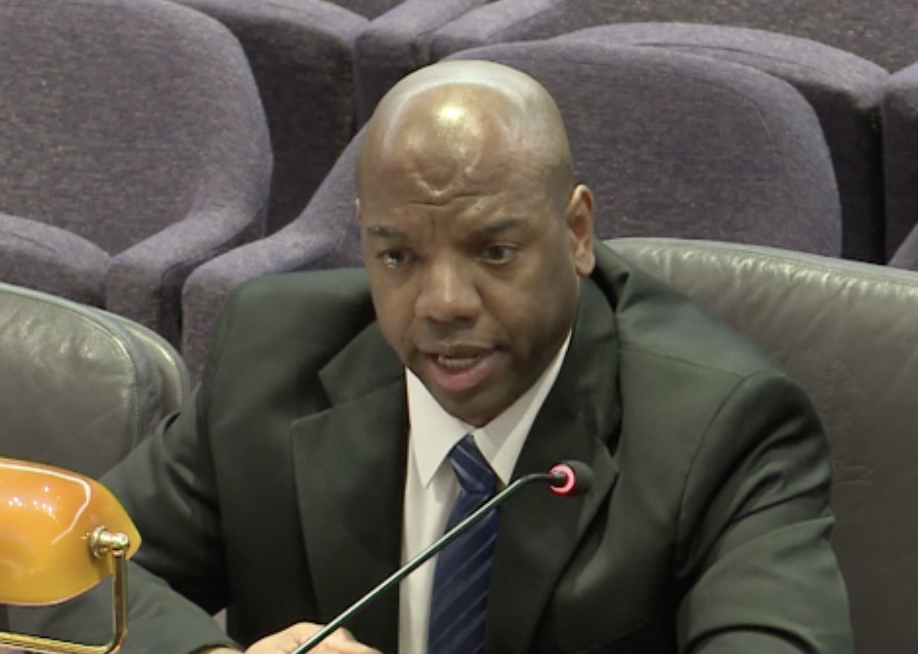
The judicial nomination of Assistant State’s Attorney Devant J. Joiner was derailed Monday, largely over claims that the 54-year-old Black state prosecutor was overly aggressive in dealing with defendants, including minorities with difficult backgrounds similar to his.
The legislature’s Judiciary Committee voted 27-10 to recommend against his confirmation as a judge of the Superior Court, raising a hurdle rarely, if ever, cleared by nominees to the bench in Connecticut. Reached by email, Joiner declined comment.
It was a rapid reversal for Joiner, who charmed some lawmakers at his confirmation hearing Friday with a self-deprecating sense of humor and an unflinching account of a difficult childhood in New Haven and periods of homelessness after high school.
“By way of background, I am the son of a teenage single mother, who grew up in New Haven’s public housing,” Joiner said. “I never met my father, who, I was told, died in prison. My mother unfortunately became addicted to drugs during my middle school and high school years.”
It was a biography embraced by the administration of Gov. Ned Lamont, who has sought diversity in gender, race and, more recently, professional background in making nominations to the state’s courts. Joiner was one of 22 nominations the governor made 10 days ago to a trial court with 35 vacancies.
No one testified against his nomination at the confirmation hearing, when the only sign of trouble was questioning by Rep. Craig Fishbein, R-Wallingford, the ranking House Republican on Judiciary, about a case dropped by the state’s attorney after the defense accused Joiner of “prosecutorial vindictiveness.”
Fishbein told Joiner, who initially said he could not recall any recent accusation of vindictiveness, that the case involved two defendants: one who accepted a plea deal and another who suddenly was faced with harsher charges after stating an intention to go to trial.
“One cops a plea down to an infraction, he pays a fine. The other one who is opting for a jury trial has more significant charges brought against him,” Fishbein said. “A motion is filed claiming that you are not being proper, and your supervisor sits down with you. And the results of that second case, instead of dealing with the motion to dismiss, the case gets nolled, right?”
“I’m trying to remember if it was,” Joiner replied. “Yes. Yes. I believe it was nolled.”
“Nolle prosequi” is a legal term meaning the state declined to prosecute the case.
Joiner said there were other differences in the two defendants other than one accepting a plea deal and another demanding a trial.
On Monday, it was evident that members of the committee were relying on communications from others who did not submit testimony.
Rep. Robyn Porter, D-New Haven, told the committee she had received complaints from clergy and others about Joiner and that she had personally observed him in courts in New Haven, where he spent the majority of his 18 years as a prosecutor. She did challenge him about those complaints at the hearing.
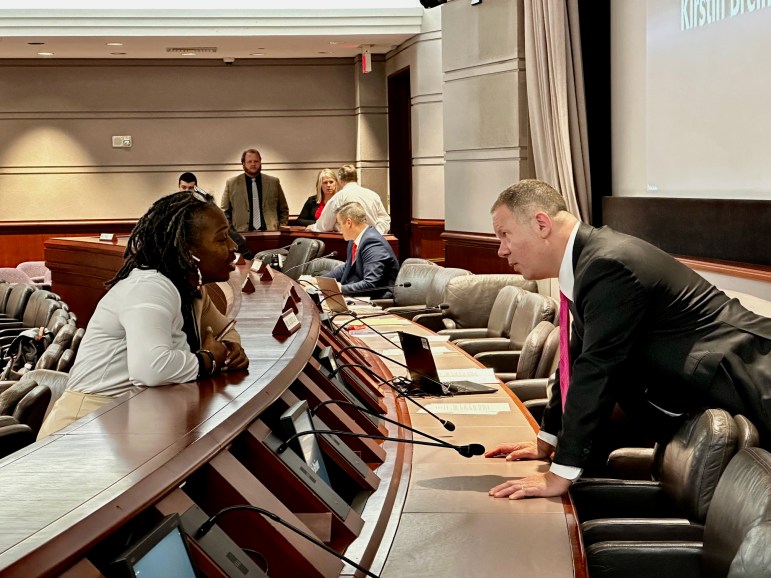
Those complaints should be heeded, said Porter, a member of the Black and Puerto Rican Caucus.
“If you have the Black community telling you that they have an issue, and that they are receiving tremendous pushback from their community around this nominee, and we don’t take pause on that, we bring it forth anyway, what is that saying to us?” Porter said. “Do our voices fall on deaf ears? How we feel, what we perceive, how we’re treated? Does it matter?”
In an interview after the vote, Porter said Joiner seemed especially harsh to people who might have come from the same places in New Haven where Joiner was raised.
“There’s some people, you know, they go up and forget where they came from. They forget their trials and tribulations and they look down. They think they’re better,” Porter said.
Sen. Gary Winfield, D-New Haven, co-chair of the committee, said the Lamont administration was informed over the weekend that Joiner might have trouble winning a favorable report, but he understood why the administration did not pull the nomination, given the absence of a record other than the case raised by Fishbein.
“This was a difficult one,” Winfield said after the vote.
Over the weekend, Winfield said, he heard from members of the community, as well as from judges and prosecutors, who raised questions about Joiner’s judicial temperament. Again, he acknowledged the awkwardness in fielding such concerns in a way that left Joiner unable to respond.
“You can’t just ignore it because it’s not in the record,” Winfield said.
Winfield voted against confirmation.
Sen. Patricia Billie Miller, D-Stamford, the leader of the Black and Puerto Rican Caucus, voted for Joiner, saying no one had directly raised a complaint to her. Also voting for confirmation was the committee’s co-chair, Rep. Steven Stafstrom, D-Bridgeport, and its ranking Senate Republican, Sen. John Kissel of Enfield.
Joiner testified Friday he attended St. John’s University on an athletic scholarship but struggled with homelessness. He worked in New York in various jobs after graduating from St. John’s then enlisted in the Marines. He enrolled in the Quinnipiac University School of Law after his honorable discharge.
He mused about the challenges of overcoming the distant past, not what would be the source of his troubles at the General Assembly — his time as a state prosecutor, first in New Haven and more recently in New Britain.
“The trials of my upbringing led me to question who and what I could become,” Joiner said. “Those experiences gave me a firm recognition that actions do have consequences. And, moreover, those consequences can follow you far into the future.”
