



Enjoying the heatwave this summer? The electric utilities sure are.
And just wait ‘til you get your next bill. They’ve been warning us for months now that we’ll be in for a shocker as the average bill will jump about a $13 per month .

That’s on top of what are already the second highest electric rates in the U.S., exceeded only by those in Hawaii. In Connecticut we pay twice as much money for electricity as customers in some other states.
But you get what you pay for and, so far this summer, our electric supply and reliability hasn’t been an issue as in other states. Aside from storm damage, there have been no interruptions, no brown-outs or requests to reduce consumption.
But increasingly we are relying on electricity for more than just AC but also, more and more, for our transportation.
As Metro-North and Amtrak add more service, that means more electric trains… and demands on Eversource. But again, so far so good this summer. Even on the hottest days the railroad has not had to reduce its consumption by running trains slower.
Credit must also go to Connecticut Department of Transportation which spent $912 million between 1993 and 2021 fixing the railroads’ catenary system delivering that electricity. That’s why our trains keep running while those in New Jersey don’t.
Consider also CDOT’s recent purchase of 46 new electric buses which will run on the CTfastrak busway between New Britain and Hartford. Bought under an $86 million federal grant, the new buses will be cleaner and quieter, running 250 miles per day on a single charge. CDOT plans to electrify all 700 of its buses by 2035.
And we’re not even talking about the nation’s future of electric-power airplanes or mandatory use of “shore power” for cargo ships when docked, all in the name of clean air and global warming.
How about other electric vehicles… e-school buses, light duty trucks (think Amazon local delivery) and, of course, electric cars? Is “the grid” ready for that increased demand?
Electric passenger car sales have slowed in recent months as consumers seem reluctant to “go electric” until we have more charging stations. But those EVs are still selling: in Q2 EV sales were up 11% year over year.
And that keeps Victoria Rojo mighty busy planning for the future.
She’s the lead data scientist at ISO-New England, the independent, non-profit organization that runs our region’s grid. They’re responsible for coordinating New England’s 32,000 megawatt power capacity, working with 400 different generators serving over 14 million customers. It’s a second-by-second balancing act.
A physicist by training, she projects that we will see a 23% increase in electric demand in just the next decade (not including electric trains). Nor does that projection include the effects of global warming on increased AC usage. “That’s a difficult one to adjust for,” she tells me.
Visit the ISO-NE.com website and you’ll see a breakdown of electricity demand and how it’s being met. There’s also a daily projection of demand, hour by hour, which proves amazingly accurate.
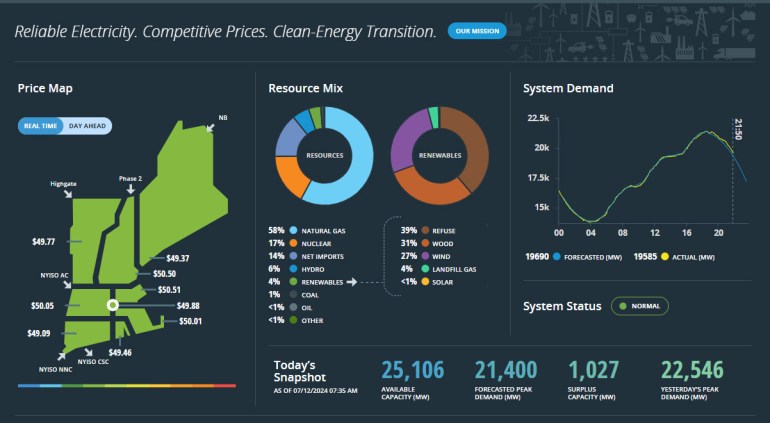
With the closing of the region’s last few coal-fired plants, New England is still heavily reliant on natural gas and nuclear power for almost two-thirds of its power. Renewables like solar and wind now answer less than 5% of our needs.
Obviously, we will need more power plants and a better transmission system (electricity suffers “line loss” the farther you send it) to meet these growing demands. So Rojo’s planning is just the first step.
In the meantime, crank up the AC.