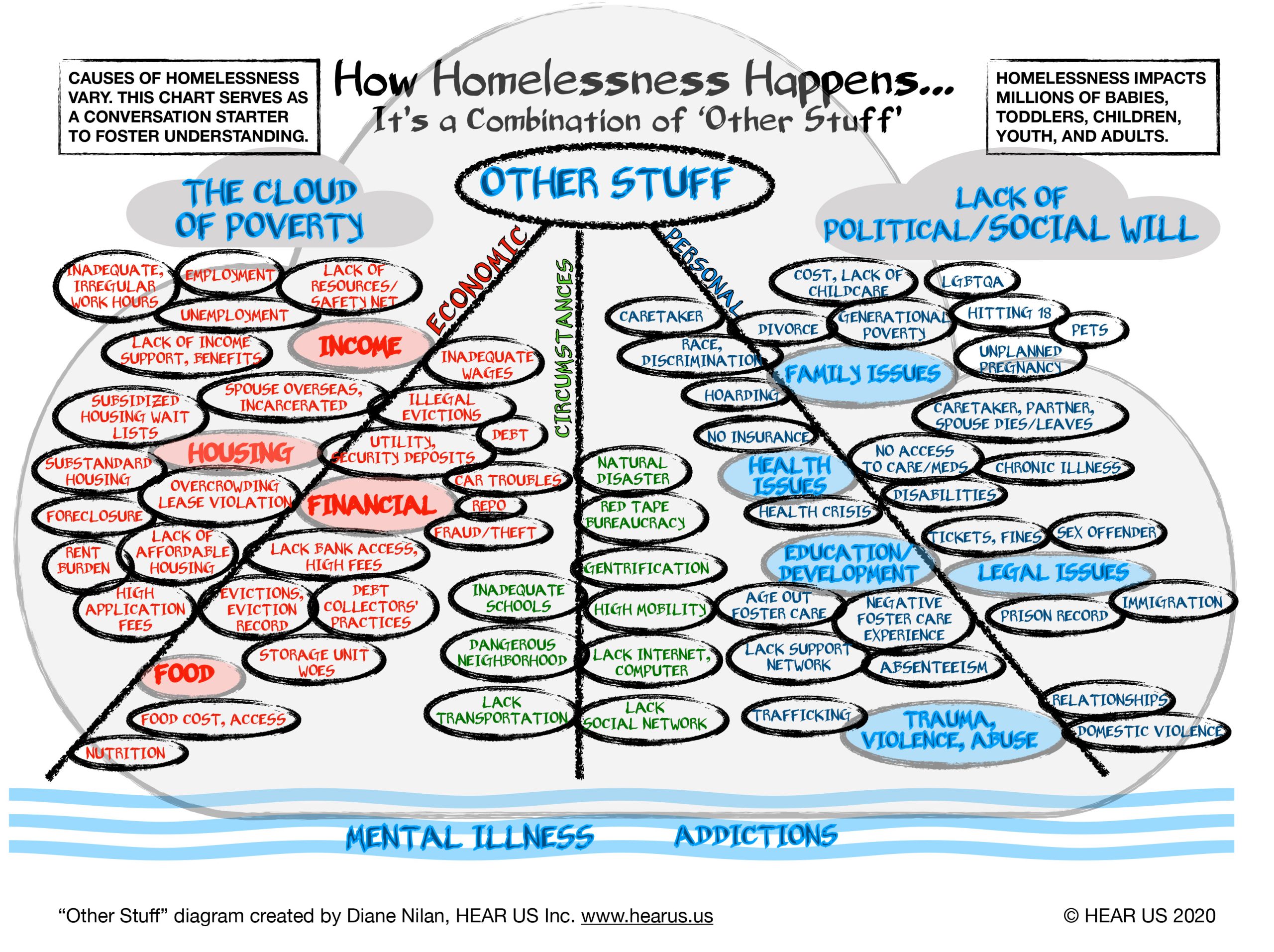
Dr. Chip Beckett is spot-on as he chastises New Haven for their absurd and ill-advised code enforcement that will further penalize occupants of the tiny homes. Beckett makes good points as he highlights the hypocrisy in policies that will perpetuate and grow homelessness in my home state.
But in doing so, he makes a common error and misses two crucial points.
Common oversights
”Homelessness is not a laziness issue, nor is it very often a choice. Homelessness is caused by mental health issues, by long-term unemployment, substance abuse and sometimes simple bad luck or misfortune.” (Dr. Beckett)
His op-ed piece reflects a syndrome affecting many people and government officials — the lack of understanding about how homelessness happens. We’ve been sold a bill of goods that homelessness is caused by mental illness, addictions, or choice which enables us to casually dismisses those without homes as flawed. That leaves the system off the hook.
The fact remains that the root causes of our nation’s homelessness surge can be directly connected to decades of disinvestment in housing, family support, health care, education and other essentials.
By default, this addiction/mental health fallacy totally misses the one primary segment of homelessness — families.
“The solution is not rooted in exclusion or eliminating options, as is the case with the tiny houses in New Haven, but instead by providing safe places and ladders to success for homeless individuals and families.” (Beckett)
Beckett at least includes families, but he doesn’t mention trauma, which has a major impact on kids and adults. And he bypasses how the homelessness “system” gives short shrift to mostly moms with kids who invisibly struggle to survive. He’s not the only one.
The Connecticut Department of Education oversees the compliance of all school districts when it comes to educating students experiencing homelessness. School is where most homeless students are identified. Or not. Connecticut schools have identified 5,000 or so homeless students, pre K-12. Toss in another 1,000+ babies and toddlers, with and without diapers. That may sound like a lot.
The federal McKinney-Vento Education for Homeless Children and Youth Act clearly states requirements for all public schools when it comes to meeting the needs of homeless students. But this map shows CT districts identifying “0” homeless students. I’ll bet my lunch money that they are mistaken. Sadly, districts are still not identifying the student homelessness in their midst, as the map below shows.
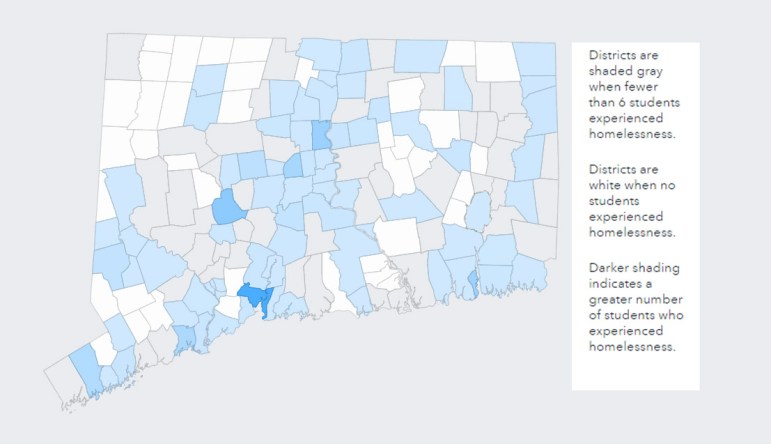
Researchers find that the bulk of districts under-identify or totally miss their community’s homeless student population. Here are national, state, all the way down to congressional and school district overviews of child homelessness (not including parents/guardians). Remember, these are undercounts.
What is being done for families?
Tiny houses? Many communities don’t even have emergency shelters. And shoving families into tiny house communes filled with adults would not be advisable. But decision makers tend to not know much about family homelessness, much less the common and debilitating trauma that impacts most families, youth, and single adults.
Help is on the way!
In my 40 years working with families in homeless situations, including the last 20 years living in a van traveling across the U.S. chronicling this issue for my nonprofit, HEAR US Inc., I’ve learned a lot by listening. My first film, My Own Four Walls, captured the poignant observations of kids, including some from Connecticut, as they described homelessness and what school meant to them. Their timeless descriptions deserve to be heard today.
My cross-country travels led me to interviewing hundreds of parents and kids in a variety of homeless situations, which led me to meet three Melissas. I kept in contact with these three moms, and realized that they could offer the rest of us, especially homeless families and those who work with them, an unprecedented amount of wisdom about surviving homelessness. So I asked them if they wanted to be a big part of a book project, and they agreed.
Next month, a much-heralded guide for homeless families will hit the bookshelves. From the affirming reviews I’ve read, my efforts and that of my co-author, Diana Bowman, are validated. “The Three Melissas — The Practical Guide to Surviving Family Homelessness” focuses on the oft-invisible families. While Diana and I add our two cents worth, the bulk of wisdom comes from the Three Melissas.
They don’t sugar-coat their experiences. And the Melissas flip the common adult-blaming categorization of homelessness to pointing out that the (mostly) single (mostly) moms have been gallantly straining to hold their families together despite our societal dismissal of their constraint of poverty and housing instability.
What continues to baffle me is how we continue to “feed” homelessness by ignoring the impact it has on babies, toddlers, and their families. Homelessness as kids can often lead to them experiencing homelessness as adults. That’s counterproductive and avoidable. How about Connecticut, the state of my birth, leading the way towards a true solution?
Diane Nilan is President of HEAR US Inc.