



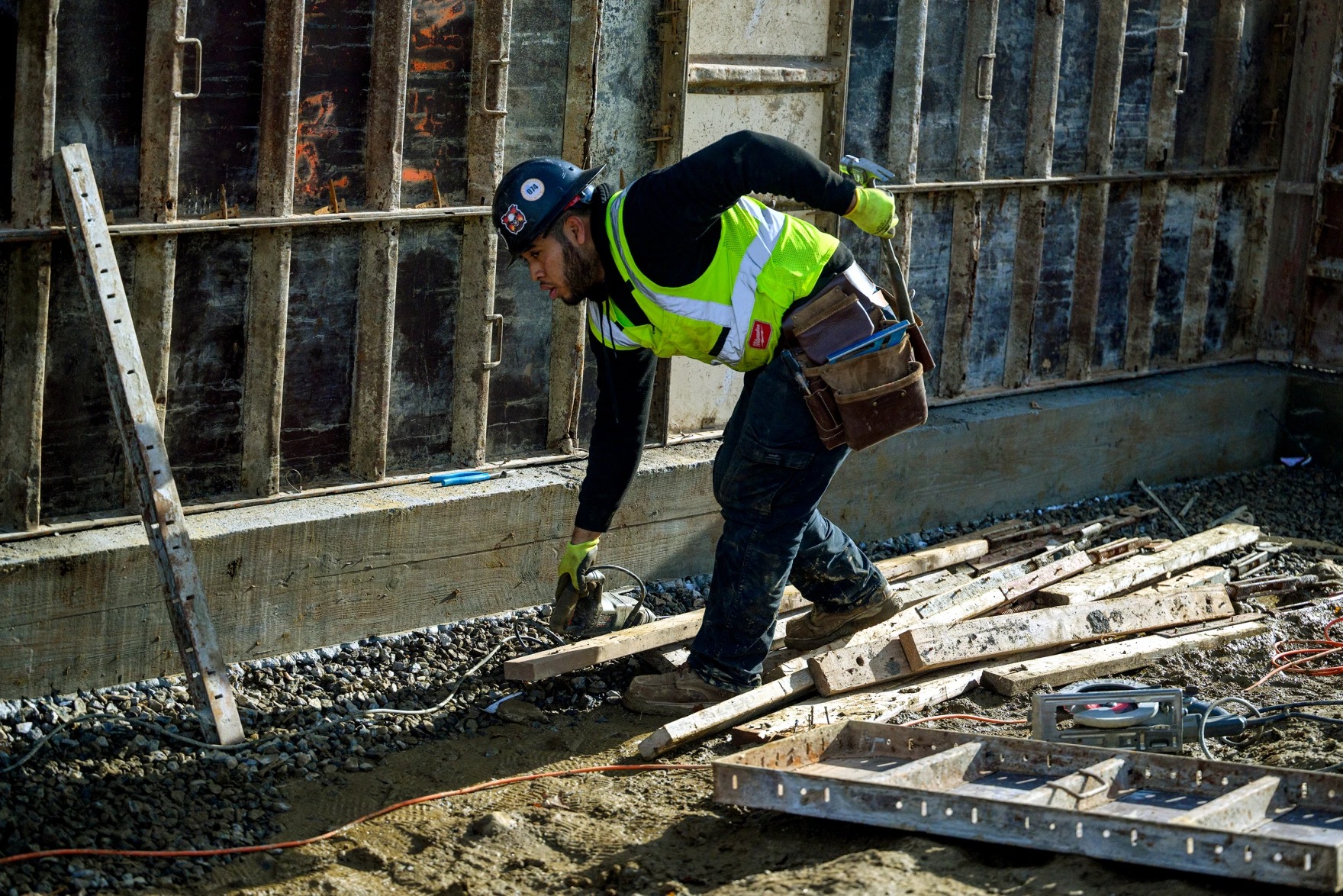
Connecticut’s pushing for more housing, energy efficiency, and heat pumps across the state. To make this happen, it first needs to address the residential construction workforce shortage.
Since the beginning of the pandemic, housing has been a marquee issue in federal, state, and municipal politics across the country. Debate continues to loom large on issues of zoning reform, affordability, and accessibility of housing. However, there is a consensus that Connecticut, like most states, is facing a monumental housing shortage that threatens to tear at our social fabric and compromise the stability of our state’s economy.
Bold policies regarding zoning reform, reform of approval processes and industry financing have all been considered with varying degrees of success. What has been missing to date from the public discourse is a dialogue on how our skilled workforce shortage is contributing to the rising costs of housing and constraining housing production.
Few if any other industries have a direct impact on both the health of our economy and the wellbeing of our residents than the residential construction industry. The construction of new homes and the remodeling of our aging housing stock uplifts and brings stability to Connecticut residents while pumping hundreds of millions of dollars in new and reoccurring revenue to state and local coffers in the form of property tax, income tax, sales taxes and permitting fees.
Despite this fact, policymakers have yet to acknowledge nor coalesce around the need for a moon-shot effort to rebuild the residential construction workforce in order to increase production to the level needed to meet Connecticut’s housing needs. Contrast this with recent successes of powerful special interest groups in the fields of defense manufacturing, bio-medical, health care and education industries whose influence has yielded significant state workforce development programs and resources in their respective industries.
Connecticut has one of the oldest skilled labor workforces in the country. During the great recession, there were many individuals in our industry who left Connecticut to go south or west to states that recovered more swiftly, some shifted to commercial construction, still others abandoned their careers in construction altogether. Our ranks have never truly recovered.
While the need for residential construction has, arguably, never been more acutely felt, Connecticut continues to lag most of the country in new housing production. And yet policymakers continue to ask more of our shrinking industry.
Case in point: The state urges the acceleration of heat pump installations.
Gov. Ned Lamont recently announced that Connecticut is the recipient of a federal grant to accelerate adoption of heat pumps for residential buildings. Portions of the grant will be dedicated to promoting heat pump skill sets in the heating, ventilation, and air conditioning, plumbing and electrical workforce.
While admirable and necessary, promoting heat pump skillsets to the existing workforce is wholly insufficient. We must expand our workforce exponentially to meet existing and future demand for new construction and energy retrofits to combat the environmental impacts of an aging and inefficient housing stock.
Where do we begin?
Change the narrative. Albeit vital to our state, rebuilding the residential construction workforce will not be easy. There are significant challenges to overcome. Stigmas and stereotypes must change.
This is not your father’s housing industry. The housing industry of today is dynamic and innovative where young practitioners of a trade are exposed to evolving technologies and building practices to construct ever more efficient, resilient, and healthy homes of the future. Parents, teachers, guidance counselors and students should demand the dedication of educational resources to foster and nurture students who show a proclivity to work in the field of construction.
Not only can a career in the trades be mentally stimulating, it can be financially rewarding. The licensed trades boast a high percentage of small business owners and self-made millionaires. Don’t take my word for it. Read the Daniel de Vise article in USA Today titled, “Meet the millionaires next door. These Americans made millions out of nothing.”
There is a reason The Wall Street Journal has dubbed Generation Z as the “Toolbelt Generation.” As pay and opportunity in the trades continue to grow, the proposition of being college-debt free and closer to economic independence is extremely attractive. But more needs to be done to introduce students to the possibility of careers in the trades.
Fund pre-apprenticeship programs in our public high schools. The death of the shop class and the hyper-focus on the college track as the only means for success for students have left an indelible mark on our industry. It’s a mark that can only be erased through a seismic shift in thought.
It begins by reintroducing the trades back into our public schools via innovative pre-apprenticeship programs, like the Home Builders Institute (HBI) Core PACT curriculum authorized by the CT Department of Labor in 2021. The program was first utilized, with huge success, by Stonington High School in 2022. Other school districts are taking notice. Suffield started their program this year and Thompson and Shelton school districts will start their programs this fall.
But these programs are not inexpensive. They require repurposing space in schools, training CTE professionals, and purchasing materials, tools, and software licenses. Startup and ongoing costs associated with these programs can be cost prohibitive for many schools. The bottom line is the state needs to step up and support these pre-apprenticeship programs in schools and make this crucial investment in our future residential construction workforce. It can’t just be lip service.
In 2022 the General Assembly, in its wisdom, recognized this hole in our education system and passed legislation directing the State Department of Education to create a Pre-Apprenticeship School Grant Program that would have granted schools $1,000 for each student who earned a certificate through an approved pre-apprenticeship program. It was modeled on a wildly successful Colorado program that has seen over 44,000 students obtain in-demand credentials since its inception in 2016.
Sadly, the grant program was never funded within the budget. It is imperative for the legislature to provide financial support for these programs if Connecticut is to have a fighting chance at rebuilding its residential construction workforce.
Make it easier for kids to pursue careers in the licensed trades via our public schools.
Connecticut’s vocational and technical high schools are the envy of the entire country. However, the number of job-ready students produced by our vo-tech high schools is just a minute fraction of what is needed to right-size the housing industry.
Private, post-high school programs like Lincoln Tech or Porter and Chester can be good options for some. However, the number one complaint heard from young adults contemplating a career in the trades but weren’t fortunate enough to land in a vo-tech high school is that working full-time to support themselves while also going to school at night to get a trade education is itself a strong disincentive. If we, as a state, truly agree that growing the trades is a priority, then we must expand opportunities more broadly in our public schools and expose more kids to the trades sooner.
The status quo is no longer working and is a disservice to our youth who are yearning for alternative pathways to success. We must expand programs like the HBI Pre-Apprenticeship program offered at Stonington High School and elsewhere. The governor and legislative leaders would be wise to work with industry leaders and educators to create and fund a pilot program with a school like Stonington with an existing program that modifies the school’s traditional curriculum and its pre-apprentice program to satisfy a licensed trade’s apprenticeship educational hours.
For example, the state of Connecticut requires 720 hours of classroom instruction for an HVAC apprentice. It would be a game changer if those educational requirements could be satisfied in a traditional public high school setting.
Creating pilot programs like this would add value to the high school experience for so many of our disaffected youths. According to a recent study by the Dalio Foundation, 119,000 kids and young adults are disconnected or at risk of being disconnected from school or employment. There is no doubt that greater access to the trades through innovative solutions such as a pilot to expand trades education in our public schools would help to bring this vulnerable population new and exciting opportunities.
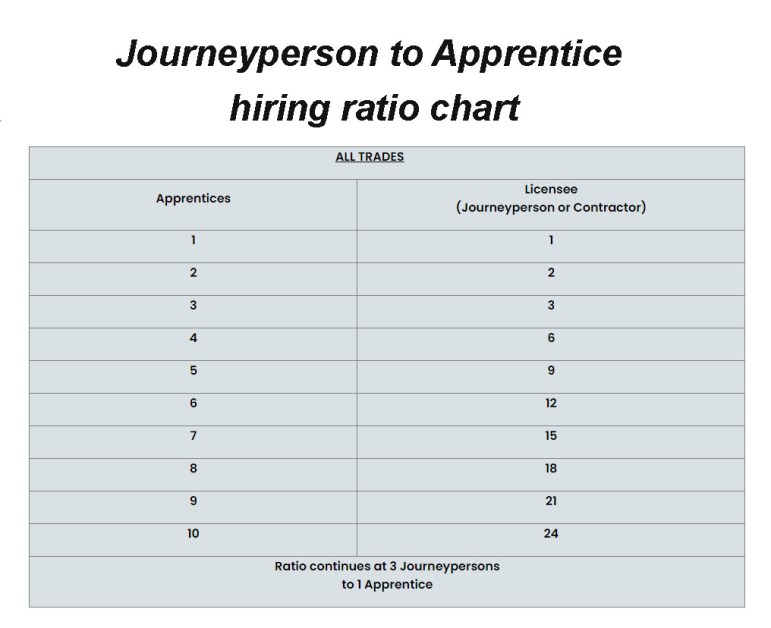
Make it easier for companies in the licensed trades to hire new apprentices. Finally, there are additional challenges beyond education that must be addressed if meaningful change is to occur. Chief among them are the Connecticut laws governing journeyman-to-apprenticeship ratio requirements. State law requires one journeyman to be on an active worksite for every apprentice present. This law is appropriate and justifiable to ensure safety and work quality.
However, there is an additional law, CGS 20-332b, which is neither justifiable nor pragmatic. This law requires that any company increase the number of journeymen it employs after hiring three apprentices at a rate of two to one until it employs 24 journeymen for 10 apprentices, at which time the ratio increases to three journeymen for each apprentice hired. In stark contrast, the state of Rhode Island only requires a one journeyman to one apprentice hiring ratio. Connecticut law arbitrarily restricts small to mid-sized companies — a majority of our industry — from expanding, thereby limiting access to would-be-apprentices. This law must be repealed if we are sincere about expanding opportunities for disaffected kids and growing the residential construction workforce.
Absent this change, Connecticut’s current ratio requirements will continue to stifle efforts to reinvigorate the state’s moribund housing industry and to achieve real, meaningful reductions in greenhouse gases through the deployment of energy efficiency measures such as heat pumps.
Our industry remains ever hopeful and committed to working with the state to grow the residential workforce because we believe, beyond a shadow of a doubt, that it is the surest path to helping the state finds its way out of the current housing crisis, to protecting the most vulnerable among us, and to improving our environment.
Jim Perras is CEO of the Home Builders and Remodelers Association of Connecticut.