


The administration of Gov. Ned Lamont is considering retaining outside counsel to investigate his staff’s misuse of two state cars: An SUV that a top aide acknowledges driving for personal use, and a sedan that an unknown staffer or staffers drove at speeds exceeding 100 mph.
Using state property for personal purposes can constitute a violation of the state ethics code if the value to the employee exceeds $100, and state agency heads are required to notify the Office of State Ethics if a state agency head has “reasonable cause to believe that a person has violated” the code.
At issue is the use of two motor pool cars assigned to the governor’s office: a 2020 Ford Escape that was driven by Jonathan Dach while he was the governor’s chief of staff, and a 2019 Ford Fusion used by members of Lamont’s communications office and possibly other staff.
The inquiry was prompted by a story posted on Nov. 24 by Inside Investigator, a news site affiliated with the conservative Yankee Institute. It detailed the use of the two cars, part of a state fleet that can be tracked by telemetry recording routes taken and speeds reached.
The matter initially was referred to the state Office of Labor Relations, which acts as a human resources office on potential disciplinary action, but the governor’s chief spokeswoman, Julia Bergman, said Wednesday that the office was leaning toward initiating an independent investigation by outside counsel.
Lamont has twice hired former U.S. attorneys to conduct independent investigations. Most recently, Deirdre M. Daly reviewed the extent to which the Connecticut State Police had properly reported racial profiling data.
The Department of Administrative Services, which oversees the state motor pool, has not made a referral to the Office of State Ethics, but one still is possible, said Leigh Appleby, a spokesman for the agency.
“Our practice is to rely on the professionals within statewide HR and the Office of Labor Relations to conduct impartial investigations and then to turn over any potential ethical violations to the Office of State Ethics as required by statute,” Appleby said. “This is done to prevent erroneous reports. We receive dozens of complaints each year regarding the purported misuse of state vehicles.”
On Nov. 25, Lamont defended a portion of the after-hours use of the car used by Dach, noting that his duties as his chief of staff extended beyond an eight-hour day or five-day work week. Dach lived in New Haven for much of his tenure as chief of staff, then in Hartford.
“But, that said, you got to be fastidious about this, and we got to lead by example,” Lamont said. “So the degree to which any of that car use can be perceived as for purely personal, not public, I think we’re going to have to make amends there.”
Dach has acknowledged the personal use of the state car, including driving it more than 200 miles round trip to Albany, N.Y., for a weekday ceremony honoring a judge for whom he had once clerked.
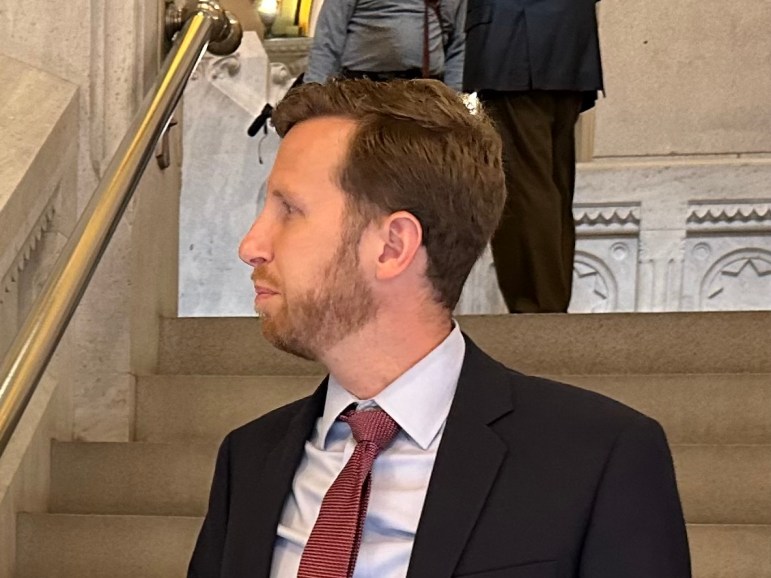
“The lion’s share of the trips, including those taken after hours and over weekends, were to staff the governor, meet with colleagues, visit state-funded projects, or return home from a late night or even early morning in the office,” Dach said. “Occasional drives, however, were for personal errands. Those were mistakes, I apologize for them, and I look forward to making amends for them.”
“The data gathered through telematics technology may be used as evidence in a disciplinary investigation involving a State employee,” DAS says in its policy on car use.
The policy notes that driving 85 miles per hour or above is considered reckless driving under state law.
“Employee reported through telematics data as having driven at this rate of speed (except briefly to avoid accident, road debris, etc.) will have driving privileges suspended immediately, and subject to investigation for possible discipline,” the policy states.
A review of the logs for the two vehicles show Dach did occasionally drive faster than 85, but not to the degree recorded in the Ford Fusion used by others. Over 242 trips, the Fusion was recorded 40 times at 90 miles per hour or faster and reached 102 mph twice and 113 mph once. The top speed recorded in the Escape was 95 miles per hour.
The governor’s office had no rigorous system for signing out the Fusion, so it was not readily clear who had been driving on those instances. Matt Brokman, the governor’s current chief of staff, said formal procedures for signing out the car have since been implemented.
Dach, who worked on Lamont’s 2018 campaign and transition, has been a member of the governor’s inner circle since his first day in office. Dach was his third chief of staff for 18 months before stepping back for a policy role in July. He now lives in Manhattan and works remotely most days.
Appleby of DAS said the speeds are recorded on logs, but there is nothing that automatically flags speeding to the agency’s fleet manager.
“Alerts are not sent for each instance; each agency has access to a comprehensive dashboard to monitor vehicle utilization, including speeding reports,” he said. “This information is readily available to DAS Fleet Administration and the respective agencies for review.”
There is no record of the governor’s office being notified of excess speeding by the cars assigned to the office, Appleby said.
“The information was available for review in the system dashboard; no formal notification was made,” he said.
Appleby said DAS is working with a vendor to improve how the telemetry is recorded and staff are alerted to evidence of reckless driving.
“Our next set of initiatives involves implementing regular, targeted requests for immediate action on vehicles flagged for speeding, seatbelt compliance, low utilization, unauthorized home garaging, and more,” Appleby said.
