



The rapid pace of remaking the Connecticut judiciary under Gov. Ned Lamont continued Monday with 15 judicial nominations, including William H. Bright Jr. to the Supreme Court and Robin L. Wilson to the Appellate Court.
Bright, 62, of Columbia, is the chief judge of the Appellate Court and would succeed Raheem Mullins as an associate justice. Wilson, 64, of New Haven, is a Superior Court judge and would succeed Bright as an Appellate Court judge.
The elevation to chief justice of Mullins, who breezed through a confirmation hearing last week, is expected to be confirmed by a vote of the General Assembly on Tuesday. He has been the interim chief justice since September.
The 13 nominees to the Superior Court, by far the largest portion of Connecticut’s three-level judiciary, include former Rep. Michael C. D’Agostino, D-Hamden, and former Senate Minority Leader Kevin C. Kelly, R-Stratford.
Lamont also nominated two family support magistrates and three administrative law judges on the Workers’ Compensation Commission, including former Rep. Christine Conley, D-Groton.
The eight men and five women nominated to the Superior Court range in age from 41 to 65 and have a diversity of professional backgrounds: public defender, prosecutor, commercial litigation, legal aid, child protection and elder law.
“We have a wide variety of different skills that represent our courts, and I think you’ll see that represented in our nominees,” Lamont said.
Lamont’s six years as governor have coincided with a wave of retirements that have allowed him to name more than half the judges on a bench that reached gender parity last year and has a racial makeup that generally matches Connecticut. Five of 13 trial court nominees are racial minorities.
“This is important, because all the research shows that diversity enhances public confidence in our courts,” Lt. Gov. Susan Bysiewicz said. “And it’s important that our communities have confidence in our bench, so when someone walks into the courtroom, we want them to see Connecticut.”
Until the election of Gov. Dannel P. Malloy in 2010, Connecticut had two decades of a politically divided government in which an independent governor, and then two Republicans, shared the selection of judges with legislative leaders.
As a result, there was little consideration of the overall makeup of the courts, and the classes of nominees sometimes were all white with few women. Malloy, and now Lamont, have had greater control over selections.
Governors must choose nominees from a pool of candidates cleared by the Judicial Selection Commission. Judges and justices are appointed to eight-year terms with the assumption of reappointment until the mandatory retirement age of 70.
The class of nominees could be the last in 2025. Only four Superior Court judges will reach 70 this year. There are 185 authorized positions on the trial court bench, with nine vacancies once the new class is confirmed.
Lamont said the trial court essentially will be at full strength with the current class, though he would consider filling other vacancies if requested by the Judicial Department.
In Bright and Wilson, Lamont chose jurists with long experience on the bench.
Bright has been a judge for 16 years, nominated to the Superior Court in 2008 by Gov. M. Jodi Rell and to the Appellate Court by Malloy in 2017. He is a graduate of Dickinson College and the University of Chicago Law School.
Lamont said he had consulted with Mullins about his successor as an associate justice on the Supreme Court.
“Without prompting, he said, ‘Bill Bright,’” Lamont said.
Wilson, who will not be formally nominated until Bright is confirmed and creates a vacancy on the Appellate Court, has been a Superior Court judge for 21 years. She currently is assigned to the complex litigation docket in Waterbury.
“My love is research and writing, and I know that I think have the opportunity to continue that and dig deeper into more legally complex, legal complex cases on the Appellate Court,” she said.
Wilson has a bachelor’s degree from Connecticut College, a J.D. from Northeastern University School of Law, and a master of laws degree in labor relations from New York University School of Law.
“I thought about it,” she said of a career on the bench. “It wasn’t something that I jumped into.”
She was an assistant attorney general with a specialty in workers’ compensation and child support from 1986 to 1994, then an administrative law judge on the Workers’ Compensation Commission from 1994 to 2003.
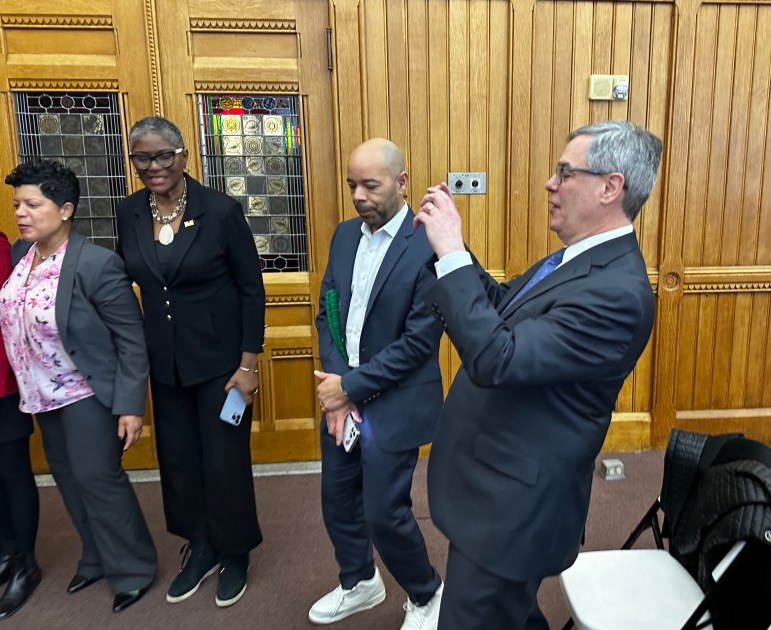
Nominated to the Superior Court:
- David G. Bothwell, 55, of Fairfield is a graduate of Villanova University and Quinnipiac University School of Law. He is legal counsel and legislative liaison to the Connecticut Board of Pardons and Paroles and a former defense attorney.
- Tracie C. Brown, 53, of Windsor is a graduate of Southern Connecticut State University and the University of Connecticut School of Law. She is the chief operating officer for the Connecticut Department of Motor Vehicles and former counsel at the Department of Correction Freedom of Information Commission.
- Michael C. D’Agostino, 53, of Hamden is a graduate of the University of Virginia and University of Virginia School of Law. He is a partner and commercial litigator at Morgan Lewis and Bockius and a former lawmaker.
- Jesse Giddings, 43, of North Haven is a graduate of the University of Maryland and Roger Williams University School of Law. He is a supervisory assistant state’s attorney in the Hartford State’s Attorney Office.
- Diana M. Gomez, 42, of Easton is a graduate of Central Connecticut State University and Quinnipiac University School of Law. She is an assistant public defender in the Ansonia-Milford Judicial District.
- Donald R. Green, 58, of Meriden is a graduate of Trinity College and the University of Connecticut School of Law. He is a family support magistrate and former assistant attorney general.
- Kaitlin A. Halloran, 41, of West Hartford is a graduate of New York University and the University of Connecticut School of Law. She is a partner at BBB Attorneys with a background in personal injury, wrongful death claims, medical malpractice and business litigation.
- Angeline Ioannou, 55, of West Hartford graduated from Sacred Heart University and Widener University School of Law. She is the managing partner of the Hartford office of Lewis Brisbois Bisgaard and Smith, with experience litigating complex tort and medical malpractice matters.
- Kevin C. Kelly, 65, of Stratford has bachelor’s degree from Assumption University, a master’s from Fairfield University and a J.D. from the University of Connecticut School of Law. His private practice is focused on elder law and municipal law. He formerly worked for the state Department of Social Services. He was a state senator.
- Daniel Shapiro, 58, of Westbrook graduated from Hamilton College and Vermont Law School, where he also obtained a master’s in environmental law. He is a deputy associate attorney general and chief of health and education for the state Office of the Attorney General.
- Kevin Shea, 58, of Madison graduated from the University of Connecticut and University of Connecticut School of Law. He is a partner with Clendenen and Shea, representing individuals, companies, institutions, and municipalities as both plaintiffs and defendants in a broad range of civil litigation. He was an in-house litigation attorney with United States Surgical Corporation in Norwalk.
- Latonia C. Williams, 41, of West Hartford graduated from Howard University and the University of Connecticut School of Law. She is a partner and commercial litigator at Shipman and Goodwin.
- Yonatan Zamir, 48, of Woodbridge graduated from the University of Illinois and Hofstra University School of Law. He is a staff attorney at New Haven Legal Assistance Association, where his focus is on housing law and eviction prevention. He also co-teaches the Reentry Clinic at Yale Law School.
The two family support magistrate nominees include:
- Benedict R. Daigle, 43, of Cromwell has a bachelor’s and M.P.A. from the University of Connecticut and a J.D. from the University of Connecticut School of Law. He is an currently assistant public defender.
- LeeAnn Neal, 39, of Waterbury graduated from the University of Massachusetts and Quinnipiac University School of Law. She is an assistant attorney general and former prosecutor.
The three workers’ compensation administrative law judge nominees include:
- Michael L. Anderson, 54, of North Stonington graduated from the University of New Hampshire, the University of Connecticut and Vermont Law School. He is a trial lawyer with Anderson Trial Lawyers in Norwich. He chairman of the Town of North Stonington Board of Finance.
- Christine Conley, 42, of Groton graduated from Bay Path University and Western New England University. She is an attorney with McGann, Bartlett and Brown. She is a former lawmaker.
- Colette Griffin, 66, of Newtown graduated from the University of Bridgeport and Quinnipiac School of Law. She is a partner with Strunk Dodge Aiken Zovas and has served as the chair of both the workers’ compensation and animal law sections of the Connecticut Bar Association.