

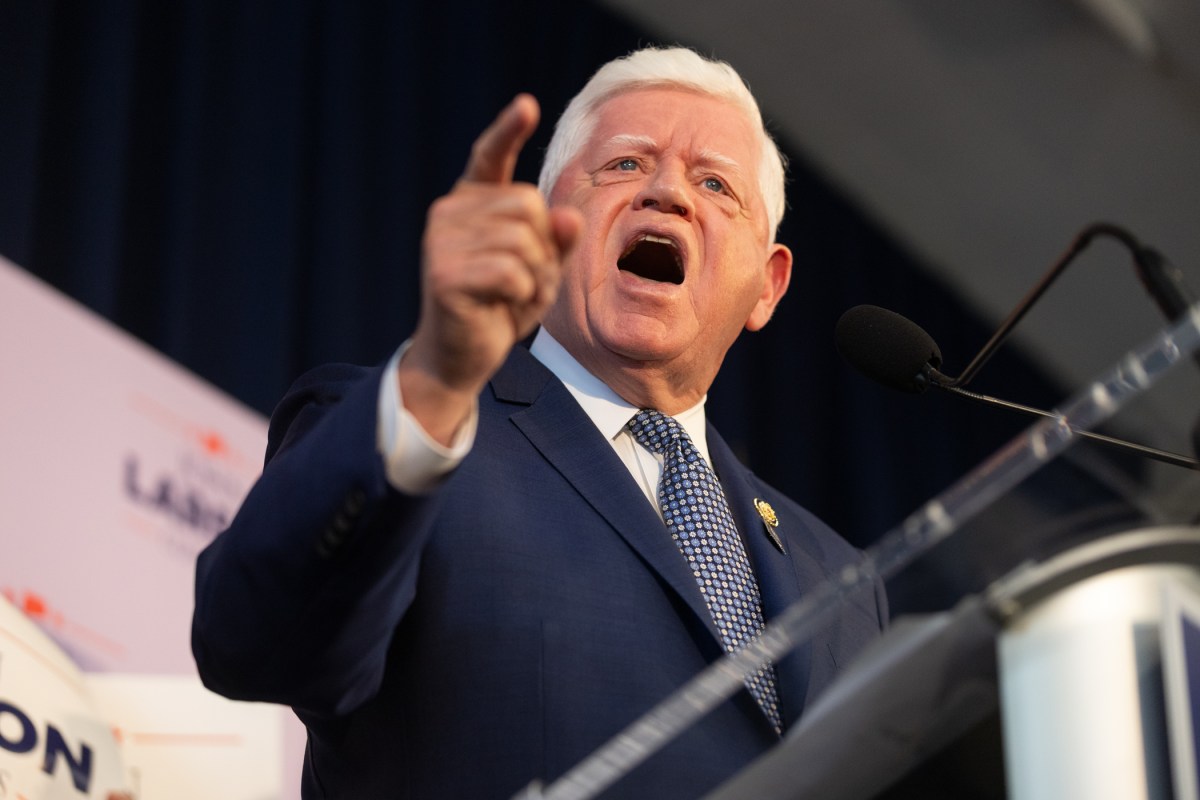


John B. Larson, a Baby Boomer elected to the U.S. House of Representatives during Bill Clinton’s final term, listened from the third row at a Democratic town committee meeting as one Gen Xer and two Millennials took turns broadly arguing for generational change in Congress.
And, more specifically, for forcibly retiring Larson.
No U.S. House member ever has faced a primary as an incumbent in Connecticut, and Larson harbors thin hope of not becoming the first. So, after 49 years in elective politics and nearly 28 in Congress, the 77-year-old Larson is back in the business of traipsing to far-flung Democratic town committees, seeking support.
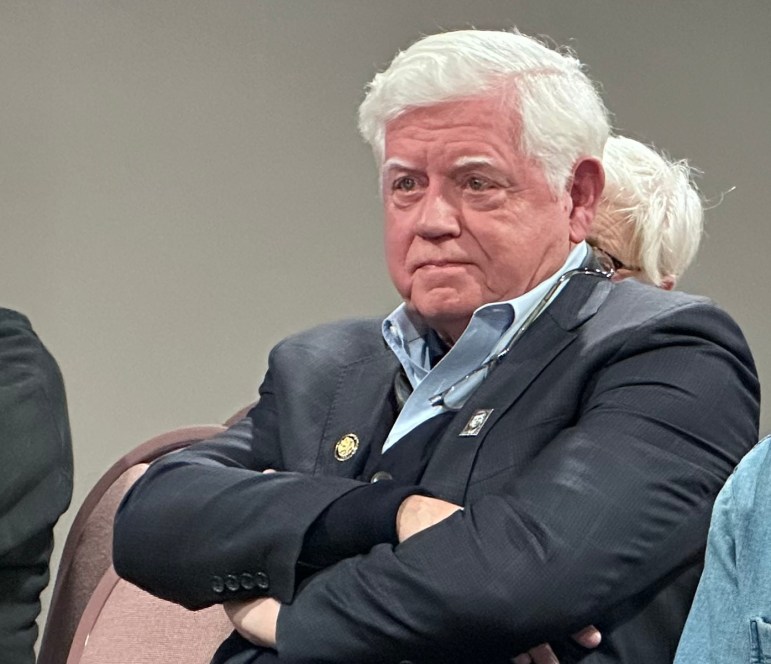
On this night in Winsted, a Litchfield County city of 7,000 on the western frontier of the Hartford-centered 1st Congressional District, Larson projected a calm resignation. His arms were crossed, face neutral. The shock and anger palpable in Larson last summer are gone, or at least squared away.
Equanimity was not so easy then. Pop, pop, pop, pop came news of one challenger, then another and another and another. It was a dizzying season for Larson, who would not announce his own candidacy until after Labor Day. He was being crowded, nudged towards an exit he was loath to take.
First came Ruth Fortune, 37, a Hartford school board member, opening a campaign on July 3. By month’s end, she was followed by Councilman Jack Perry, 35, of Southington and Luke Bronin, 46, the former Hartford mayor. State Rep. Jillian Gilchrest, 43, of West Hartford joined them in late August.
Perry ended his campaign in December. The others persist. The congressman wryly notes all three are younger than was Larson in 1998, when he won a four-way primary for the open seat with 45% of the vote. He was 50 then. He turns 78 in July.
In Winsted last month, Larson told Democrats he has experience and seniority his challengers lack, and they have something he does not: The time to wait that comes at the beginning or mid-point of a political career, not the end.
“These are all very talented people, but I’m going to be in a position where I’ll have both the experience and the time served in the position to deliver,” Larson said. Not quite plaintively, he added, “This seat for Congress is going to come open soon enough.”
But there is no promised end date. That’s Politics 101, Larson likes to say. He recalls advice from Chris Dodd, now gone 15 years from the Senate: Never make yourself a lame duck when you’re still running. In a quieter moment, pressed to explain how soon is soon enough, Larson says only, “Some things are intuitively obvious.”
Bronin was the only candidate to mention Larson by name in Winsted, just as he was the only one to privately urge Larson last summer to retire, an awkward prelude to announcing a challenge. They met over coffee on Larson’s turf, East Hartford. It’s where voters elected him to the school board in 1977, town council in 1979 and state Senate in 1982, the latter post won by unseating a Democratic incumbent in a primary.
The meeting did not go well. Larson first thought Bronin was joking. There was no laughter as they parted.
Now, more than half a year later, Larson sat in the modest theater of a quirky museum, Winsted favorite son Ralph Nader’s American Museum of Tort Law, as Bronin delivered a public version of the private message.
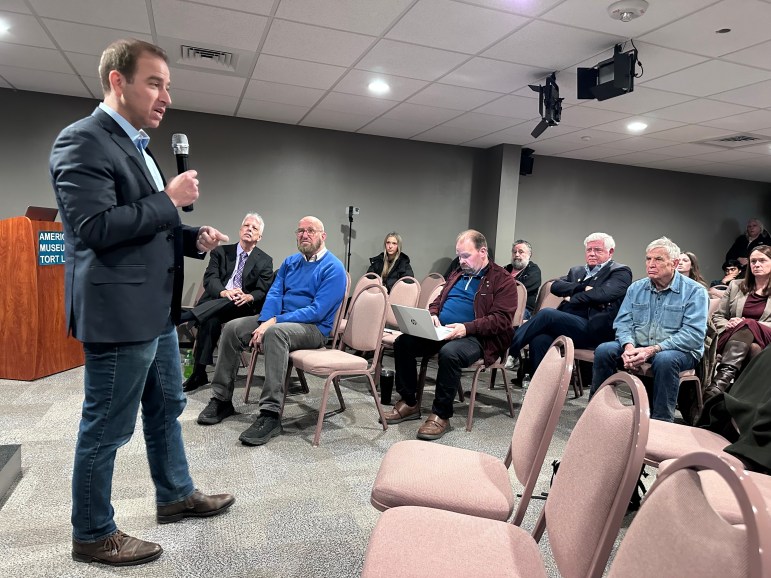
“In normal times, I would say John Larson is a good man — as he is,” Bronin said. “And I respect him. And I’ve been proud to work closely with him, and I’m grateful and admire the work that he’s done for so long on our behalf. But I don’t think these are normal times.”
It is Bronin’s stump speech, one geared to making a case against an incumbent whose voting record is not the rationale for unseating him.
“I think this is a moment when we have to get some new energy in our Democratic Party, and we have to rebuild, and we have to start laying out a vision that allows us to do more than just ride the backlash … that’s rising against Donald Trump,” Bronin said.
Like a dinner host coaxing guests to try unfamiliar fare, Bronin invited the town committee members to step away from Larson without guilt.
“I believe deeply that you do not have to be against anybody to be for something new,” Bronin said. “I’m not against Congressman Larson. I respect him. I’m grateful for the work we’ve done together and for his service, but I do think it’s time for something new.”
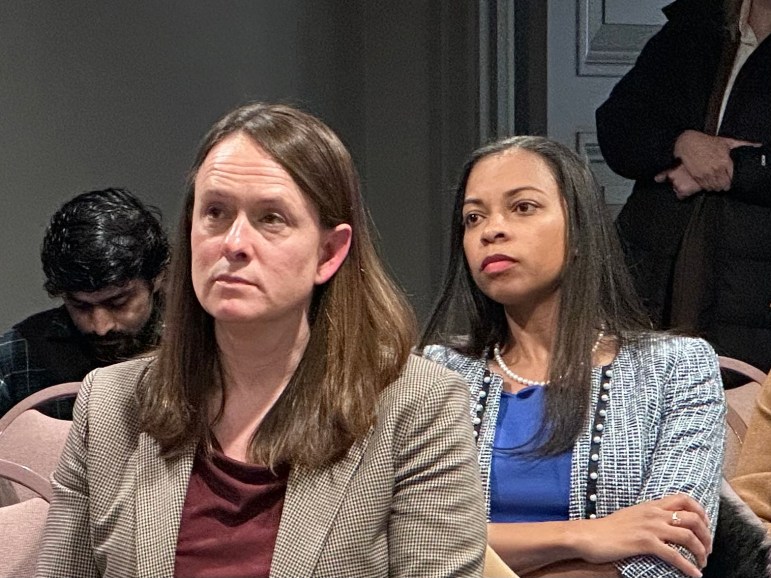
Fortune and Gilchrest spoke of the need for change more generally, not uttering Larson’s name. But, with variations, their central message landed in the same place: At home and abroad, the nation faces multiple crises under Trump, and the Democratic Party needs the new ideas that come with new voices.
Fortune referred to the pain and stress of living with uncertainty that comes from myriad sources, everything from economic instability to being an immigrant without legal status. Fortune, a naturalized citizen, came to the U.S. from Haiti at age 12 and was undocumented for nearly a decade. She’s now an estate lawyer, finding financial security in her 30s.
“I was the first to enter this race, because I saw the pain. I understood it, personally,” Fortune said, insisting the best advocates are people who live an issue and feel its ramifications, whether they be trans kids or undocumented immigrants. “The people who don’t give up, the people who have the spine, are the people for whom it is personal. That’s why representation matters.”
Gilchrest, a social worker by training, spoke about wealth inequality, the ability of millionaires and billionaires to avoid taxes, and the widening gap between pay at the top and bottom of the average corporate salary range. One study found the 30-1 gap in 1978 reached 281-1 in 2024.
“I can’t just blame Republicans for where we are right now,” Gilchrest said. “And so if we want to change how Washington works, we’re going to need to change who works for us in Washington.”
Larson said he agrees with their assessment of Trump as an existential threat to democracy, peace and economic stability, but not their argument for change. He stands by his record, his contacts and his understanding of Congress. It’s a delicate balance, a posture reinforcing what he’s done and who he knows, but also inevitably reminding audiences of just how long he’s been there.
When his challengers called for the abolition of ICE, Larson smiled and noted he voted against its creation as part of the Department of Homeland Security. That was 24 years ago. Now that Trump has attacked Iran, offering an ever-shifting rationale, including the threat of weapons of mass destruction, Larson can remind audiences he was in the minority, voting against a resolution authorizing George W. Bush’s war on Iraq. That, too, was 24 years ago.
His passion is Social Security reform, both protecting what’s now promised and advocating for more generous benefits. He waxes rhapsodic about Frances Perkins, the architect of the Social Security Act of 1935, the only woman in Franklin Delano Roosevelt’s cabinet, and a hero to Larson’s mother, the late Lois Nolan Larson.
“My mother is smiling down on me for saying that,” said Larson, who once taught history in high school.
Larson’s mother, who bore eight children before her own entry into local Democratic politics, was a child of the Great Depression, starting her family in public housing, Mayberry Village. The community center there was rehabilitated and named for her in 1990, when her son was the leader of the Connecticut Senate.
Her son’s Democratic touchstones include FDR’s New Deal and John F. Kennedy’s New Frontier. Larson never is without a lapel pin bearing the image of JFK, a gift on the 100th anniversary of Kennedy’s birth in 2017 from Caroline Kennedy at a conference on public service.
At the mention of the pin, a woman shouted out the most memorable line from JFK’s inaugural address in 1961.
“Ask not what your country can do for you, ask what you can do for your country,” she said.
“Amen,” Larson replied.
The woman said she was 10 years old when she watched the inauguration on television. Larson nodded. He was 12.
Larson is the ranking Democrat on the Social Security subcommittee of the Ways and Means Committee, presumably in line to become the chair if Democrats win back the House, as often happens in midterm elections when a Republican sits in the White House.
There, too, his advocacy is double-edged. He is in a position to shape legislation, but the fact is he hasn’t delivered in a polarized Congress, even in those fleeting times when Democrats held the House, Senate and White House.
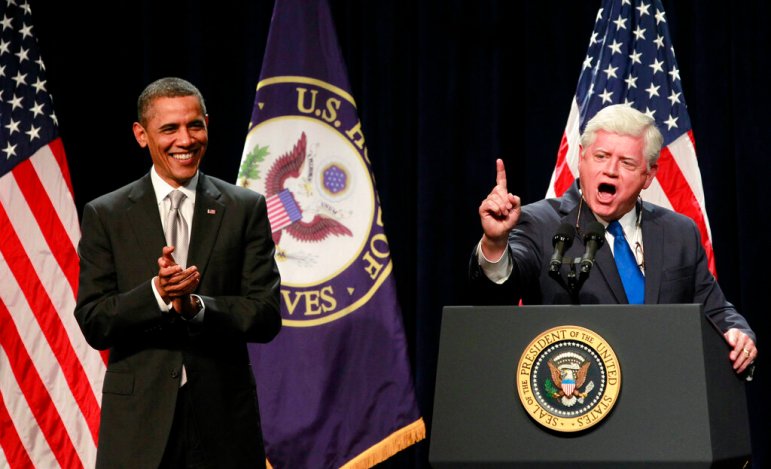
“This is my 27th year, and of those years, only eight have we been in the majority, and of those eight, only four did we have the House and Senate and a Democratic president,” Larson said.
Those four years came in two-year increments, 10 years apart, he said.
“So the vast majority of my time has been spent in the minority,” Larson said. “So you have to work to get things done. You have to work across the aisle. And that’s not a bad thing.”
Larson has a booming speaking voice. On the House floor, he has raged against Trump giving Elon Musk the keys to the government’s vast trove of data on Americans and against Musk’s break-it-now, fix-it-later approach to downsizing government.
But he is a legislator at heart, ever eager to find common ground. Larson tends to compliment his three challengers, keeping the room temperature low, leaning in to their complaints about Trump. He blurs their differences, save one: what his time on the job means.
Larson had a health scare a year ago, freezing during a speech on the House floor in a C-SPAN moment that went viral. The episode was attributed to a complex partial seizure, related to cardiac surgery 15 years ago. No one spoke of it in Winsted, not directly. Bronin expressed regret at not speaking out when Joe Biden flailed during his only debate with Trump in 2024.
“I said to myself at that time that I wasn’t going to do that again — that if there was something that seemed clear to me, that you just have to call it like you see it,” Bronin said.
For now, the campaign is an inside game. The incumbent and challengers are speaking to the small universe of potential delegates to a nominating convention on May 11, people like the two dozen Democrats who gathered to hear the candidates in Winsted, the old city that actually is part of a slightly larger town, Winchester.
Winchester will have just five of the 419 delegates at the convention, chosen by town committees or caucuses this month, beginning Tuesday. Winning the endorsement and top ballot line in a primary requires a simple majority, 210 votes. To qualify for the primary in August requires 15%, or 63 votes. The alternative is gathering petition signatures from at least 2% of the party’s registered voters in the district’s 27 communities.
The prospect of a primary offers a stress test on a system friendly to incumbents. Nationally, the congressional reelection rate hovers around 90%. Institutional PAC money from business and unions flows to incumbents like Larson. Of the $1.5 million he raised for his 2024 race, 68% came from PACs, according to the campaign finance tracker, Open Secrets.
Bronin, a prodigious fundraiser who won Hartford’s mayoralty by unseating an incumbent in a primary amidst a fiscal crisis in the city, makes an issue of Larson’s PAC money, pledging he would not take corporate dollars.
Gilchrest makes an issue of Bronin’s network of well-heeled individual donors.
The son of a dermatologist, Bronin grew up in Rye, N.Y., and Greenwich, attended Yale and Yale Law School, studied as a Rhodes Scholar at Oxford and served in the administrations of President Barack Obama and Gov. Dannel P. Malloy. His campaign began 2026 with $1.5 million in the bank, compared to $956,000 for Larson, $33,000 for Fortune and $23,000 for Gilchrest.
“It’s easy to say you’re not going to take corporate donations if more than $750,000 of the money you raised comes from those who can max out, give a check of $3,500 or more,” Gilchrest said. “I don’t know barely anyone who can do that. I got $3,500 from my parents together, most they’ve ever given.”
The audience, including Larson, laughed when Gilchrest said her ex-mother-in-law, a Trump voter, was one of her more generous donors.
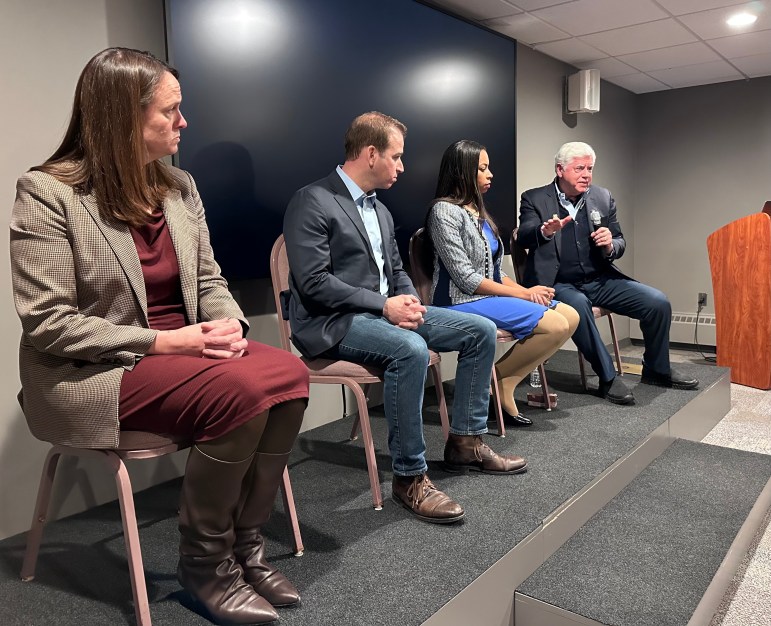
Gilchrest was elected to the state House in 2018, unseating a Democrat in the mid-term election after Trump’s first win. She was an organizer and a featured speaker at Women’s March CT that year, drawing cheers from women for saying she was unwilling to heed calls to wait for the man holding the office to retire.
It was a point of reference in Winsted.
“I challenged a 23-year Democratic incumbent to a primary, because I felt like he wasn’t using the seat with the urgency that it needed,” Gilchrest said. If that was too subtle a jab at Larson, she added, “I see parallels to today.”
Money was not an issue for Gilchrest’s run for the General Assembly. Connecticut’s voluntary Citizens’ Election Program provides campaign financing to qualifying candidates who agree to strict spending limits. Federal candidates are not eligible, and Gilchrest said it was a reform Congress should consider.
“Well, let’s see. I think it was 2018, and ’19,” Larson said, recalling his time chairing the Task Force on Election Reform at the request of then-House Speaker Nancy Pelosi, who is retiring this year. “We passed twice, not once, but twice, comprehensive campaign finance reform that looks very much like what Jillian was describing before.”
It failed in the Senate, defeated by a Republican majority.
A mayoral appointee to the Board of Education, Fortune is new to fundraising. She agrees with Gilchrest that money is a barrier, but her focus during speeches to the town committees and potential delegates is a different obstacle — one they can lower by helping her get to 15% of the convention vote.
“Once you’re on the ballot, you have a fighting chance, but if you’re not on the ballot, you don’t have a chance,” Fortune said.
In a district dominated by one party, the absence of a primary essentially means the incumbent is uncontested. And no Connecticut congressional district has been under one party control as long as Larson’s. No Republican has won the seat since 1956, lifted by Dwight Eisenhower’s reelection.
“We cannot be the party that is pro-choice except when it comes to the ballot box. We cannot be the party that blames Republicans for picking their voters through gerrymandering, when we dictate who a candidate is and expect everyone else to fall in line,” Fortune said. “I’m 37 years old. My husband’s about to be 45. If we had always lived in this district, we never would have had a chance to vote for who our nominee for Congress is, because we haven’t had a primary in the 1st District since 1998.”
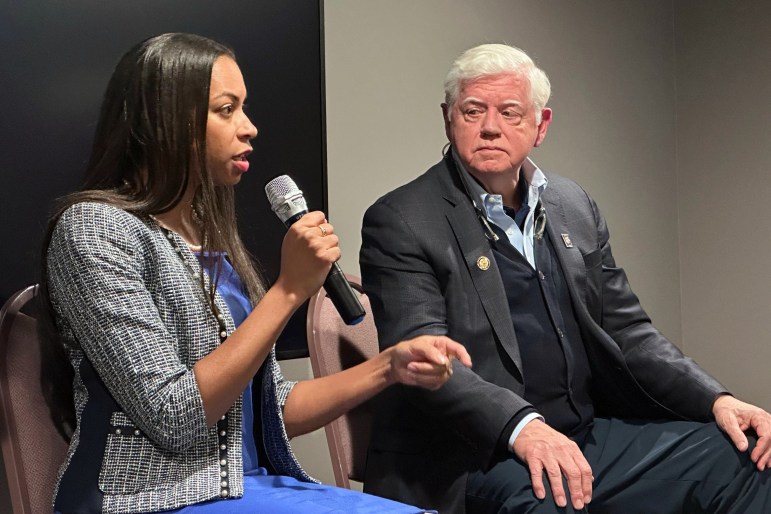
The next night, the quartet gathered again, another trip to another town committee in another town. This time, the audience was in the Hartford suburb of Bloomfield, near the center of the district. Bloomfield will have 21 delegates; Hartford, 61; West Hartford, 50; East Hartford, 27. Waiting to address the group, Larson genially reminisced with a retiree, Joe Suggs, one of his opponents in 1998.
Larson says he has come to terms, more or less, with the notion of three challengers casually arguing in his presence that his time has passed, that he should bow to the zeitgeist and join the record numbers leaving the House. As of March 11, according to a tally kept by Ballotpedia, 56 of the 435 had announced other plans: 26 retirements and 30 campaigns for other offices, mostly U.S. Senate and governor.
“Look, anyone’s got the right to run. There’s nothing I can do about that,” Larson said as he exited the meeting in Bloomfield. “You can’t take things personally. You’ve got to stay focused on what you’re trying to accomplish.”
But he doesn’t pretend to be happy that his 15th run for Congress, his 14th as an incumbent, has drawn a crowd. He enjoyed being a solo act.
“You can’t say, ‘Oh geez, I really feel comfortable about the fact that I have three challengers,’” Larson said. “You know, who does?”
