


This story has been updated.
A recent mailer delivered to voters in Connecticut’s 1st Congressional District warns that Luke Bronin is “battery-powered by billionaires” along with pictures of a phone with the text “new hardware, same corporate software.”
The mailer was paid for by a super PAC called “Count on Connecticut.”
Another flyer — this one from “Time to Lead PAC” — attacks incumbent U.S. Rep. John Larson, arguing he’s “become part of the problem in Washington” because he takes money from corporate political action committees, or PACs. Next to it is a smiling photo of Bronin saying he’ll “bring new energy to fight against Donald Trump and a broken system.”
These new super PACs add to the burst of activity from outside groups playing in the four-way Democratic primary for Larson’s Hartford-based seat on Aug. 11.
About a half-dozen groups, which can’t coordinate with the campaigns they support, are pouring more than $2.5 million into the race, according to publicly available reports filed with the Federal Election Commission as of Thursday afternoon. Some of the groups are focused on positive media to boost their preferred candidate. But others are spending on a mix of both positive and negative mailers, advertising and text messaging.
Of the money currently spent in the race, about three quarters of it is on behalf of Bronin, but both candidates have gotten a big boost from outside money in the final weeks of the campaign.
The candidates also have significant money donated to their own campaigns, which gives them the ability to make their own decisions on spending, messaging and voter outreach. Larson and Bronin are headed into the last few weeks well-funded. West Hartford Rep. Jillian Gilchrest and Hartford Board of Education member Ruth Fortune remain far behind in fundraising.
In the final major reports released ahead of the Aug. 11 primary, Larson outraised Bronin from July 1 through 22. During that same period, Bronin spent nearly twice as much as the congressman. The campaigns have brought in additional money since the pre-primary reports were filed.
During those same three weeks, Gilchrest raised about $6,500 and spent nearly $5,200. Fortune, meanwhile, brought in $3,300 and spent about $7,100.
We took a deeper dive into the outside spending seeking to shape the primary.
VoteVets is one of the biggest players in Connecticut’s 1st Congressional District. The group announced last month that it would spend $1 million in an ad campaign to boost Bronin. Those ads are running on cable and broadcast in the Hartford and New Haven media markets through the Aug. 11 primary.

The ad campaign is notable not just in the size of the buy but also because it’s one of the rare instances of VoteVets, which seeks to elect Democratic military veterans to elected office, investing in a primary against a long-time incumbent in a safe blue district. Bronin is a U.S. Navy veteran who served in Afghanistan in 2010.
VoteVets PAC has had big-name donors over the years and past support from groups aligned with Democratic leadership in the House and Senate. It’s also received contributions from billionaire hedge fund manager Stephen Mandel, who has donated to other groups like The Bench that also support Bronin. Mandel also funds the progressive advocacy group The Connecticut Project, where Bronin has worked as a paid consultant.
VoteVets has so far spent a little over $1 million on ads for Bronin, according to the latest report filed with the FEC on Aug. 6.
Servant-Leader Fund Inc. has so far spent about $147,000 on direct mail in support of Bronin. The group has similar goals to VoteVets: to elect Democrats who are “next-generation veterans and national security professionals.” It also donates to a number of other candidates.
The super PAC’s funding primarily comes from two other PACs affiliated with the group With Honor Fund, which also backs veteran candidates.
With Honor Fund II, which was terminated in the spring, got most of its funding from Jeff Bezos’ parents, Miguel and Jacklyn. That group gave a lot of its money to With Honor III, which has also received large checks from donors and groups including Everytown For Gun Safety Victory Fund, investor and philanthropist Paul and Mary Finnegan and venture capitalist John Drew.
Impact CT has spent about $390,000 on positive digital ads, mailers, and text messaging supporting Bronin, as of filings reported to the FEC on Aug. 6. The Connecticut-based group formed in 2024 as an independent expenditure committee that says it prioritizes affordable housing, healthcare, education, public safety and transportation. Impact CT is chaired by former New Haven Mayor Toni Harp.
The group’s emphasis has largely been on General Assembly races, though it spent money on U.S. Rep. Jahana Hayes’ reelection race in 2024. The largest contributors to Impact CT’s state PAC were Mandel, who has contributed about $3.9 million since 2024, and Garrett Moran, who served on Gov. Ned Lamont’s Workforce Council and was COO of Blackstone’s Private Equity Group, according to records through the Connecticut State Elections Enforcement Commission.
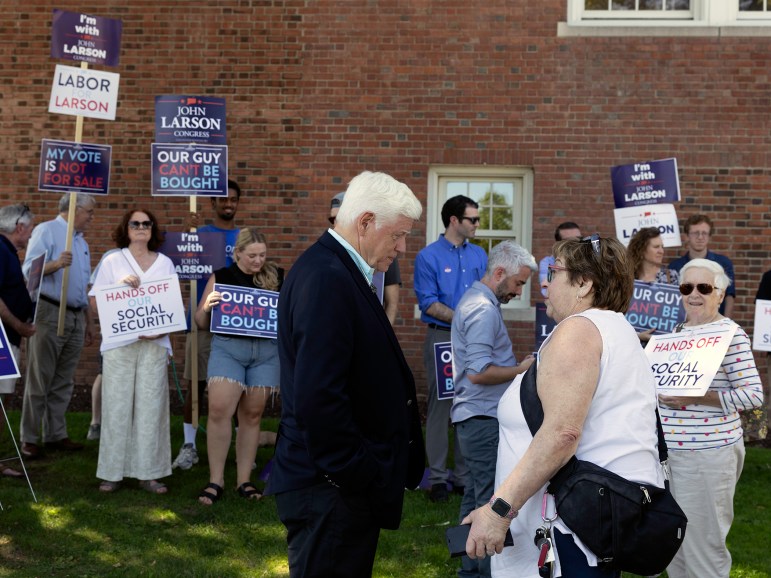
Meanwhile, the Working Families Party PAC has spent a total of about $55,000 on phone banking and digital ads in support of Larson. The Working Families Party endorsed Larson in May, one of the dozens of union-backed groups supporting him in the primary.
A lion’s share of the Working Families Party PAC money comes from Democracy PAC, which was founded by billionaire and Democratic megadonor George Soros.
While those groups are investing in multiple races this election cycle, there are also newer super PACs that have so far only dropped money in Connecticut’s 1st District primary.
Count on Connecticut formed as a super PAC this summer, filing a statement of organization with the FEC on June 15. It has spent about $92,000 in direct mail opposing Bronin, according to its latest report filed on Aug. 1.
The group gets a lot of its money from leadership PACs, which are groups established by members of Congress to help support other candidates. Some of those include leadership PACs associated with U.S. Reps. Rosa DeLauro, Nancy Pelosi of California and Terri Sewell of Alabama. DeLauro, a colleague of Larson’s in the Connecticut delegation, has endorsed Larson. Pelosi has previously donated to Larson’s campaign.
The super PAC has also received contributions from a number of other PACs, including American Resort Development Association Resort Owners Coalition PAC, Sheet Metal Air Rail Transportation Political Action League, Rebuild America PAC and Tried and True PAC.
One of the Larson’s campaign recent disbursements was labeled an in-kind voter list to Count on Connecticut. It’s in line with an FEC advisory opinion from 2024 that differentiates canvassing from public communications and is not considered coordinated communications.
“The Commission concludes that the canvassing literature and scripts are not public communications, and as a result are not coordinated communications under Commission regulations,” the then-FEC chairman wrote in the 2024 opinion. “Further, the costs to produce and distribute the canvassing literature and scripts are not coordinated expenditures.”
Time to Lead PAC, meanwhile, was created in August 2025, according to FEC records. The group similarly filed as an independent-expenditure only group (or super PAC). It has spent about $273,000 as of Aug. 4, with nearly half opposing Larson through direct mail and digital advertising and the other half used to support Bronin through the same media.
But the group’s funding has been more mysterious. Time to Lead PAC has only reported raising $10,000 from SEIU Illinois Council PAC, which came in late February. The group is a monthly filer with the FEC, and its next report with the latest fundraising numbers won’t come until mid-August, likely after Connecticut’s primary.
The group has filed periodic reports each time it’s made an independent expenditure or IE. That’s because the FEC requires 24-hour and 48-hour reports on IE spending in the lead-up to a primary. Connecticut’s IE reporting window started on July 22 and runs through the Aug. 11 primary.
Defend the Vote made its first independent expenditure in the race, reporting on Thursday that it dropped about $515,000 on TV and digital advertising against Bronin. The PAC says it’s focused on issues around democracy and voter access and supports a number of incumbents and candidates running for House and Senate. The group endorsed Larson’s campaign in April.
“After 28 years in Congress, it’s sad to see John Larson rely on last-minute false attacks from a D.C. super PAC,” Bronin campaign manager Akash Kaza said. “Voters will see through this because it’s the exact type of politics they are ready to move on from, and that’s why they’re voting for new leadership on Tuesday.”
Larson’s campaign was critical of both Bronin’s own fundraising and help from super PACS, pointing to one of the outside groups supporting him — Impact CT — which expressed an openness regarding the development of AI data centers.
“Luke Bronin and his campaign are the spitting image of the kind of corporate-powered, pay-to-play politics that people are tired of,” Larson spokesperson Bee Ungar said.

Gilchrest and Fortune haven’t been able to raise the same kind of money, nor have they received third-party support from an outside group. They have described a “broken” political system where big money and special interests uplift candidates with the expectation they’ll benefit if they get into office.
“The super PAC spending in this race speaks for itself. In the final stretch, we’re being outspent by outside money tied to interests that have never had to live paycheck to paycheck, never had to choose between rent and health insurance,” Fortune said. “We can’t outspend a super PAC. We were never going to try. What we can do is outwork them, and that’s exactly what we’ve spent the final weeks doing.”
Neither has been able to afford TV advertising, instead relying on other kinds of get-out-the-vote efforts. Fortune said her campaign has focused on door knocking, phone calls and direct conversations with voters.
Gilchrest, meanwhile, has been spending money on digital advertising on Facebook as well as postcards and texting and continues to focus on canvassing.
“The excessive super PAC funding in this race makes two things crystal clear. Both men are bought by the billionaire class and corporations, and both men are disingenuous,” Gilchrest said. “The people I meet are struggling with high costs and angry that the wealthy are running this country. Spending hundreds of thousands of dollars on mailers is offensive.”
Note: Stephen Mandel is a donor and The Connecticut Project is a funder of The Connecticut Mirror. Garrett Moran is also a donor to CT Mirror.
Correction: An earlier version of this story reported that Defend the Vote hadn’t endorsed in the primary. The group endorsed Larson.
The Connecticut Mirror/Connecticut Public Radio federal policy reporter position is made possible, in part, by funding from the Robert and Margaret Patricelli Family Foundation.
