




When Jillian Gilchrest goes out to knock on doors in her campaign for Congress, it’s a “mixed bag.”
On average, she says, two or three people answer for every 10 doors. Some are unaware of the Democratic primary on Aug. 11. A larger share of voters are more familiar, but “some only know it as a two-person race.”
Her quick pitch to those willing to listen hits on both aspects: Democratic voters in Connecticut’s 1st Congressional District are getting a choice for the first time in 28 years, and three candidates, including Gilchrest, a state representative from West Hartford, are running to unseat U.S. Rep. John Larson.
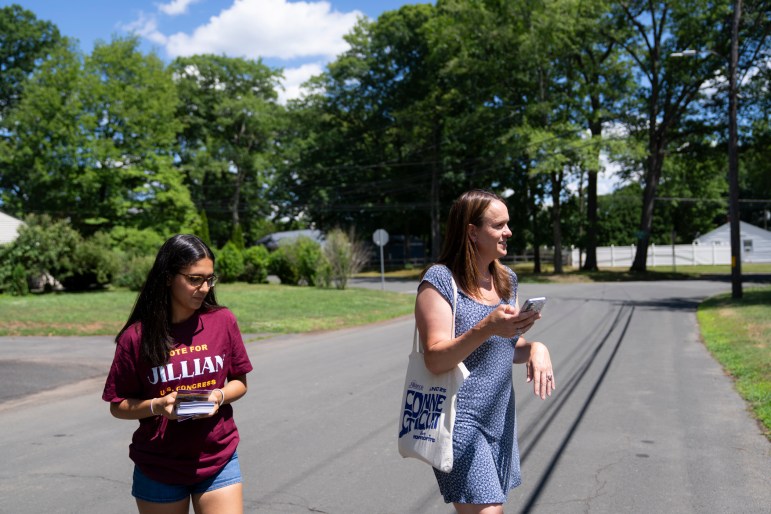
As Gilchrest canvassed in Bloomfield on a sunny weekday afternoon in late June, she approached a woman in the middle of yard work, a wheelbarrow behind her. Standing at the edge of the property, Carolyn McGregor paused to hear out Gilchrest for a few minutes. Was she familiar with the race? “Absolutely,” McGregor replied.

She appeared receptive to Gilchrest’s message. McGregor, 61, expressed concerns about President Donald Trump and the need for lawmakers who are willing to challenge him. McGregor, who is first generation and one of seven children born to parents from Jamaica, later spoke of her love of Connecticut.
After Gilchrest left for the next house, McGregor said she has supported Larson in the past but will “have to investigate” ahead of the primary.
“If something isn’t broke, don’t fix it, but I’m always open,” McGregor said. She added she has an appreciation for people who aren’t afraid of taking on a challenge.
Canvassing in Bloomfield provided a snapshot in time of an unpredictable — and unprecedented — race split among Democratic voters who plan to stick with Larson and those who are open to shaking things up in Congress. Gilchrest is trying to break through in a crowded primary that includes a longtime incumbent and a well-funded and party-endorsed challenger, former Hartford Mayor Luke Bronin.
As she crisscrosses the Hartford-based district, Gilchrest said, she hears a common theme at the doors.
“People have respect for Congressman Larson but want someone new.” She added a notable caveat: “Not necessarily me.”
A vast door-knocking operation helped propel Gilchrest to unseat a 12-term incumbent in 2018 for her West Hartford seat. Now she’s trying to replicate that strategy to take on a 14-term congressman in a four-way primary. Since the May 11 nominating convention, when she narrowly qualified for the primary after some Larson delegates flipped to support her, she’s missed just three days of door knocking.
She canvasses for hours at a time and has hit all 27 towns of the 1st Congressional District. Her team goes out twice a day: Gilchrest, staff and volunteers take the daytime session and a larger network of volunteers handles the evenings and weekends.
But it’s changed quite a bit in the eight years since she first ran for her West Hartford seat. She sees more non-solicitation signs (politicians can still approach those homes) and leaves more messages through doorbell cameras. She leaves a flyer at every unanswered door with a message that Congress needs more social workers.
After Gilchrest spoke with a couple of people at another home in Bloomfield —including a first-time voter turning 18 — Sezinando Manna II approached the door and called her back over to ask if she knew other local politicians. Gilchrest and the 43-year-old engaged in a long conversation that veered into a cost-of-living crisis, a poor job market and fears over Social Security insolvency.

Manna, who has been on disability for a couple of years, said he watches the stock market every day and blamed Trump for “destroying the economy in favor of his buddies.” Like other voters that day, his focus was squarely on the president and wanting “someone who can go toe-to-toe with him in office.”
He had complimentary things to say about both Larson and Bronin but was generally supportive of the congressman.
Gilchrest is trying to make the pitch that there’s a “third option” beyond Larson and Bronin. Door-knocking provides one of those rare opportunities to meet voters where they are and get face time outside of their own turf. But it’s also challenging and time consuming with a mixed success rate. And Connecticut’s campaign season is in the thick of summer, with a primary weeks out from the start of school.
“I love the door knocking. I call it rapid-fire social work — getting to actually meet real people and understand what issues impact them,” Gilchrest said while walking to the next house. “And I think in this world and in particular politics, it can seem so hateful that it really just shows you most people have a kind heart and just want the world to be a better place.”
Gilchrest has faced headwinds before. But the odds are stacked against her and attorney and Hartford Board of Education member Ruth Fortune, neither of whom are raising the sums of money needed to compete with the other candidates.
Congressional candidates don’t have access to public financing like they do at the state level. And incumbency is a more dominant force. Gilchrest said the same unions and groups that have supported her before are now off limits.
“I think having an incumbent in the race has been a huge barrier,” Gilchrest said. “As a state representative, I have always been endorsed by unions, progressive groups, reproductive health groups — and they all have policies of sticking with the incumbent. So that money was off the table.”
Her outreach focuses on registered Democratic voters, since they are the only ones allowed to vote in their party’s primary. Republican voters would have needed to switch their party affiliation three months ahead of the primary. Unaffiliated voters, who make up a large share of Connecticut voters, can register with a party by noon the day before the Aug. 11 primary (or noon the day before they plan to vote early).

That’s one of the issues Gilchrest ran into during her canvass of Bloomfield. Sitting outside in a lawn chair, Mattie Adgers, 80, said Larson has been in Congress too long. But Adgers can’t vote in the Democratic primary since she’s a registered Republican from years earlier and has never changed her affiliation.
“One person can’t do much” in Congress, Adgers argued, but lawmakers need enough people to get something done. She brought up Bronin, saying she found him “very personable” and recalled a time when he stopped by a party during his time as mayor.
“I’m going to try to influence enough other people to think how I think,” Adgers said.
Gilchrest has the harder job of positioning herself against both an incumbent as well as a main challenger who have largely focused their attention on one another.
Fortune, who has never held elected office, faces similar hurdles to Gilchrest. After failing to qualify at the convention, she secured the thousands of petition signatures needed to get on the primary ballot. Fortune has said she’s the only candidate in the race with “personal experience with barriers that we face” regarding immigration.
The expanded field of four candidates likely bodes better for the incumbent because the vote “can get a little bit divided,” Quinnipiac University political science professor Scott McLean said. But “that’s not to say that he’ll win.”
The candidates have different regional bases, but McLean sees the suburbs as up for grabs with Bronin and Larson having more of a grip on the urban areas. He believes Gilchrest could be an “X-factor” among more suburban parts of the district.

With little daylight on many of the issues, the fault lines in the race have come down more to style, smaller nuances on policy, and money. But Gilchrest, who has a progressive voting record in the state legislature, has sought to position herself to the left of both candidates, including at last week’s first televised forum among all four candidates.
“[Trump] is blatantly stealing from the American people, but I’m also frustrated with the Democrats, and that’s why I’m in this race,” Gilchrest said at the forum. “I’m challenging a Democrat because I think right now in this country, billionaires and corporations are running things, and it’s because of that that your costs are up. Unfortunately, two of the men in this race do take funding from billionaires and corporations.”
Bronin and Larson didn’t respond to or acknowledge Gilchrest’s assertions at the forum and kept the criticism on each other or at Trump.
Fundraising and where money is flowing from has been one of the animating forces of the primary and one they’re all trying to capitalize on. All four candidates want to see campaign finance reform in a post-Citizens United world after the U.S. Supreme Court allowed unlimited political spending by special interests such as corporations and unions.
But Larson and Bronin are raising the most. And with that comes scrutiny from one another as well as the other challengers in the race.
Bronin has called on Larson to stop accepting money from corporate political action committees, with PACs making up half of the congressman’s quarterly fundraising hauls. (At the televised forum, Bronin said wouldn’t take corporate PAC money now or in future races). Larson, in turn, has criticized Bronin for accepting individual donations from billionaires as well as payments as a consultant for the progressive advocacy group The Connecticut Project. Both candidates have received donations from individual donors tied to private equity firms and other wealthy networks.
Gilchrest has directed her criticism at both. She argues that voters should question why certain funders with extreme wealth or special interests are getting behind either of the two candidates and how those donors might benefit from them getting into office.
“So the system that’s in place is broken because corporations and billionaires are influencing the politics that get passed or don’t get passed,” Gilchrest said.
“What did we, in the 1st Congressional District, get from a John Larson in Congress who takes money from Republican billionaires and from corporations? We got inaction. And so do we want more of the same?” she said later, referring to Bronin. “He is just a new version of John Larson.”
But Bronin’s fundraising has kept him competitive and puts him at an advantage in the race, even with the dynamics of a crowded four-way primary, McLean said.
“Bronin is raising the money,” McLean said. “A candidate like Ruth Fortune or Jillian Gilchrest are going to depend a lot on shoe leather and just meeting a lot of people.”
The lack of funds comes at a cost. Unlike Larson and Bronin, who have already put ads on air, Gilchrest will not have ads on TV — though she questions the relevance with more people getting rid of cable — and will instead do digital ads on streaming platforms and maybe one mailer. That’s why she hopes door knocking will matter.
“We just have to do it different.”
The Connecticut Mirror/Connecticut Public Radio federal policy reporter position is made possible, in part, by funding from the Robert and Margaret Patricelli Family Foundation.
