


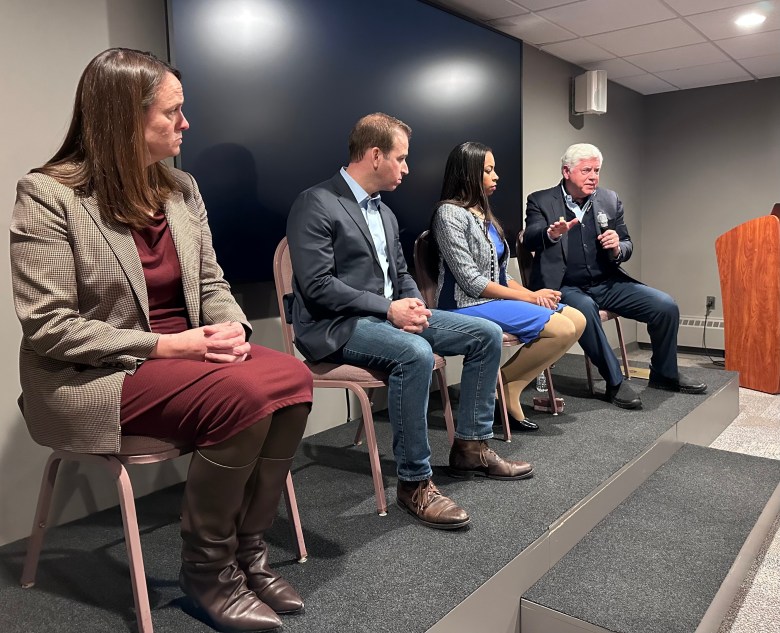
Campaign contributions from national political groups, state legislators and executives in Hollywood are fueling the four-way Democratic contest for Connecticut’s 1st Congressional District, but donations are favoring two candidates.
U.S. Rep. John Larson and one of his Democratic challengers, Luke Bronin, are far ahead of the other hopefuls, but the former Hartford mayor narrowly outraised Larson again during the first three months of 2026.
Bronin is one of three challengers vying for Larson’s Hartford-based district, along state Rep. Jillian Gilchrest of West Hartford and Hartford school board member Ruth Fortune. The winner of the primary will have a glide path to the seat in November.
The candidates are a month out from the May 11 nominating convention, where they’ll be looking to secure a spot on the ballot for the August primary. They can qualify by getting 15% of the delegates at the convention. Another avenue is collecting petition signatures from at least 2% of the party’s registered voters in the district.
While much of their focus has been on connecting with delegates in Democratic town committees across the 1st District, fundraising has also been a marker in a race that is starting to pick up. Challengers need to raise enough funds to afford advertising in the Hartford media market and boost name recognition against a 14-term incumbent.
From January through the end of March, Bronin raised nearly $511,000 and spent nearly $193,000. He went into the second fundraising quarter of the year with almost $1.8 million in the bank.
During that same three-month period, Larson raised about $452,000 and spent $306,000. The congressman spent more than all three of his opponents, including Bronin. Larson has $1.1 million cash on hand.
Both Larson and Bronin continue to hold financial advantages over Gilchrest and Fortune. Gilchrest brought in about $25,000 and spent nearly $28,000 from January through March. She has about $20,000 in her campaign account.
Fortune, meanwhile, raised nearly $9,800 and spent $10,100 over the past three months. She has $32,500 in the bank.
All candidates needed to file their April quarterly reports — covering fundraising from January through March — with the Federal Election Commission by Wednesday. They will need to file pre-convention reports 12 days prior to the nominating convention.
A deeper look into candidates’ fundraising
Bronin’s was the first campaign up with a TV ad and has been running digital ads as well. Larson’s team confirmed it has been running a paid media campaign.
When it comes to the fundraising battle, the two have tangled over where their donations are coming from. Gilchrest criticized the fundraising networks of both Larson and Bronin.
Nearly half of Larson’s support once again came from political action committees, or PACs, including those representing businesses and corporations, as well as labor unions. Individual contributions made up the other half of his fundraising.
Some of those individual donors include multiple Democratic Town Committee members, local officials and state government employees, and people associated with The Bushnell and the Connecticut Business and Industry Association.
Larson’s support also includes a number of notable names in local political circles: former Connecticut Democratic Party chairwoman Nancy DiNardo, former Connecticut Secretary of the State Denise Merrill and former U.S. Rep. Barbara Kennelly, who was succeeded by Larson when she vacated the seat in 1999 to run for governor.
Some of the PACs that donated to Larson included the American Israel Public Affairs Committee, The Boeing Company PAC, the Alliance for Retired Americans Political Action Committee, Employees of RTX Corporation Political Action Committee, Social Security Works PAC, the American Federation of Teachers and the Bank of America Corporation Federal PAC.
The American Israel Public Affairs Committee (AIPAC) has become a much bigger player in Democratic primaries this cycle4, and has donated to Larson the past two fundraising quarters. The pro-Israel lobby has had mixed success with its involvement in past primaries.
Larson also received a $5,000 contribution from the American Mobilization PAC, which was created by his colleague U.S. Sen. Chris Murphy, D-Conn. That group has given to a range of candidates but has mostly gone to organizing efforts across the country.
Larson’s campaign trained its fire solely at Bronin, touting an internal poll it commissioned earlier this year that showed the congressman well above the rest of the field. There has yet to be public polling not affiliated with a campaign conducted on the Democratic contest.
“From expanding health care access to protecting workers’ rights, his record of delivering for Connecticut speaks for itself. With $2 million raised and more on the way, he has every resource he needs to finish what he started,” Larson campaign manager Greg Gerratana said in a statement.
“Luke Bronin is a corporate lawyer backed by developers and Wall Street dark money. That may help his fundraising, but it’s not the kind of change voters want. This is a working-class district that needs a fighter with a proven record, not someone whose credentials were built in Greenwich private schools and corporate offices. He just isn’t raising nearly enough to make up for his deficit with voters,” he added.
Bronin has said he won’t accept campaign contributions from corporate PACs. Half of Bronin’s itemized contributions — individual donations that exceed $200 where names, occupations and locations must be disclosed — came from Connecticut, a figure that is higher than Larson’s, according to the campaign.
“A huge percentage of John Larson’s fundraising has come from corporate PACs, and once again I challenge John Larson to reject and return the hundreds of thousands of corporate PAC money that has backed him in this election,” Bronin said in a statement.
“We are continuing to build the kind of campaign that can actually get our message out to votes: that our country and the Democratic Party need change and new energy, and it’s time to pass the torch to a new generation of leaders who will stand up to Donald Trump, defend our democracy and lower costs for everyday families,” he continued.
But Bronin, who used to work for the Obama administration, has still been able to tap into a well-financed and connected network of fundraisers.
Like the previous fundraising quarters, Bronin’s donations largely come only from individual contributors as well as partners and executives for wealth and asset management firms and law firms. While much of his support comes from within Connecticut, he still raised a lot of money from elsewhere, like Washington, D.C., New York and California.
The campaign confirmed he held a fundraiser in the Los Angeles area earlier this year.
Some of Bronin’s donations from Hollywood and the entertainment industry include: the co-chairman of talent agency Creative Artists Agency, a few donations from an executive, editor and producer at Warner Brothers; contributions from two executives at HBO Max, a TV executive at Disney and an executive at Netflix. He also received $1,000 from actor Bob Odenkirk.
Bronin received $5,000 from Crosspartisan PAC, which contributed small amounts of money to congressional candidates over the past two cycles. All of the money went toward Democrats those years. He also got $5,000 from VoteVets, an organization that supports Democratic candidates who are military veterans for federal and local office. Bronin is a Navy veteran who served in Afghanistan in 2010. VoteVets PAC endorsed him in January.
Gilchrest’s haul consists mainly of smaller-dollar donations from Connecticut. She has consistently gotten support from many of her fellow colleagues in the General Assembly. In the past three months, she got contributions from Democratic state Reps. Jennifer Leeper, Eleni Kavros DeGraw and Sarah Keitt.
The West Hartford representative also received contributions from some Yale University and University of Connecticut professors, an RTX executive, $2,000 from the CT Association of Optometrists and $500 from the Radiological Society of CT Federal PAC.
Gilchrest has bemoaned the heavy emphasis on fundraising in these races and has called for a public financing system, similar to that of Connecticut, for candidates running in federal races.
“This race is going to take off after the convention, when Democrats know who their choices are. Congressman Larson is financed by the same PACs and corporations he’s cultivated over a generation in Congress. Luke Bronin has a network of wealthy donors built over a decade of running for the next office. Raising more money than them was never part of my strategy,” Gilchrest said in a statement.
“My campaign models what my time in Congress will look like: instead of begging for money, I’ll be passing laws — something Congress has abandoned, though I’m doing it right now in Hartford — putting forward creative progressive policy, and making sure everyday people have a leader focused on improving their lives, not donors’ interests,” she added.
Fortune has a similar sentiment to Gilchrest on campaign fundraising, arguing that she has been able to do more with less in her campaign instead of focusing on money.
Most of her money came from Connecticut or nearby states. Some notable contributors included donations from the CEO of Community Health Resources, a behavioral health care provider with locations across the state and a senior researcher for NAACP Legal Defense Fund.
“I waitressed nights and weekends to put myself through college, graduating debt-free with honors in four years. As an undocumented student, I was not eligible for loans or financial aid. I was told then that it was not possible, but I did it,” Fortune said in a statement.
“I’m bringing that same discipline to this race and to Congress,” she continued. “It is possible to run for Congress and win even when outspent by candidates backed by corporate PACs and billionaires. This race is about the people of this district, not the size of a campaign bank account.”
While the four candidates seek to carve out a lane for themselves, Larson’s opponents have continued to make the case for generational change against a longtime incumbent who turns 78 this summer. But overall, they haven’t deviated too much on the issues.
As war continues with Iran and throughout the Middle East, chatter among Democrats about removing President Donald Trump from office has become a prominent focus as the candidates seek to rally the base.
On Jan. 6, Gilchrest signed a pledge through the national group Citizens’ Impeachment to support the impeachment of Trump.
Last week, Larson introduced 13 articles of impeachment against Trump, a long-shot effort while Democrats remain the minority party. He also supports seeking Trump’s removal through the 25th Amendment. That allows for the temporary removal of presidents if the vice president and a majority of Cabinet members deem they are “unable to discharge the powers and duties of his office.”
Bronin has also called for Trump’s impeachment or his removal by invoking the 25th Amendment. Fortune called Larson’s impeachment efforts “overdue,” according to CT Insider.
There hasn’t been a primary for Connecticut’s 1st District since 1998 when Larson first ran for office and won a primary for the open seat.
The Connecticut Mirror/Connecticut Public Radio federal policy reporter position is made possible, in part, by funding from the Robert and Margaret Patricelli Family Foundation.
