



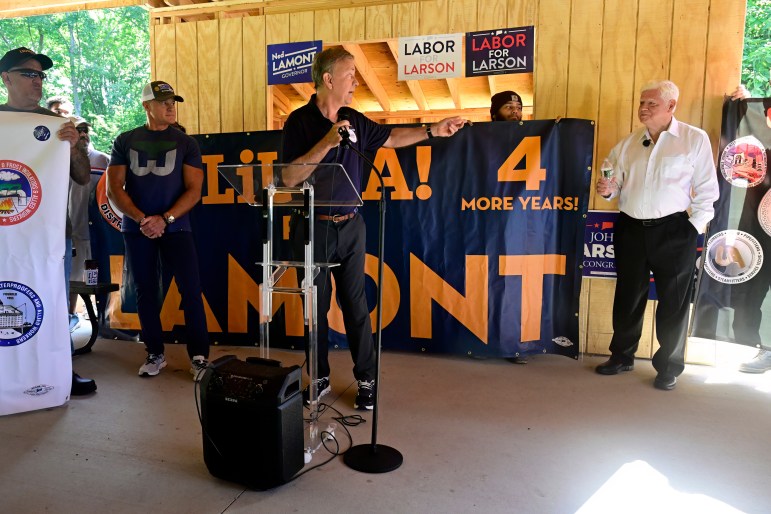
Gov. Ned Lamont stood in dappled sunlight on College Street in New Haven on Tuesday, basking in the praise of labor and community leaders at a rally outside the red-brick headquarters of Unite Here, one of the unions often at odds with one of the Democratic governor’s alma maters, Harvard and Yale.
“As you’re going to hear from my union brothers and sisters, it’s not complicated why labor is supporting our governor, Ned Lamont,” said Josh Stanley, the secretary-treasurer of Unite Here Local 217, whose members include cafeteria workers at Yale. “Can I get a woo-woo?”
Arms tightly by his side and hands folded at the belt, the wealthy businessman-turned-governor, whose family tree includes a capitalist great-grandfather made rich by J.P. Morgan and a socialist grand-uncle made famous fighting McCarthyism, gamely accepted the proffered woo-woo.
Lamont, 72, a Democrat elected in 2018 and reelected in 2022, is the first Connecticut governor in 48 years to face a primary. His challenger, state Rep. Josh Elliott, 41, is hitting him from the left, claiming a man of wealth from Greenwich is tone-deaf to the economic inequities and the needs of working families.
Most unions beg to differ, even if they remain unenthused about the governor’s central political brand — a hostility about committing to new things that come with a recurring cost and no commensurate source of revenue. While Elliott insists Lamont is trying to rebrand himself as a lefty-come-lately on issues of the moment such as Trump and ICE, his essential approach to money is little changed.
Initiatives Lamont promises to pursue in a third term, notably the state expanding healthcare options and taking on greater responsibility for special education, is more about finding efficiencies than writing big checks.
The “Connecticut Option” the governor is pursuing with Comptroller Sean Scanlon would be a public-private partnership giving the state greater influence in the cost and delivery of healthcare without assuming the costs of a true public option.
Elements would include lowering premiums by driving patients toward a designated network of high-quality, lower-cost healthcare facilities and using the state’s buying power to negotiate caps on costs. Similarly, his ideas about providing relief to municipalities on special education involve finding efficiencies and negotiating lower costs on expensive out-of-district placements.
“Everybody I’m around in the legislature, both sides of the aisle, ‘More, more, more, more!’ And I go, ‘Better, better, better, better!’ You know, it’s a slightly different mindset,” Lamont said in an interview. “I’m an entrepreneur, that’s what I am. I think that’s what a progressive is. Progressives are not just about more, they’re about better.”
That’s not the reason why most unions are siding with Lamont in the Democratic primary on Tuesday. On money, they agree to disagree.
The governor’s eight years in office have been good ones for labor’s agenda: Passage of individual laws assuring, among other things, one of the nation’s highest minimum wages, a near-universal mandate on private employers to provide sick days, and protections aimed at Amazon warehouse workers.
He vetoed one high-priority labor bill, a measure that would have provided jobless benefits for strikers. But Sen. Julie Kushner, D-Danbury, co-chair of the Labor and Public Employees Committee, said she and the governor are negotiating a compromise to be considered in 2027. She has endorsed him for reelection.
“Obviously, I was a little reticent,” she said. “You can’t be the chair of the labor committee and have a veto by the governor on your priority bill and just say, ‘Oh, well.’ And I will say to the governor, to his credit, before he vetoed the bill last year, he called me and said we need to work on a compromise.”
And on May 11, Lamont signed into law an omnibus workforce development and worker protection bill packed with disparate labor goodies, including enhanced benefits for teachers and health workers assaulted on the job and making contractors liable for subcontractors who stiff workers on wages.
All those things were dutifully noted this week outside Unite Here by speakers representing the AFL-CIO, the Connecticut Education Association and the building trades, the latter represented by Joe Toner, an ebullient and white-haired trade unionist with a habit of going to topics that others might avoid.
Lamont was pleasantly surprised when Toner expanded the list of accolades by mentioning a trait that more often than not inspires reactions ranging from anger to eye-rolling among labor leaders: His reluctance to take on new spending without a steady source of matching revenue — or to sign off on sharply higher taxes on the rich.
“Fiscal responsibility means a lot, and I know I’m a Democrat. I’ve been a lifelong Democrat, and I will say sometimes there’s not enough money to go around to be responsible and still run the state of Connecticut, right?” Toner said. “Think about the responsibility that has been displayed over the last eight years. What Gov. Lamont’s doing right now is he’s paying for the pensions that weren’t paid for the predecessors before him.”
There were no woo-woos.
But no boos, either.
Paying down pension debt is not the best talking point in a Democratic primary, but Lamont rarely misses a chance to talk about it. When he took office, Connecticut had one of the worst unfunded pension liabilities in the U.S., a consequence of generous benefits and a failure over multiple generations of politicians to invest in a pension fund.
“We were 35% funded. Now we’re 70%. We’ll fall back 10% because the market will do something bad,” Lamont said.

But a string of budget surpluses that have left Connecticut with a full rainy day fund and allowed Lamont to pay down pension debt is not a reason to loosen fiscal guardrails set in 2017 that require revenues gains from historically volatile sources to be held in reserve or reduce debt, Lamont said.
Elliott complains that Lamont is the beneficiary of luck — being in office when the state economy has improved and the Wall Street profits important to Connecticut’s income have boomed.
“We’ve had a pretty good economy, no question about it. And Trump and Biden threw a lot of money at us during COVID,” Lamont said. “We’ve also gone from being one of the worst-performing economies in the country to the 12th-best, or whatever you want to argue about. That makes a big frigging difference. Look at the pension. We finally got a good guy in there as chairman of the IAC.”
The IAC is the Investment Advisory Council that advises the state treasurer on investment policies.
“We’ve gone from a chronic under-performer for 40 years to outperforming where we were before by about 1.5%. You go 1.5%, it’s $60 billion. One and a half percent of $60 billion was worth $900 million to our pension last year. So, I pay down a billion. We get $900 million,” Lamont said. “Pretty soon, you’re talking about real money.”
One of those earlier chairmen of the Investment Advisory Council was a fellow named Ned Lamont. He was installed there by Gov. Lowell P. Weicker Jr. and served throughout the entirety of Weicker’s eventful single term.
“It was insane when I was there,” Lamont said. “I couldn’t invest in international stocks, because of, you know, Mandela and South Africa. And I said, ‘Apartheid is over. Mandela’s in office.’ If you say I can’t invest in one third of the economy or the world economy, you’re holding us back.”
Lamont said Weicker, who took office looking at the worst budget shortfall in the U.S., understandably was more concerned about keeping government going.
“Weicker, I love Weicker, but he couldn’t give a shit about the pension funds either,” Lamont said. “You know, he just said, ‘I’m cutting support for Sonny, and you’re telling me about the pension fund?’ ”
Weicker’s son, Sonny, had intellectual disabilities, and he came to symbolize a broader population that relied on important state services.
Lamont’s predecessor, Dannel P. Malloy, was the first governor to make the actuarially required contributions to the state pension fund, even though he, too, faced a severe budget crisis.
Deferring pension contributions remains a crutch for state and local governments when a chief elected official is faced with immediate service cuts and tax increases — or pushing off pension investments.
“Guess who’s doing that now? Mamdani,” Lamont said.
Zohran Mamdani was elected mayor of New York City and was quickly confronted with a projected budget shortfall of more than $5 billion. With help from the state, he managed to balance the budget.
“Want to know where he got that extra dough? Defer some payments, stretch them out,” Lamont said. He laughed and added, “Believe it or not, his pension’s in better shape than Connecticut, though. So I can’t be too harsh.”
The pension gimmick comes at a cost. By pushing back a pension debt repayment plan five years to 2037, it will cost New York about $7 billion in long-term interest.
