


A decade after Connecticut emptied its death row, state lawmakers are again tinkering with the machinery of death, responding with seriousness to comic John Oliver’s surprising disclosure about a state manufacturer’s role in the secretive world of government executions elsewhere in the U.S.
Absolute Standards Inc. of Hamden was identified last spring on Oliver’s “Last Week Tonight” as the source of pentobarbital used by the U.S. Bureau of Prisons to execute prisoners, including a man whose mother tearfully described his death to Connecticut lawmakers at a public hearing on Monday.
A subsidiary of another company, Walter Surface Technologies, which has its U.S. headquarters in Windsor, was reported by Reuters and other sources as providing the respirator safety masks that Alabama modifies to use in a new method of execution: suffocating its condemned by nitrogen hypoxia.
A bill proposed by two state senators and a state representative states that anyone “licensed, registered or doing business in this state shall not manufacture, compound, sell, test, distribute, dispense or supply any drug or medical device for the purpose of executing the death penalty.”
The federal government resumed executions in the waning months of the first administration of President Donald J. Trump, when he was engaged in a difficult and ultimately losing campaign for reelection in 2020. Thirteen federal prisoners were put to death, reportedly with pentobarbital sold by Absolute Standards.
“My son, Christopher Vialva, was the seventh of those executed with these drugs,” Lisa Brown, a U.S. Army veteran and retired civil service worker from Texas, said in testimony to the legislature’s General Law Committee. “It took my son 28 minutes to die.”
She pointed to evidence, including the autopsy of another executed prisoner, Corey Johnson, that indicated the drug can induce pulmonary edema — an accumulation of fluid in the lungs that can cause the painful sensation of drowning. Her own son seemed to fight for oxygen after the drug was administered, Brown said.
“There were tears coming from his eyes as he turned his head to look at me as he was dying,” Brown said. Her voice broke, and she clutched a tissue.
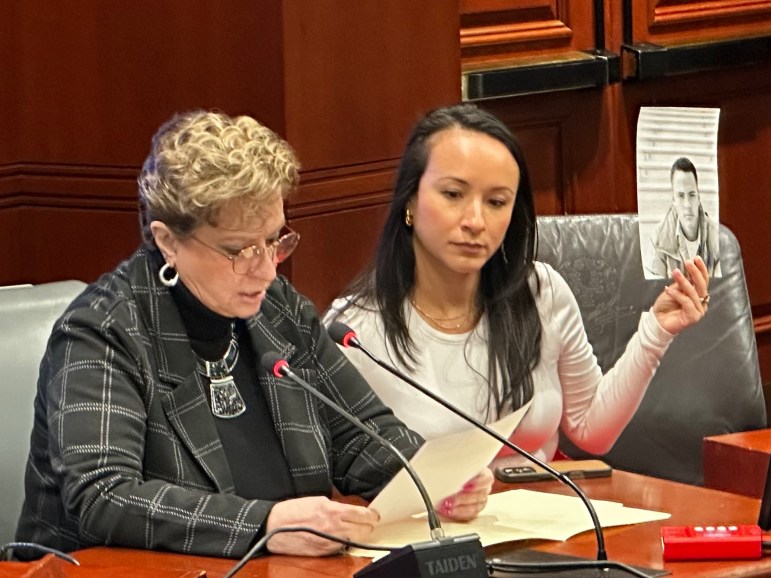
Her son was executed on Sept. 24, 2020, in the federal penitentiary in Terre Haute, Ind. An accomplice, Brandon Bernard, was executed on Dec. 14, 2020, the ninth federal execution of the year. They had been convicted as teens in the 1999 abduction, robbery and murders of Todd and Stacie Bagley, who were on their way from a Sunday service in Killeen, Texas.
“During the execution, I realized that I was witnessing state-sanctioned premeditated murder of my son,” Brown said. “I am grateful to Connecticut for banning the death penalty, but it is deeply troubling to me that Connecticut companies are still profiting from it.”
Absolute Standards notified two state lawmakers in June after Oliver’s report that it has ceased providing pentobarbital for executions. The notification went to Sen. Saud Anwar, D-South Windsor, and Rep. Josh Elliott, D-Hamden, two of the three sponsors of the current proposed ban, Senate Bill 430.
The company is not a drug manufacturer, and the origins of its involvement as a supplier for executions was unclear. Its chief executive officer, John Criscio, could not be reached Monday.
“Last Week Tonight,” which airs on HBO, is a comedy program that digs into public affairs. Its staff includes researchers and former journalists.
“That was what really initiated the reveal of Absolute Standards. And now, since then, we’ve been able to find them in Arizona and a few other places,” said Bianca Tylek, the executive director of Worth Rises, a New York-based organization that works on prison reform and related issues.
Prison systems increasingly have struggled to find suppliers willing to provide drugs and equipment used in executions. The three largest suppliers of industrial gases, including Airgas, have announced they will not supply nitrogen to any prison system seeking to emulate Alabama’s new form of execution, which was first used last year.
The other Connecticut company implicated in the execution supply chain, Walter Surface Technologies, is a diverse manufacturing company. Its subsidiary, Allegro, supplied the masks used by Alabama to kill prisoners by nitrogen hypoxia.
The company would not say Monday if it still supplies the equipment for executions.
“We don’t have any comment on that,” an unidentified customer services representative said.
Connecticut repealed the death penalty for future crimes in 2012, leaving undisturbed the sentences of 11 men awaiting execution. The state Supreme Court erased the last vestiges of capital punishment in a 4-3 decision in 2015, saying it was untenable to keep the death penalty after its prospective repeal.
Justice Richard Palmer wrote on behalf of the majority, “[W]e are persuaded that, following its prospective abolition, this state’s death penalty no longer comports with contemporary standards of decency and no longer serves any legitimate penological purpose.”
The 11 condemned to death had their sentences changed to life in prison without possibility of parole.
Connecticut had executed just two prisoners in more than half a century before abolition: Michael Ross in 2005 and Joseph L. Taborsky in 1960. Both had dropped their appeals and sought execution as an alternative to life in prison. Ross was killed by lethal injection; Taborsky by electrocution.
