The death of Carl “Robby” Talbot in a jail cell thick with the choking fumes of a potent pepper spray was described Friday as the catastrophic consequence of excessive force and medical neglect, compounded by a forged use-of-force report and an ineffectual internal investigation.
Angel Quiros, the commissioner of correction, did not protest the lawmakers’ harsh assessment. Talbot’s mother, Colleen Lord, offered one dissent: Her son’s death also is a consequence of the criminalization of the mentally ill, a failure that began outside jailhouse walls, long before her Robby died.
The first public dissection of all that went wrong at the New Haven Correctional Center on March 21, 2019 came Friday in a Judiciary Committee hearing on whether to accept a proposed $3.75 million settlement of the federal lawsuit filed by Talbot’s estate.
Undisputed is that Talbot, 30, who had a history of mental illness and misdemeanor arrests, had become agitated after being jailed on a probation violation, and that a jailhouse supervisor, Lt. Carlos Padro, responded with four long point-blank bursts of pepper spray, twice in a shower room and again in an elevator and a cell.
Talbot was left lying on his back in contaminated clothing in an unventilated cell, checked every 15 minutes by officers who peered through a window, taking no notice that he was immobile on his bunk. Only when the shift changed did a supervisor take closer look, found him unresponsive and called 9-1-1.
New Haven firefighters and AMR paramedics coughed and sneezed upon entering the contaminated cell, two hours after Talbot was last hit with the pepper spray. Talbot would not be pronounced dead until he was removed to a hospital, but that was a formality. Paramedics reported him cold to the touch, with rigor mortis evident.

Quiros, who became commissioner a year after the incident, told lawmakers that nearly everything about the treatment of Robby Talbot violated correction policies and protocols but conceded that a full accounting of staff responsibility has yet to come — nearly six years later, despite a video record.
“You have my commitment to do everything possible that to ensure this never happens again,” Quiros said.
He announced he had reopened the internal investigation in hopes of discovering who forged and signed a false use-of-force report in which an officer other than Padro supposedly took responsibility for deploying oleoresin capsicum, a pepper spray known as OC. The report blamed an officer who was not present, and the signature was deemed a forgery.
Padro, who sprayed Talbot all four times and kicked him once in the torso, was immediately suspended and retired eight days later with an annual pension that paid him $103,490 last year. He pleaded guilty to a misdemeanor assault charge related to the kick and was sentenced to probation.
Quiros said the spray is supposed to be used in a one-second burst from a distance of several feet. Padro hit Talbot from six inches in bursts that lasted perhaps four seconds. DOC rules required Padro to consult Talbot’s medical records before spraying him, which he did not, Quiros said.
The medical examiner ruled Talbot’s death a homicide, the cause being “sudden death due to physical struggle with restraint, atherosclerotic and hypertensive cardiovascular disease and morbid obesity.”
With one exception, no disciplinary action was taken against any of the officers who joined Padro in restraining Talbot, failed to follow procedures in treating and cleaning him after the paper spray, or adequately monitor him. Quiros said after the hearing the exception was an officer counseled for “using inappropriate language.”
Had the incident occurred after the passage of a police accountability law in 2020, the other officers would have been subject to discipline or charges for failure to intervene and failure to report Padro, Quiros said after the hearing.
Quiros and Eileen Meskill, the deputy attorney general, faced the lawmakers, outlining the facts of the case and why a settlement was advisable. Lawmakers were incredulous at times at the details, struggling to decide to where to press them for details.
“I don’t even know where to begin,” said Sen. Gary Winfield, D-New Haven, co-chair of the Judiciary Committee.
Sen. John Kissel, R-Enfield, said the taxpayers will pay $3.75 million, Padro retires with a pension, and the DOC makes some minor changes.
“And we’re just going to move along. Scary, it’s really scary,” Kissel said. “I like to think I live in a state that’s progressive enough that we don’t have to worry about people getting killed when they’re in a lock up.”
Rep. Craig Fishbein, R-Wallingford, objected to Padro being covered by the settlement. Meskill replied that it would be difficult under state law to cut him loose, nor would it save the state money.
Attorney General William Tong declined to provide Padro with representation, but the bar to denying him indemnification against damages is high, Meskill said. State law allows the revocation of pensions for certain offenses; this is not among them.
Rep. Tom O’Dea, R-New Canaan, a lawyer whose practice involves negotiating settlements, commiserated with Meskill: “You’re between a rock and a hard place.”
Fishbein was one of three lawmakers to vote against recommending the full General Assembly accept the settlement.
“Should the taxpayers be solely responsible for this number?” Fishbein said. “And my answer is no.”
Nothing in the presentation surprised Talbot’s mother, who sat in the audience and did not speak at the hearing. Lord repeatedly has viewed the video of her son’s last day, read the sworn depositions of the officers she had sued, and studied the documents produced by the DOC in discovery.
“My goal is to decriminalize serious mental illness, and that’s a long journey,” Lord said.
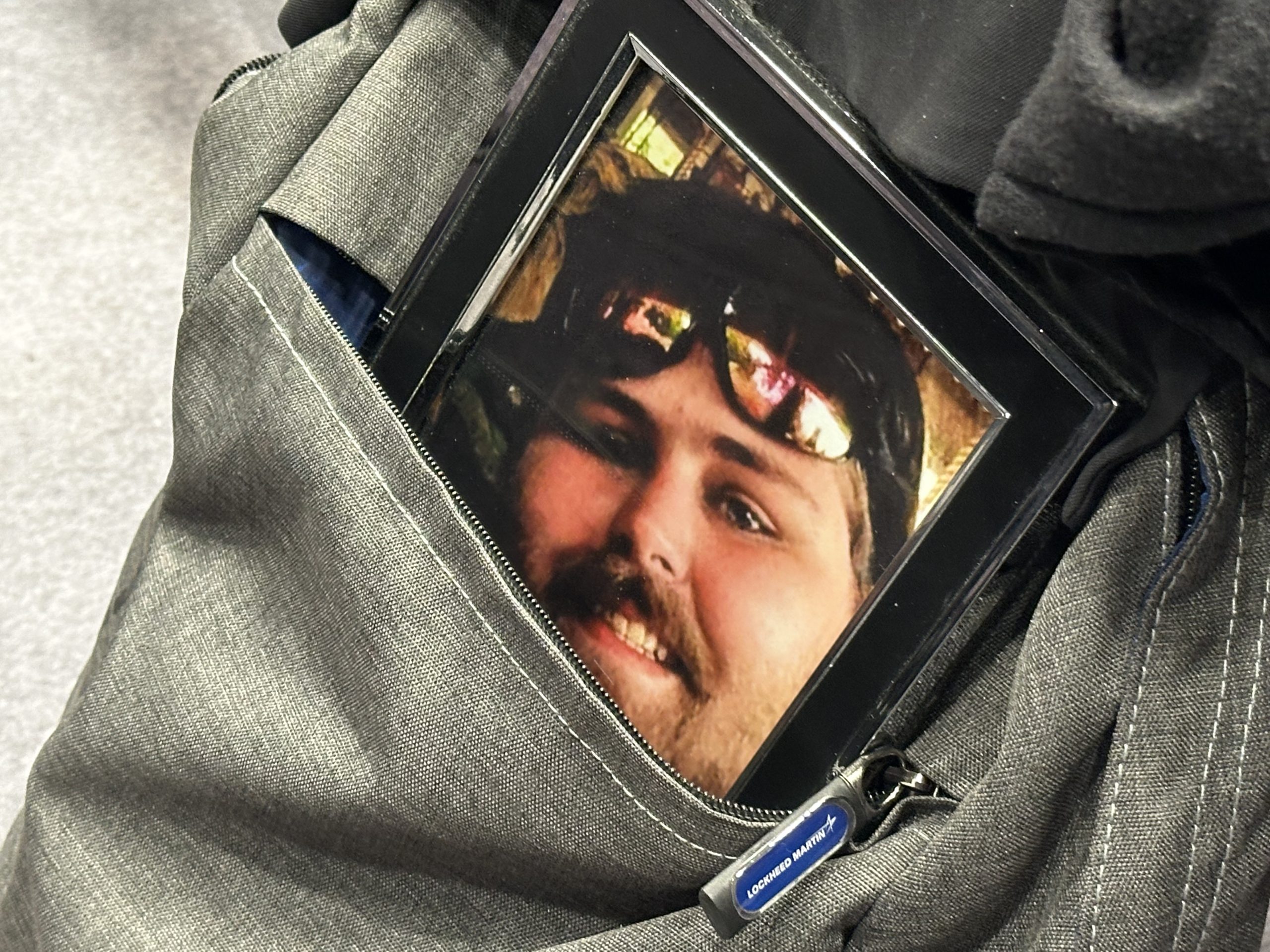
She took a framed portrait of Robby from a backpack and quietly held it during the hearing. It’s a gesture she says is intended to remind everyone of the humanity of people, even when struggling with schizophrenia or being bipolar. Part of the settlement is involving her in training officers.
Lord said she intends to use the settlement to establish some place where people in crisis can stay. One of her son’s arrests, she said, came when he sought help at an emergency room, then became disruptive when turned away.
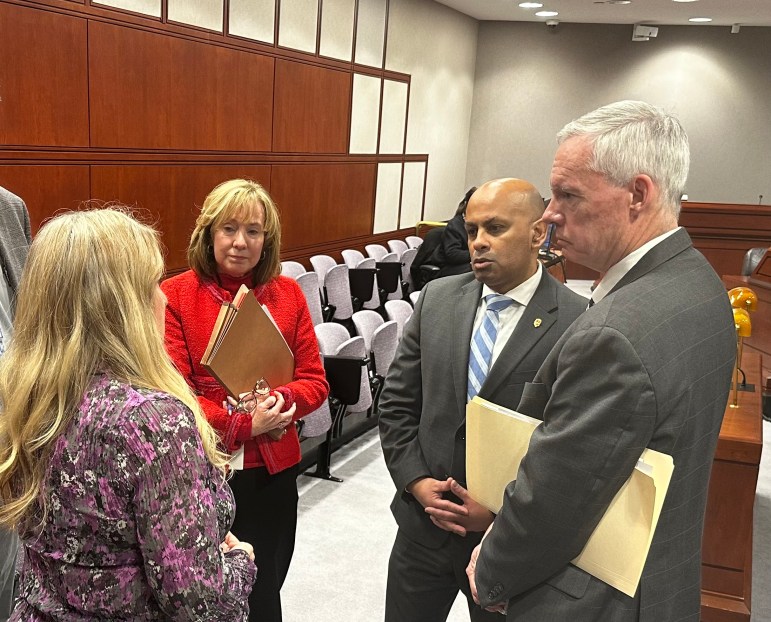
Quiros and Meskill spoke with Lord. Meskill offered condolences.
“I’m thankful that Commissioner Quiros is planning another investigation,” Lord said. “Anything that he can do in order to improve the system, it is much appreciated. And I just told him that in the future, I want to be able to be a help to the department in that they’re the ones who are going to be responsible for the care of so many thousands and thousands of people in our state, and the majority of them have mental illness.”
Lord said she would stop later at the jail where Robby died. She visits monthly, praying on the outside of the wall.
“The neighbors know me. ‘Oh, that crazy lady,’” Lord said, smiling. “I have flowers I’m going to drop off today.”
It’s Valentine’s Day. The flowers are for Robby.