


In Connecticut, Democrats lined up Tuesday to say President Donald J. Trump’s performance actually is worse than his dismal polling reflects, while Republicans say it is too early to judge one of the most consequential starts to a new administration since Franklin Delano Roosevelt’s first 100 days in 1933.
Gov. Ned Lamont contrasted FDR’s efforts to calm a nation rocked by the Great Depression with Trump’s destabilization of a solid economy with a trade war on America’s closest allies, unpredictable shifts on tariffs and the threat of deep federal budget cuts and layoffs.
“People are scared. People are holding back. We’re going the wrong way, driving the economy into a ditch, as opposed to ‘The only thing you have the fear is fear itself.’ You might as well say, ‘If you’re scared today, just wait ’til tomorrow,’” Lamont said.
A new NPR/PBS News/Marist poll found that twice as many people gave Trump a failing grade of F as gave him an A, and a Gallup assessment of first 100 days polling going back to Harry Truman found Trump’s approval rating was 42%. Only Trump’s first-term mark of 41% was lower.
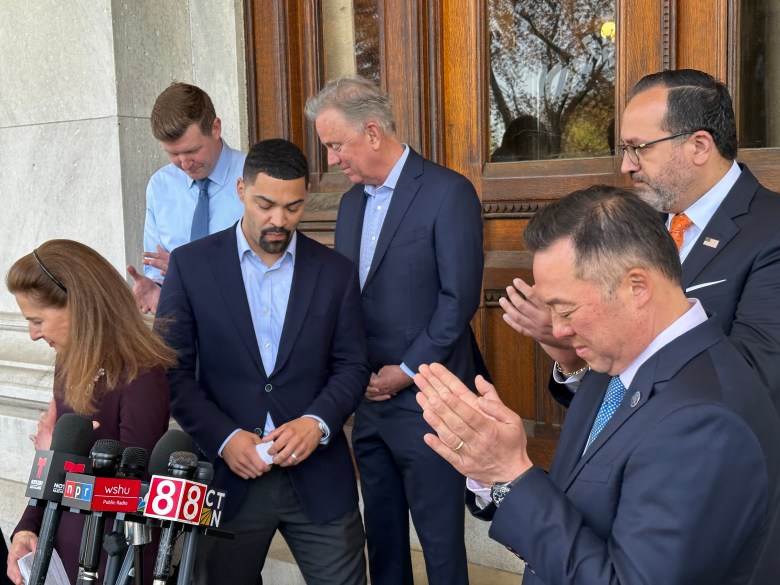
Lamont spoke outside the state Capitol, joined by the Democratic state chair, Roberto Alves, and Lt. Gov. Susan Bysiewicz, Secretary of the State Stephanie Thomas, Comptroller Sean Scanlon, Treasurer Erick Russell and Attorney General William Tong.
Republicans, mindful that Trump has lost badly in Connecticut in each of his three runs for the White House, staged no similar event in Hartford, though the state GOP chair, Ben Proto, and House Minority Leader Vincent J. Candelora, R-North Branford, offered varying degrees of praise, or at least calls for patience, when called for comment.
“I start with promises made, promise kept,” Proto said. “That’s one of the biggest problems the Democrats have: They are going to have to start keeping promises.”
In Proto’s view, Trump has accomplished what he promised: controlling the southern border and taking steps to deport migrants in the U.S. without legal status, especially those implicated in crimes.
“I think there is good and bad with President Trump,” Candelora said. “He certainly controlled the border crossing. He is trying to address the immigration crisis, trying to reposition our manufacturing bases in the country with his tariffs. I think it’s too early to say whether he is successful. I think he is taking a path that brings a lot of anxiety.”
Candelora said he was not supportive of the president’s calls for the impeachment of judges who have issued adverse rulings in challenges to executive orders and expressed a wariness about Trump’s withholding federal funding from universities that have displeased him.
But Candelora said he resented the challenges from Democrats for Republicans to stand up to the president, saying they are “gaslighting” Republicans with exaggerated claims of how the initial cuts have impacted federal services or its aid to state governments.
“I have an assessment of the first 100 days of the Connecticut Democrats, and that is they have completely lost their minds, and they wouldn’t know the truth if it hit them in the face,” Candelora said.
Senate Minority Leader Stephen Harding, R-Brookfield, held a press conference Tuesday to criticize Lamont for agreeing to a deal that will remove Connecticut State Colleges and Universities Chancellor Terrence Cheng from his leadership post but allow him to collect his base annual salary of $442,187 until his contract expires next year.
Harding offered no assessment of Trump, but he had plenty to say about Lamont tolerating Cheng’s controversial wining and dining expenses. The governor should have pressed the Board of Regents to fire Cheng for cause, he said.
“We’re focusing on the things that we actually can control here in the state,” Harding said. “The governor can do something about this. The governor can turn around and tell the Board of Regents, ‘No, do not offer an extension on this contract. We’re going to fire this individual.’”
Scanlon, the Democratic comptroller whose office audited Cheng at Lamont’s request, said Harding should be able to comment directly on Trump, who is provoking a constitutional crisis with his use of executive powers, even when contradicted by federal law.
“I think it’s important that we talk about that. It’s not apples for apples. Here we are acting on this situation,” Scanlon said of Cheng. “That situation has been dealt with. The governor asked me to do an audit of that gentleman, and that audit, I think, bore out as to why they decided not to re-up his contract with them.”
In Washington, Republicans praised the president.
House Speaker Mike Johnson of Louisiana said he spoke twice with Trump ahead of the president’s big speech Tuesday night in Michigan to celebrate his first 100 days. Johnson argued Republicans’ electoral wins gave them the leverage and authority to reshape parts of the federal government and the ways in which they are trying to address inflation and immigration.
“We got a mandate to do exactly what we’re doing right now. We have not wasted a moment,” Johnson said at the Republican National Committee’s headquarters that sits a few blocks away from the U.S. Capitol.
He acknowledged some of the challenges facing the administration when pressed about the recent drops in Trump’s approval rating. Johnson believes there will be an eventual payoff of Trump’s tit-for-tat tariff policies that have led to market volatility.
“There’s been a little question and concern about the rocky start — some of the stock market, some of the tariff policy and all that,” Johnson said. “But right now, even today, people are beginning to see the dust settle on that. They understand there was a master strategy behind this, and they’re seeing the results.”
While the strategy may be a slower burn, Republicans believe Americans will see the promised results when they hash out and pass their major tax package, which is currently still in the beginning stages. They are promising relief for families and entertaining proposals like no taxes on tips. But they will also need to reckon with not further driving up the deficit and making enough spending cuts that could possibly lead to disruptions in some programs.
Johnson and his leadership team also took some shots at the Democratic Party, which had initially struggled to respond to Trump amid an onslaught of executive orders. Some Democrats, like U.S. Sen. Chris Murphy, have openly criticized the party for not addressing the concerns of working families. Republicans believe they are still operating without a message.
“They don’t have any message. They don’t have any clear leader. They don’t have a clear vision. They don’t know what to do. Their platform has been repudiated, and they’re turning on themselves,” Johnson said, noting that one of the vice chairs of the Democratic National Committee will fund primary challenges against some incumbents in safe blue seats.
Republicans call it obstruction. Democrats see it as a renewed resistance movement.
And Democrats argue they have now found their footing since Trump took office in January.
U.S. Sen. Richard Blumenthal, D-Conn., sees a big change in the energy over the past 100 days. The mood was “despairing and despondent” at earlier town halls, but he said things feel differently whether it was at his weekend town hall in Middletown or at an event in Michigan.
“People are ready to go on offense. We need to do more than just attack Trump,” Blumenthal said Tuesday from Washington. “What I saw in the town halls and the reaction from people generally is disgust and anger.”
Members of Connecticut’s congressional delegation have held town halls and events over the past few months to hear out constituents. And in other states and districts that aren’t getting facetime with their members, Murphy, who has become one of Democrats’ go-to messengers, has sought to fill in the gaps and hold town halls in red states with his colleagues.
Connecticut, like every other state, has grappled with swift changes coming out of the White House — and the occasional walkback of some policies. Within a week of Trump taking office, his administration planned to pause all federal grants and loans. That was ultimately reversed, though the short-lived policy had a lingering effect and caused delays for some sectors.
Since then, other federal funding streams have started to see cuts or completely disappear, whether for food banks, public health agencies or universities. That has led Tong to join multiple lawsuits looking to block a number of those actions.
Cuts to federal funding mean states like Connecticut will likely need to fill in the gaps if programs and services are at risk.
“Gov. Lamont and the legislature have planned pretty meticulously and budgeted carefully, and now Trump is pulling the rug out from under all the states that have tried to forecast and plan responsibly like Connecticut,” Blumenthal said.

