



Two young fish are swimming along when they pass an older fish, who nods and says, “How’s the water today, boys?” The two younger fish swim on until one finally turns to the other and asks, “What the hell is ‘water?’”
We often go about our lives without acknowledging the systems that shape them. Zoning is one of those systems. It dictates what can be built and where, determining how we live, how we move, and how we interact with one another. Most people don’t give it a second thought, and assume that the way our communities look is simply how they’ve always been. But our modern infrastructural paradigm is not some universal standard, the apex of civilizational development. It is the result of policies that have become outdated.

The dominant zoning model in Connecticut (single-family homes on large plots of land removed from commercial spaces) is a relatively modern innovation. It emerged in the 20th century, when local governments began implementing zoning laws to control land use. While some of the original intentions were reasonable, the drawbacks of this model have become increasingly apparent. It impedes economic growth, harms the environment, and damages residents’ quality of life. Zoning regulations in the state of Connecticut must be reformed.
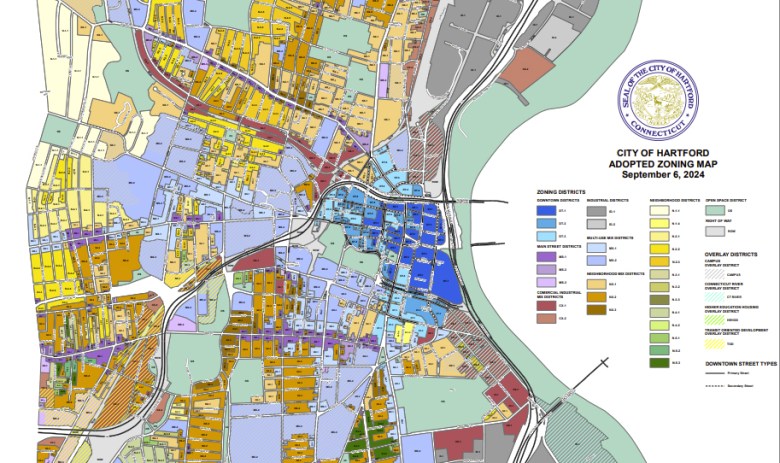
Across Connecticut’s 169 towns, there are 169 different zoning codes. This byzantine patchwork of regulations makes it difficult to build housing, start small businesses, or respond to changing economic and social circumstances. Only large corporations have the necessary resources to navigate these rules. For local entrepreneurs and would-be mom-and-pop’s the system is a barrier.
The consequences are disastrous. Housing costs are soaring because zoning restrictions make it impossible to build enough homes where people want to live. By enforcing low-density development, Connecticut towns handicap their potential revenue while increasing infrastructure costs, creating onerous tax burdens for residents.
The cost of bad zoning is not only financial. When residential areas are sequestered from areas of employment, commerce or recreation, owning a car becomes a necessity. For some, driving is not a problem, but for others (seniors, people with disabilities, low-income residents) it’s a burden. More cars means more traffic, more deadly accidents, more pollution, and less nature, uprooted to make way for parking lots.
Car-centric development negatively impacts our bodies and minds. With few walkable destinations nearby, we spend more time sitting and less time moving, leading to health issues. Without accessible public spaces we become isolated. Many lament the fracturing of community in America, but the rules that govern our physical infrastructure inhibit connection: our neighborhoods offer few places for spontaneous in-person interaction.
This may sound grim, but fatalism is unnecessary. Zoning codes can be rewritten to better serve our needs. A promising path forward in Connecticut would be statewide zoning reform. Instead of 169 convoluted, often contradictory codes, we could establish a universal, statewide framework that facilitates smart development: flexible density where appropriate, increased mixed-use allowances, and less red tape to encourage small-scale, locally-driven projects.This kind of comprehensive, standardized system of zoning has worked in Japan, keeping home prices stable amidst demographic spikes.
The aim of such zoning reforms is not to turn quaint suburbs into towering mini-Tokyo’s, but to facilitate accessibility and opportunity. Personally, I want my cousin to be able to walk safely to a playground. I want to help my parents downsize without sacrificing their independence. I want my friends to start businesses and families without going broke. Rationalizing zoning restrictions across the state does not mean explosive urbanization, it means thoughtful development that reflects the real needs of real people. I do not advocate for the abolition of single-family homes on a quarter acre of land; I merely suggest that that specific use of land need not be the only legally permissible one in every instance.
Change makes people nervous. Many worry that changes to zoning will ruin the character of their home. But preservation shouldn’t mean fossilization. Communities should be allowed to grow and adapt in response to residents’ priorities, and not just in accordance with the written directives of bureaucrats from a century ago. Users of a community should determine that community’s character, not a dusty collection of bylaws, invoked by those who would attempt to freeze time. Is the ability to walk to get your morning coffee truly a nerve-wracking proposition?
Zoning is the water in which we swim, invisible yet all-encompassing. But unlike the fish in the parable, we are able to perceive and even modify the water around us. By making reasonable adjustments to our zoning codes, we can thread the needle on many issues, building affordable homes in a state with clean air, booming businesses, and healthy residents.
Matthew Silber lives in Norwalk.