


A U.S Supreme Court decision Friday in a birthright citizenship case joined by Connecticut cast a shadow over the authority of federal judges who repeatedly have frustrated President Donald Trump’s executive orders with nationwide injunctions.
In a 6-3 decision, the court did not resolve the constitutionality of one of Trump’s earliest and most provocative executive orders — a denial of birthright citizenship ensconced in the Constitution and affirmed by the U.S. Supreme Court.
Instead, the court faulted district court judges who blocked the order in every state, not just in Connecticut and the other states who challenged it.
Justice Amy Coney Barrett said, in a majority opinion praised by Trump, that the administration was likely to prevail in its claims that a nationwide or “universal injunction” exceeded the power granted to the judiciary. She acknowledged “some say” it is a check on the Executive Branch.
“But federal courts do not exercise general oversight of the Executive Branch; they resolve cases and controversies consistent with the authority Congress has given them. When a court concludes that the Executive Branch has acted unlawfully, the answer is not for the court to exceed its power, too,” Barrett wrote.
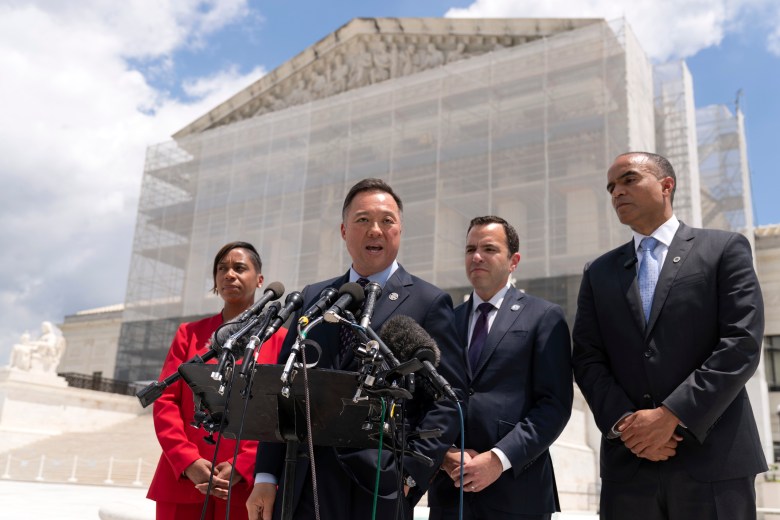
William Tong, the attorney general of Connecticut, one of 18 states in a coalition that sued the Trump administration over the birthright order, said he was confident of the court eventually declaring the order to be unconstitutional but feared chaos in the near term.
The court left open the possibility that the ban could take effect after a 30-day period in the dozens of states that did not challenge the order.
“That’s the chaos and the uncertainty that comes from the president’s unlawful executive order,” said Tong. “This entire citizenship regime that we’ve relied on for more than 150 years, it upends it all.”
In a press conference in Hartford and on a separate Zoom call with the attorneys general of California, New Jersey, Massachusetts and Washington, all states that have sued Trump to preserve birthright citizenship, Tong and his colleagues emphasized the limits of the decision.
“The court very clearly did not address the merits of birthright citizenship, and they, in fact, stayed the executive order for another 30 days for everyone. So let’s be clear, birthright citizenship remains the law of the land in states like New Jersey and in every state across the country,” said Matthew Platkin, the attorney general of New Jersey.
Tong, a Chinese-American born in Hartford to immigrant parents, calls the birthright issue personal. There is a uniquely Chinese aspect to the history of birthright citizenship, as established by the 14th Amendment: “All persons born or naturalized in the United States, and subject to the jurisdiction thereof, are citizens of the United States.”
The full reach of the 14th Amendment was not affirmed by the U.S. Supreme Court until 1898, a period of deep anti-Chinese sentiment. Wong Kim Ark, who was born in San Francisco, was denied reentry to the U.S. after a trip to China under the Chinese Exclusion Act.
“I’m here this morning, not just because I’m an attorney general and I represent the great state of Connecticut, but because I, too, am Wong Kim Ark. There are millions of Americans who share Wong Kim Ark’s story,” Tong said.
The limited decision was not unexpected, as it resulted from an emergency hearing focused on the reach of the injunctions, not the constitutionality of the president’s executive order. But the attorneys general still expressed disappointment.
“I think the Supreme Court had the opportunity to provide clarity for the entire nation, to reaffirm what has been the law of this land for over 150 years, and missed that opportunity with this order this morning,” said Nick Brown, the attorney general of Washington state. “But what the court did not do was negate any of the substantive arguments that the states made in bringing challenges to this blatantly unconstitutional executive order.”
According to the Congressional Research Service, at least 25 universal injunctions had been issued in response to executive orders issued in the first three months of the second Trump administration, challenging decisions on suspending federal spending, ending diversity programs, firing employees and other actions.
Every president in recent decades has faced them: The CRS reported 12 nationwide injunctions were issued during the presidency of George W. Bush, 19 during Barack Obama’s presidency, and 55 during the first Trump Administration.
Tong noted that the limit on universal injunctions was doubled-edged. Trump’s allies applauded some previous ones, most notably one that limited the availability of the abortion drug, mifepristone.
“And so I think they have to tread very carefully, because what’s good for the goose is good for the gander. And if they want to go in and open up a can of worms, well, we’re going to open up a can of worms, too,” Tong said.
Tong said the decision had no immediate impact on other injunctions, but he said states that did not participate in challenges that produced universal injunction most likely appreciated them.
“Your federal funding, your NIH funding, birthright citizenship in your states, has not been cut or eliminated because Connecticut acted,” Tong said.
The three liberal justices dissented. Justice Ketanji Brown Jackson said the injunctive authority was a vital check on executive power.
“The power to compel the Executive to follow the law is particularly vital where the relevant law is the Constitution,” she wrote. “But when the Executive violates the Constitution, the only recourse is the courts. Eliminate that check, and our government ceases to be one of ‘limited powers.’”
Trump said the decision takes away power from left-wing judges, though some of the orders had been delivered by Republican appointees.
“I was elected on a historic mandate, but in recent months, we’ve seen a handful of radical left judges effectively try to overrule the rightful powers of the president to stop the American people from getting the policies that they voted for in record numbers. It was a grave threat to democracy.”
