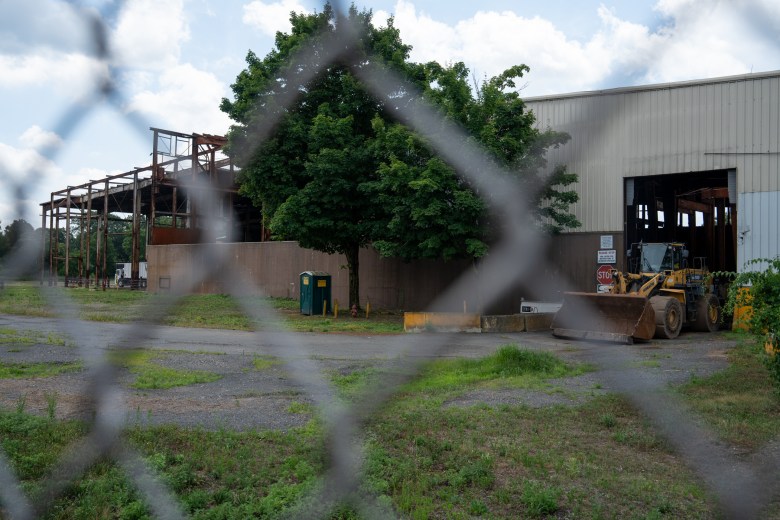
Attempts to reopen a shuttered garbage transfer station in Wallingford cannot go forward for the time being, state officials said this week, despite a provision in the state budget that directed Gov. Ned Lamont’s administration to sign off on the plan.
On Monday, the Connecticut Department of Energy and Environmental Protection said it would not issue a temporary operating permit to the owners of the transfer station, which had been subject to several complaints and violations before it closed in 2023.
The decision puts the agency at odds with controversial language inserted into the state’s sprawling budget bill — also known as the “implementer” — that directed officials to issue the permit while the facility’s owners completed a formal application to reopen the transfer station.
“In consultation with the Office of the Governor and the Office of the Attorney General, the State has determined that the provision of the budget implementer bill concerning the ‘Wallingford Transfer Station’ cannot be acted upon as drafted and does not provide the Department the authority to issue a ‘temporary operating permit,'” DEEP spokesman James Fowler said in a statement. “The Department will continue to work to resolve open violations of state statutes and regulations at that facility.”
Fowler has previously said the agency was not involved with drafting the language regarding the permit, which also appeared to catch several lawmakers off guard before it was added into the budget two days before the end of the legislative session.
Still, the proposal became law when Gov. Lamont signed the budget on June 30.
The transfer station is owned by Country Holdings LLC. An attorney for the company, Joseph Mazzarella, on Monday accused DEEP of flouting the plain language of the law and said he would consider taking legal action to force the agency to issue the permit.
“It says what it says, and it seems to me they’re going through extraordinary gyrations to try to avoid complying with the law,” Mazzarella said.
Mazzarella previously told the Connecticut Mirror that he was involved in getting the the permit language included in the budget on behalf of Country Holdings’ owner, Richard Antonucci Jr. In addition to the Wallingford property, the amendment also blocked the proposed sale of a transfer station in Torrington by conveying its operating permit to a recently-established public waste authority.
According to Mazzarella, both provisions offered a boost to Antonucci’s plans to compete against another hauler, USA Waste and Recycling, which he argued has already consolidated its control over much of the state’s waste business.
“How can that be good?” Mazzarella told CT Mirror in an interview last month.
But several lawmakers have since said they had no knowledge of the language addressing the transfer stations — or its origins — before they were asked to vote on the budget.
State Rep. Craig Fishbein, R-Wallingford, said he was surprised when he saw the language for the first time in an amendment to the budget bill that passed the House on June 2. “I represent Wallingford, I think maybe I would’ve known about this,” he said, according to a video of the debate.
Fishbein’s colleague, State Rep. Mary Mushinsky, D-Wallingford, said the language amounted to a legislative “rat” — a pejorative term used by lawmakers to describe ideas that are included in the budget without going through an public hearing. On Monday, she praised DEEP’s decision not to go ahead with issuing a temporary permit for the property.
“It’s a wise move for now,” Mushinsky said. “We should never run stuff in the budget implementer that hasn’t been run by somebody.”
Wallingford’s mayor, Vinny Cervoni, also expressed disappointment in the process through which the language made its way into the budget. He said he only learned about it from lawmakers after the fact. And he said he was supportive of DEEP’s decision to allow for a regular review process before approving any new permits for the facility.
“The facility really, to put it politely, is in a state of disrepair,” Cervoni said.
Country Holdings acquired the transfer station in 2019 from Covanta, which had previously operated a waste-to-energy incinerator on the property. At the time of the sale, daily operations at the transfer station were being contracted out to another company, Country Disposal Services, which had the necessary permits to operate the facility.
That arrangement continued for several years until disagreements between the two companies led Country Holdings to fire Country Disposal in early 2023. (Mazzarella said the two companies are not related, despite their similar names.)
In July of that year, DEEP issued notices of violations to both companies after determining that Country Holdings had continued to operate the facility without a valid permit.
The notices also documented a number of problems at the site including an excessive buildup of trash, improper storage and a failure to inspect waste coming into the facility. In addition, as a result of “numerous” fires on the property, DEEP ordered an engineer to inspect the structural integrity of the buildings.
Those notices remain unresolved as of this week, the agency said.
“The Department has concerns about the physical condition of the facility to accept solid waste,” DEEP’s Fowler said in a statement. “The facility has been prone to fires in the past, and is believed to be in poor physical condition, including gaps and voids in the walls and ceilings that expose solid waste to stormwater and vectors. … These violations must be addressed — through execution of a consent order or otherwise. The Department has consistently encouraged the owners of the facility to address the open violations and seek a permit to operate through the Department’s standard process.”
The owner of Country Disposal, Michael Couden, declined to comment about his past involvement in the property on Tuesday.
Mazzarella, however, said that the issues largely stemmed from Country Disposal’s operation of the transfer station. After taking over the facility, he said Country Holdings notified DEEP about its problems and began working to clean up the site before being hit with violations.
“We were operating under the presumption that we were doing the right thing,” Mazzarella said. “It’s a Catch-22, that’s the whole issue in a nutshell.”
In response, Fowler said that notifying authorities of problems at the transfer station did not absolve the owners of their responsibilities.
“As the property owner, Country Holdings is still subject to the laws and regulations governing the operation of the facility,” Fowler said. “Violations occurred on their property under its control, and Country Holdings operated the facility even though it did not hold the required permit to do so.”
Cervoni, the mayor, said he had spoken with the owners of Country Holdings about their plans for the site — which include the potential development of modern waste-to-energy technologies — and that he was “not unsympathetic” to their frustrations. Still, he said he wants to take more time to understand the company’s proposals and for officials to resolve any outstanding issues at the property.
“We could use the facility for disposal of our local waste, but at the same time the whole thing should occur through the normal process,” Cervoni said.
Mark Pazniokas contributed to this article.