


Connecticut and 25 other states filed a lawsuit Monday to force the federal government to release $6.8 billion in education funds that states say the Donald J. Trump administration has no right to withhold.
The funding, which includes $53.6 million for Connecticut, was slated for professional development, after school programs, adult education and students learning English. The money was earmarked for the 2025-26 school year, meaning local school districts would soon have to figure out how to adjust their budgets to make up for the gap.
“Without [the funding], programs and positions may be cut, vacancies left unfilled, and vulnerable students left further behind,” the Connecticut Conference of Municipalities, an organization representing Connecticut’s 169 towns, said in a statement after the federal fund withholding was announced late last month.
The loss is projected to affect nearly every district in Connecticut. The largest losses will be in the state’s urban centers. Hartford Public Schools are projected to lose about $3 million. Bridgeport is slated to lose $3.8 million.
The lawsuit, filed on Monday, argues that Congress requires this money be sent to the states by a certain date, and that the executive branch cannot refuse to do so. While agencies like the Department of Education can ask Congress for the ability to revoke payments lawmakers have approved, the lawsuit argues the Trump administration hasn’t taken the necessary steps to be able to do that.
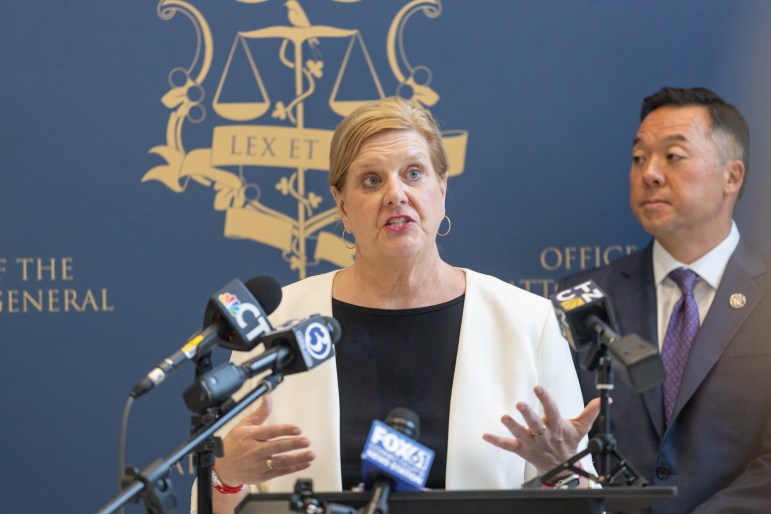
“ This is Congress’ power, not the president’s power,” Attorney General William Tong said at a press conference Monday. “[President Trump] has hijacked, usurped, taken away, just totally unlawfully stepped in, where he does not have the authority, to take power away from Congress.”
Normally, the federal government makes 25% of annual funding available to states on July 1. But this year, states received notice on June 30 that the administration was reviewing the funding for certain grant programs and that the money would not be released.
“The Department remains committed to ensuring taxpayer resources are spent in accordance with the President’s priorities and the Department’s statutory responsibilities,” the June 30 email, as quoted in the lawsuit, read.
The impacted grants include Title II, which pays for things like teacher recruitment, professional development and teacher training. Also included are Title III grants, which pay for programs teaching children learning to speak English, and Title IV, which funds a variety of initiatives, including mental health counseling, drug and violence prevention programs, science and math programs, college and career counseling and investments in technology.
“ This is the big ticket stuff that we, as a state, and local school districts have depended on for decades, for 60 years,” Tong said.
The grants were first established in a law passed in 1965, according to the lawsuit. Tong said he was not aware of any past administrations who had refused to release these grants to the states.
Connecticut House Minority Leader Vincent J. Candelora, R-North Branford, criticized the Democrats for the lawsuit in a statement, saying they’d failed to reconsider their own priorities “despite the President’s clear intent to disrupt the Biden-era status quo that failed just about every Connecticut student.”
“Instead of holding near-daily press conferences, Democrats here would serve Connecticut better by working with federal officials in partnership to produce positive outcomes for everyone, whether it be students, educators, or taxpayers,” Candelora told the Connecticut Mirror.
Gov. Ned Lamont sees things differently. Speaking at the press conference alongside Tong, the governor criticized the federal government’s “herky-jerky” method of distributing funds to the states, and disputed that the cuts were being done with the goal of reducing “waste, fraud and abuse.”
“ These are afterschool programs. Programs that help us recruit teachers, programs that help our kids get back on their feet. These are the programs that are being yanked away,” Lamont said.
Mike McKeon, an attorney for the Connecticut State Department of Education, said the loss of funds was “blowing a hole” in the budgets of local school districts, which were already finalized with the assumption that they would have this money to work with.
Kate Dias, president of the Connecticut Education Association, the state’s largest teacher’s union, said that after school programs and before school programs were at risk. “We can still open school if we don’t have before and after school programs. But what is the quality of the before and after school experience, and then how does that impact the day? That’s really important to us as educators,” she said.
Mental health counseling would also be at risk, she said, and programs focused on teaching English as a second language would probably be scaled back.
Mary Yordon, vice president of the Connecticut chapter of the American Federation of Teachers, also noted that the funds had been supporting “established programs” for students and additional learning for teachers.
“ Teachers across Connecticut are attending conferences and workshops to learn the new techniques, the latest brain-based science and the science of reading, and all of the other techniques that we need to keep ourselves current and to keep our practices efficient and effective,” she said.
Justin Harmon, spokesperson for New Haven Public Schools, said the $3.1 million his district could lose was supposed to fund teacher development, bilingual instructors for students learning English, internship coordinators, anti-bullying programs, credit recovery programs and college courses at the high school level.
“We remain hopeful that these funds will become available,” he said.
In Hartford, the funds at risk include $2 million for adult education programs teaching citizenship and language classes, as well as $900,000 for “Student Support and Success” centers, which focus on helping students who are behind in their academic credits catch up to where they need to be. The district also stands to lose $1.1 million in professional learning and $500,000 for coaches and a coordinator for students learning English.
Dr. Alberto Vazquez-Matos, superintendent of Middletown Public Schools, said the $861,000 his district stands to lose would make it difficult to provide similar services. “These funds are crucial to maintaining the integrity of programs that serve our diverse student population and help ensure equitable access to learning opportunities throughout our community,” he said in a statement to CT Mirror.
Nonprofits that offer after school programs may also see their funding cut.
Amanda Steffen, director of marketing and communications for the Boys & Girls Clubs of Hartford said the organization receives funding from one of the federal grants for after school programs. While it remains unclear whether her organization will receive the grant, she said it will continue to operate either way.
“Safe and supportive places for kids and teens to go in the afternoon and evening are critical community resources,” the nonprofit’s vice president of development & communication, Tomeka Cole, said in a statement. “For us, every dollar matters but Boys & Girls Clubs of Hartford is fortunate to have diversified funding sources. We continue to work with local supporters and donors to ensure that we will always be able to offer our programming and services to all young people, especially those who need us the most.”
The attorney general said he was confident in the claims the states were making in their lawsuit, but said the legal battle could be challenging.
“It’s going to get tougher as we move up in the U.S. Court of Appeals, but attorneys general are fighting tooth and nail every single day,” he said.
