Attorney General William Tong launched his latest legal challenge against the Trump administration on Wednesday, joining again with other states to challenge cuts made to a multibillion-dollar federal disaster mitigation program.
The lawsuit, brought by Democratic officials in 20 states, seeks to block the Federal Emergency Management Agency from eliminating its grant program to help states develop projects to protect residents from natural disasters such as floods, storms and wildfires.
The program, known as Building Resilient Infrastructure and Communities, has provided nearly $4.5 billion in funding for more than 2,000 projects around the country in the last four years, according to the lawsuit.
In Connecticut, roughly $84 million of that funding, earmarked for local projects, is now at risk of being canceled, Tong said.
“We are midstream in a lot of these projects, and now they’re going to pull the rug out from under us,” Tong said. “Or we are about to break ground on projects, or these projects have to happen or else — or else people’s lives will be at risk.”
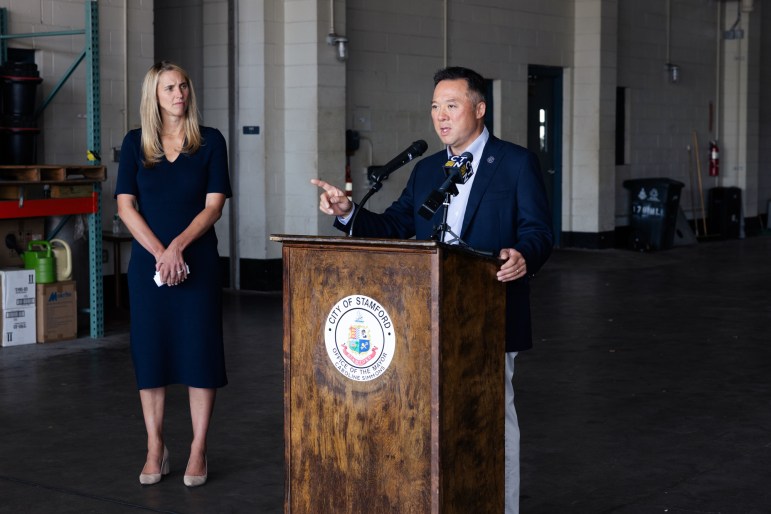
Tong announced his participation in the lawsuit in Stamford, near the site of a project to repair an aging seawall that was slated to receive $900,000 in federal funding through the BRIC program, city officials said.
The seawall, located along a canal, protects the city’s transfer station, sewage treatment plant and other critical infrastructure from flooding, officials said. The total cost of repairing the wall is estimated to be $12.7 million, split between federal, state and local governments.
“Stamford is a coastal city, and we know that our sea levels are projected to rise by almost potentially two feet over the next several decades,” Mayor Caroline Simmons said.
“We’ve taken a number of steps that enhance resiliency across our city, but particularly in the South End, to mitigate the effects of flooding,” she added. “We have a number of projects underway, one of them being to improve and upgrade our seawalls so that we can protect our residents and businesses from harm.”
A White House spokesperson referred comment to FEMA on Wednesday. Officials at the agency did not immediately respond to a request for comment.
In a since-deleted press release announcing plans to end the program in April, however, a FEMA spokesperson cast the BRIC grants as wasteful, ineffective and “more concerned with political agendas than helping Americans affected by natural disasters.”
Tong has joined or led two dozen different lawsuits against the Trump administration since January, according to his office. Earlier this week, he joined with officials in 25 states in suing the Trump administration to release $6.8 billion in federal education funds.
Wednesday’s legal action against FEMA was filed in federal district court in Massachusetts. In addition to FEMA, it named the agency’s acting administrator, David Richardson, and Department of Homeland Security Secretary Kristi Noem as defendants.
In a declaration that was filed as part of the lawsuit, Connecticut Department of Emergency Services and Public Protection Commissioner Ronnell Higgins said that canceling BRIC funds would have a “devastating” effect on the state through wasted time and money that has already been spent developing projects, as well as from harsher impacts from future storms.
Higgins identified two other projects that were impacted by FEMA’s plans to cancel its grant program: a coastal flood defense system in Bridgeport that was slated to receive $47 million in BRIC funding, and a $2.7 million project to assist the state in modernizing its building codes with newer, “hazard-resistant designs.”
The Bridgeport project, which aims to protect a pair of power-generating facilities, is also at risk of losing an additional $32 million in funding from the U.S. Department of Housing as a result of FEMA’s termination of its grants, Higgins said.
The BRIC grant program was created by a law signed by President Donald J. Trump during his first term in 2018, replacing an earlier disaster mitigation program.
In its announcement from earlier this year, FEMA said it was canceling grants that were approved during the Biden Administration between 2020 to 2023. The decision would return an estimated $882 million in unspent funds that had been dedicated to the program under the 2021 Infrastructure Investment and Jobs Act to the Disaster Relief Fund or the U.S. Treasury, according to the agency.
Earlier this year, Trump floated the prospect of eliminating FEMA altogether. More recently, following a devastating series of floods in Texas, officials have begun to walk back that idea, according to the Washington Post.