



Part One of this two-part piece on Connecticut’s HB5002 — the land use bill vetoed by Gov. Ned Lamont — explained the elements of the legislation and made some observations of their benefits and failings. Today’s installment takes a close look at the bill’s major and most controversial components, the Big Five.
Parking
Excessive parking requirements are a well-known and frequently used exclusionary zoning technique. Parking spaces consume land and reduce density. H.B. 5002’s proposal to jettison both unfettered municipal discretion and one-size-fits-all parking ratios in favor of a site-specific needs assessment is a prudent modification to our land use system.

All developers strive to get parking right. They have to because if a development is under-parked, residents are unhappy, neighbors bear the burden of overflow parking, acrimony results, and rents go down due to the inconvenience. Overparked and over-paved developments are a waste of time and money, and bad for the environment. The site-specific needs assessment mandated by the bill will utilize data from the Institute of Transportation Engineers and the Urban Land Institute, which are based on actual experience nationwide.
Parking need is not what it used to be. Remote work, transit-oriented development, ride-sharing, and Uber and Lyft-type services reduce the number of households that need cars.
In 2021, the General Assembly adopted a ban on excessive minimum floor area requirements. This ban, combined with limits on parking requirements, will make more land developable and lower per unit cost, which is exactly how housing efficiency should be achieved.
If legislators are not comfortable leaving parking to the bill’s needs assessment process, the bill could be amended to require a minimum such as at least one half or one space for each residential unit; but again, we should recognize that an applicant who does not provide parking undermines the development’s value. Also, “shared parking” should be called out expressly as a consideration in the parking needs assessment.
The parking provisions of §§ 2, 3 and 42 (the latter repeals the 2021 provisions) should stay in the bill. They will promote affordability.
Middle housing
Section 8-2s of the existing General Statutes, adopted in 2024, allows zoning commissions to approve middle housing as of right “on any lot that allows for residential use, commercial use or mixed-use development.” Section 2 of H.B. 5002 adds a mandate that every municipality’s zoning regulations “shall” allow “as of right” “middle housing development,” as defined in the bill, on “any lot that is zoned for commercial use,” except that the regulations “may require that a site plan conforms with applicable zoning regulations and that public health and safety will not be substantially impacted” by such development.
This provision states a worthwhile goal and process and one that encompasses both affordable and market-rate housing objectives, but it is unclear in several important ways.
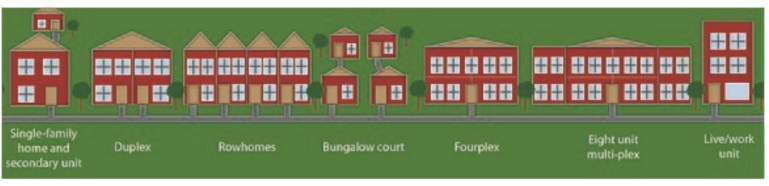
Section 19 defines “middle housing development” as “a residential building containing not less than two dwelling units but not more than nine such units, including but not limited to, townhomes, duplexes, triplexes, perfect sixes, and cottage clusters,” and a perfect six as “a three-story building with a central entrance containing two dwelling units per story.”
The first thing to notice is that this definition says that “the development” must be between two and nine units, so apparently if a lot zoned commercial is three acres, with sewer, water, and traffic access, the maximum density on the parcel regardless of acreage and infrastructure is nine units total?
Second, what the provision gives, it then takes away. What if the municipality adopts site plan regulations that effectively undermine middle housing development, including the as-of-right process?
Does the phrase “public health and safety will not be substantially impacted” have the same meaning as § 8-30g, and since the development is as of right, does the zoning commission have the burden in its decision or in an appeal to prove such impact?
“Zoned for commercial use” is problematic. Section 8-30g contains an exemption for land “zoned industrial” that has been an issue in more than a dozen court cases, and has prompted some commissions to rezone land to industrial for the sole purpose of avoiding affordable housing. A common, simple definition of “commercial use” is “activity involving the sale of goods or services carried out for profit.”
Given these key issues and the fact that this § 2 affects every lot “zoned commercial” in the state, it seems that the problems in this section alone justified the governor’s veto. My suggestions for fixing this section are:
- Define “zoned commercial,” and broadly, along the lines of “any zone that allows as a permitted or specially permitted use private sector business-related activity involving the sale of goods or services, excluding industrial, light industrial, manufacturing, governmental, and institutional uses.” Make it clear that “zoned commercial” shall be broadly construed, as a remedial statute, to promote affordable housing development.
- Do not limit a middle housing development to nine units. Like § 8-30g, let the requirement of no public health or safety impact be the factor that limits excessive density; and recognize that the definition of middle housing limits the massing, and available infrastructure regulates density.
- Clarify that a middle housing development must conform to a municipality’s site plan regulations, instead of the unclear requirement that the site plan must conform to “applicable zoning regulations.”
- One other alternative for the promotion of middle housing is to specify that any development composed completely of the type of structure(s) that constitute middle housing will be governed by a process akin to § 8-30g – if denied and appealed, the zoning commission must prove that its denial is based on a substantial public health and safety concern. The existing § 2 of H.B. 5002 comes close to this, but does not quite get there. Why not use the existing § 8-30g caselaw, 35 years of defined standards, if we truly want to promote middle housing as an alternative to multi-family?
Fair share/ “Towns Take the Lead”
In Public Act 21-29, the state established a requirement that every municipality, at least every five years, adopt an affordable housing plan, a/k/a a “Section 8-30j” plan. The 2021 act contained sparse guidance for what the plans should contain, and specified a relatively short deadline in 2022 for filing the initial plan.
During 2022-23, I co-chaired (with State Rep. Roland Lemar) the Affordable Housing Plans Working Group, a committee of the Commission on Connecticut’s Future and Growth. Our diverse, experienced group was tasked — while the towns were writing their initial plans — with developing guidance for future plans. In turn, we reviewed every filed plan, and used what we read in assembling our recommendations.
Our February 2023 report is online. While recognizing the challenges of the task, our overall assessment (as stated in our report) was that this initial “towns take the lead on affordable housing” resulted in plans that were mostly replete with grumbling, perfunctory compliance, and suffered from a distinct lack of specifics. We did highlight about 15 towns that set a good example for what a plan should be.
After our reviews and process, we developed a checklist of 15 specific factors that a municipality should consider when crafting an affordability plan (§ VII of the Report). In January 2025, I converted the list to a draft bill and submitted it to legislative leaders as a “towns take the lead” proposal. In H.B. 5002, however, the legislature embraced a different towns-take-the-lead approach, the Fair Share provisions, §§ 6 and 7. These sections are complex prescriptions, but in brief summary, they propose to:
- Convert § 8-30j, the affordable housing plan requirement, into a mechanism to require municipalities to adopt zoning regulations that will enable construction of a specific percentage of the number of affordable units that the Office of Policy and Management, in a program carried out in the past year, has “allocated” for each municipality;
- Establish a revised set of target household income levels; and
- Require each municipality to adopt regulations that will provide a “realistic opportunity” for the development of the specified percentage/number of affordable units, with this term defined by a list of broad-stroke steps such as “utilizing municipal powers” including zoning regulations to promote lower cost housing.
The Fair Share provisions then identify a category of municipalities — generally speaking the 80 percent with the highest per capita grand list — that are tasked with preparing a different type of affordable housing plan, a “priority affordable housing plan.” The bill then contains highly prescriptive rules for unit types (such as “family units” and units for the elderly and disabled), number of bedrooms, and income levels that must be accommodated in such plans.
The most specific prescriptions require the plan to enable 25 percent of each municipality’s Fair Share allocation. Municipalities not meeting the specifications must provide an explanation to OPM as to why they could not comply, and must provide an alternative target. Section 7 of the bill provides for an alternate calculation of a municipality’s housing unit allocation.
The state’s 169 towns are directed to file their initial plans under this new program in three staggered periods, 2027-2028-2029, proceeding alphabetically by town name. The OPM Secretary must review and approve each plan. Priority for “discretionary infrastructure funding” is stated as the financial incentive for compliance.
In my opinion, the Fair Share provisions can be improved as follows:
- Classify the unit number allocation, a process now essentially complete, as the state’s measure of each town’s affordable housing need. This will help us put aside the perennial misstatement that ten percent affordable units is a statewide goal or quota.
- However, at this time – to be revisited in the future – put aside the Fair Share allocation/percentage as a specific number that every town filing a “priority” plan must achieve through amendments to its land use regulations.
- As an alternative prescription for the next cycle of municipal affordable housing plans, remove from Section 6 the “realistic opportunity” definition and the prescriptive mandates for regulation amendments, unit types, and household income limits (§§ 6(e) through (i)) and replace them with direction that § 8-30j plans “shall” utilize the checklist stated in the February 2023 Affordable Housing Plans Working Group Report. § VII. This change should respond to the angst expressed about Fair Share, and accommodate advocates by keeping and utilizing the Fair Share allocation as a new measure of need but not requiring every plan going forward to either achieve a specific percentage of the allocation, or explain the failure, or seek an alternative allocation.
Legislative language to implement the 2023 Working Group’s checklist as part of § 8-30j plans was drafted for the 2025 legislative session and is ready to go.
Transit-oriented development
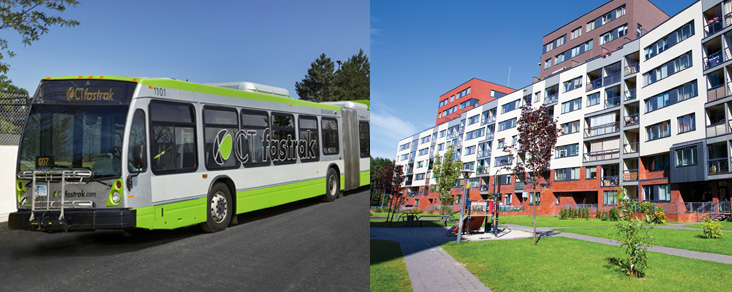
Five sections (19, 20, 21, 23 and 25) aim to facilitate housing near public transportation.
The terminology and definition require close reading: there are qualifying bus, rapid transit, and transit-oriented communities and districts. This program is opt-in, no mandates. Municipalities (“transit-oriented communities”) participate by creating a transit-oriented district that, through zoning regulation amendments and rezoning, allows as of right: (1) middle housing; (2) § 8-30g set aside developments of more than ten units; and (3) developments on land owned by the municipality or a non-profit or religious organization that will be 100 percent deed restricted at 60 percent of the area or state median income, whichever is less. In addition, a municipality that has adopted a district shall allow “as of right” the conversion of any residential development or commercial development under any of the three categories listed above.
Any development within a district that is not allowed as of right and contains ten or more units must be subject to a 40-year deed restriction preserving units at 60 percent of area or statewide median income, or a “contribution agreement.” The percentage of affordable units in one of the three development types will be five to ten percent as determined by CHFA’s most recent Housing Needs Assessment.
Section 19 then specifies priority eligibility for “discretionary infrastructure funding” as the financial incentive for municipalities to participate, though the bill also carefully specifies that non-participating municipalities will still be eligible.
Important details are deferred. The OPM Secretary, in consultation with a new “interagency council on housing development,” is tasked with developing guidelines for districts including prioritizing mixed income and mixed use development; paying attention to environmental concerns including environmental justice; increasing mass transit use; decreasing motor vehicle travel; expediting approvals; modifying dimensional standards to facilitate density; and inclusionary zoning.
The OPM Secretary may grant exceptions if municipalities opt to establish districts that do not strictly meet the statute.
Municipalities that locate their districts in “activity zones” identified in the State Plan of Conservation and Development obtain additional funding priority.
Section 20 aims at recognizing the regional nature of public transit, allowing funding for municipalities adjacent to a qualifying transit-oriented community by adopting the specified type of zoning regulations, even if the municipality is not host to an actual rapid-transit facility.
Section 21 establishes the interagency council on housing development, to advise the Sate’s Responsible Growth Coordinator about implementing the transit-oriented program.
Finally, Section 25, notwithstanding that a municipality has opted out of the accessory apartment rules adopted in 2021, allows an owner of land for at least three years within a transit-oriented district to construct an accessory unit as of right.
In my opinion, the transit-oriented program is voluntary, realistically achievable, and reasonably well explained (albeit with added guidance forthcoming from OPM, the State Responsible Growth Coordinator, and the new interagency council). It warrants continued inclusion in H.B. 5002. These are no reasons to not give this program a try.
Priority housing development zones
Based on definitions contained in § 37, H.B. 5002’s § 38 allows a municipal zoning commission to adopt regulations to establish a “priority housing development zone.” Such a zone must:
- Be consistent with the State Plan of Conservation and Development (generally, Conn. Gen. Stat. §§ 16a-24 and following);
- Obtain from the Commissioner of the Department of Housing a determination that the regulations are “likely to substantially increase production of new units necessary to meet housing needs,” including the categories of housing stated in the Zoning Enabling Act;
- Allow multi-family housing “as of right”;
- Allow at least four units per acre for single-family housing, six units for duplexes and townhouses, and ten units for multi-family;
- Not require a special permit
- Consist of at least ten percent of the “developable land” (a defined term) within the municipality; and
- Be consistent with the Zoning Enabling Act, including its economic diversity and fair housing provisions. However, a zoning commission may “modify, waiver, or eliminate” dimensional standards to achieve the minimum densities. A priority housing zone may include business, commercial, and non-residential uses.
If a commission adopts a conforming priority zone, the Commissioner of Housing issues a letter of eligibility within 90 days of a request. However, one year later, if building permits “or other indications of progress” have not occurred, the Commissioner can revoke the letter. If this occurs in a municipality that currently has a § 8-30g moratorium, the Commissioner “shall also rescind” the moratorium.
Recognizing that this bill originated in the Governor’s office, my opinion is that it should be removed from H.B. 5002 for at least these reasons: (1) §§ 37-39 are essentially a retread of General Statutes §§ 8-13m and following the 2007 Incentive Housing Program, which as noted withered when its financial incentives did not materialize; (2) it is hard to imagine a municipality adopting a zone covering ten percent of its “developable land”; (3) the definition of developable land is complex, time-consuming, and subjective; (4) “consistency” with the State Plan of Conservation and Development will be difficult if not impossible for most municipalities to achieve, because that Plan is focused on “growth zones” which are generally in or near our urban areas; (5) it is hard to imagine a municipality that has achieved a § 8-30g moratorium putting that relief at risk of rescission by agreeing to a deadline for issuing building permits; and (6) we don’t need the confusion of the term “priority housing zone.”
I would delete §§ 37-39. Doing so will require revision of Section 34 regarding § 8-30g moratorium points.
Conclusion
In summary as to H.B. 5002:
- Retain all of the “Improvements to existing housing programs”; all of the “Financial programs”; all of the “Land Use procedural reforms”; and all of the “further study” provisions, as summarized above.
- Modify or remove the § 8-30g attorneys’ fees provisions (§17).
- Retain the parking sections.
- Modify the middle housing provisions as discussed above.
- Modify the Fair Share/Towns Take the Lead provisions as explained above.
- Retain the transit-oriented programs.
- Remove the Priority Housing Development Zone provisions.
As a last piece of the pie, I also recommend reconsideration of two proposals I advanced in my Part 4 September 2024 CT Mirror articles, what I called the “low hanging fruit”:
- Require all zoning and planning commissions, by a specific date such as June 1, 2026, to amend their zoning regulations to comply with the 2021 amendments now codified in General Statutes § 8-2(d) (the “shall not” provisions regarding zoning regulations) because four years later, dozens of towns have not done so; and
- Prohibit wetlands commissions from adopting or using stricter standards or criteria for affordable housing than for market rate housing.
Thanks for listening.
Tim Hollister is a land use attorney with the Hartford office of Hinckley Allen. His affordable housing experience includes arguing the landmark exclusionary zoning case Builders Service Corp. v. East Hampton Planning and Zoning Commission, 267 Conn. 208 (1988); serving as an assistant to the Co-Chair of the Governor’s Blue Ribbon Commission on Housing, 1988-1989, which drafted and recommended General Statutes § 8-30g; since 1990, handling more than 200 affordable housing applications; in 2002, drafting § 8-30g’s regulations under contract to the Department of Housing; and in 2022-23, co-chairing of the Affordable Housing Plans Working Group, part of the Commission on Connecticut’s Future and Growth.