



Continuing our summer reprise of some older columns, here’s an update on memories of years past…
This week marks the 56th anniversary of the grand-daddy of all rock festivals… Woodstock. I was in my teens the summer of 1969, but couldn’t get off from my job to join the swarms of rock fans. But I did see most of them.
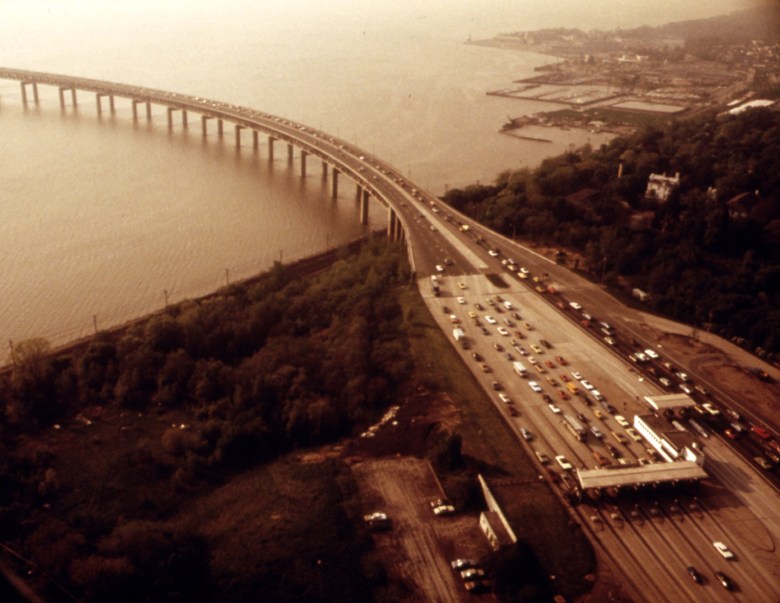
That summer I was as working as a “temp seasonal” toll collector on the Tappan Zee Bridge, joining Westchester and Rockland counties.

Most days life as a toll collector on the Tappan Zee was a delight, as I was usually assigned to the far outside lane, also known as “the country club” because of its green vistas and views of the mighty Hudson River.
There were two things I learned in that job: how to roll quarters and how to listen to the radio. The tiny toll booths lacked air conditioning, but I could bring a fan or a radio. My portable FM entertained me eight hours a day as I listened to both the music and the FM DJ’s… a job I eventually earned at Long Island’s WLIR after college graduation.
New York’s FM stations were buzzing about Woodstock for weeks, and that Friday and much of Saturday, it seemed that every kid in the tri-state area was heading for Yasgur’s Farm. Most weekends were pretty crazy in my toll collecting job, because in those days tolls were collected in both directions… 50 cents north-bound and 50 cents coming home. (Today the toll is $6.75 roundtrip, if you have an E-Z Pass).
Busy as it was on summer weekends on that bridge, nobody expected a half-million people would show up heading to Woodstock, especially not the folks at the New York Thruway Authority. But after the rock fest was well underway, the Thruway brass realized the mobs would eventually be heading home, clogging the bridge. Because the music was expected to end late on Sunday, many of us temp-collectors worked overtime into the wee hours of Monday morning.
Late into the night we had five toll lanes open southbound, most of us enjoying some handsome overtime. However, traffic was so light, they sent us home by about 1 a.m. But I was due back in the booth five hours later.
Of course, the music didn’t end until early that Monday morning, meaning that the usual morning rush hour carried as many burned-out hippies as it did regular business commuters. I remember one station wagon that pulled in to my toll lane, caked in mud up to the windows and stuffed with a dozen zonked-out kids.
“Hey man,” said the driver with bloodshot eyes that struggled to focus. “We don’t have any money” (to pay the 50 cent toll). “How about these instead?” That day, his Tappan Zee toll was an orange and a warm Coke.
Later that summer, after being reassigned to the New Rochelle toll barrier on the New England Thruway, I learned about the “exact change” lanes. As folks threw their change into the basket, the coins went into a machine with rotating discs and holes the size of nickels, dimes and quarters. As the coins fell though the holes, their value was totaled and the driver could pull away.
What I didn’t know was the people threw more than coins into those baskets.
One day, while inside the booth removing change buckets, I heard a car stop in the lane outside followed by an ominous thump. Not the clinking of change, but a thump.
Imagine my horror as I watched an entire orange work its way down the change chute, hitting the rotating discs like a food processor, spewing orange juice and peel everywhere over the machinery, the buckets of coins and me.
Oh, for those days back in “the country club lane” back on the Tappan Zee!