Opponents of a proposed high-voltage transmission line in Fairfield County won a temporary reprieve on Thursday as the Connecticut Siting Council voted to table the issue to allow more time to study alternative routes.
The move came two days after Gov. Ned Lamont waded into the dispute over the transmission line by writing a letter to the Siting Council, asking it to postpone a final vote that had been scheduled for Thursday. At the same time, Lamont said he was meeting behind the scenes with the project’s developer, United Illuminating, about a compromise.
While the governor lacks any formal authority to request a delay from the Siting Council — an independent agency tasked with locating power plants, transmission lines and other essential infrastructure — his request was echoed in a filing submitted Wednesday by several parties to the matter, including the cities of Bridgeport and Fairfield.
During the Siting Council’s meeting on Thursday afternoon, council member Brian Golembiewski made a motion to table the vote until Oct. 16, which was agreed to unanimously.
Lamont’s office released a statement following the vote thanking the Siting Council for agreeing to a delay.
“My office is in the process of convening a meeting with representatives of all parties to facilitate a discussion on potential alternatives and a path forward,” Lamont said.
Likewise, local officials from the two towns impacted by the proposed transmission line expressed relief at the delay. Earlier this month, the council held a non-biding straw poll in which a majority of council members voted to support the project.
“I am very happy that they tabled the matter,” Bridgeport Mayor Joe Ganim said in a test message. “I want to thank all the elected officials and the Governor especially for requesting a delay and hopefully a different result when they ultimately vote.”
United Illuminating did not comment on the council’s decision Thursday prior to publication of this article.
The utility’s proposal, known formally as the Fairfield to Congress Railroad Transmission Line, would move its existing transmission lines from the aging cantenary structures above the Metro-North rail corridor onto a series of large monopoles that would be built mostly along the south side of the railroad tracks.
The proposed route has drawn the ire of local residents and town officials who say the height of the proposed poles — up to 195 feet — would tower over neighborhoods while suspending high-voltage wires near homes, businesses, churches and a library.
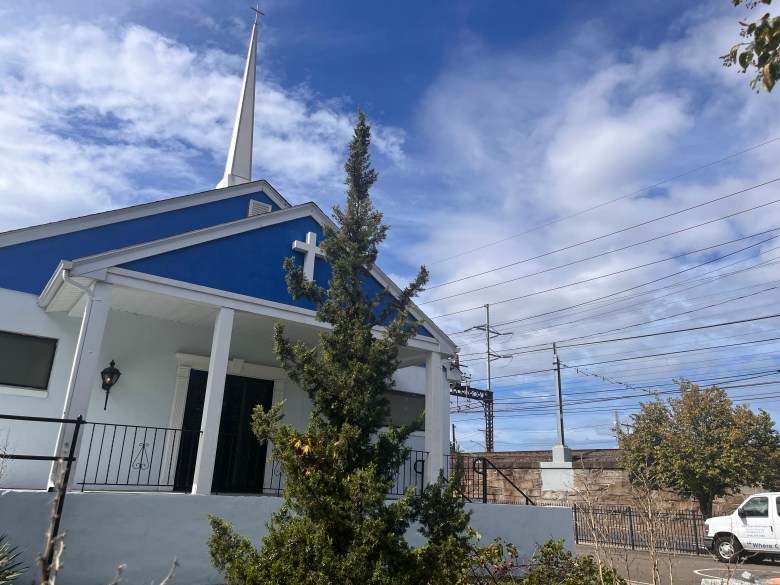
A portion of the easement being sought by United Illuminating to build the transmission line passes directly over the sanctuary, basketball court and playground of the Shiloh Baptist Church, an 85-year-old congregation located in Bridgeport’s South End.
“There would be no place for the kids to play basketball,” said the Rev. Carl McCluster, the senior pastor at Shiloh Baptist. “The playground could not be used because you could not enter it, because of the easement that would take away the entrance to the back playground.”
Opponents of the project have repeatedly sought to have UI bury the transmission line underground. The utility has argued that doing so would add up to $500 million in costs to the project’s existing $300 million price tag — estimates that critics argue are wildly inflated.
In an effort to forge a compromise that addressed some of the local concerns, the Siting Council last year came up with its own route, shifting some poles onto the north sides of the tracks through portions of Fairfield. Opponents of that route filed a lawsuit, and in April a judge ruled that the council had exceeded its authority by deviating from the utility’s proposal.
As a result, the original plan went back before the members of the Siting Council for reconsideration.
Earlier this month, the council met and held a non-bonding straw vote in which two members who had previously opposed the original UI route said they planned to allow the project to move forward. Another member who had previously abstained also indicated they planned to vote yes.
One of those members who switched their vote, Khristine Hall, said during the meeting that she had gone “back and forth, back and forth,” over the utility’s proposal, which she called the most difficult decision she’s had to make during her year-long tenure on the council.
Ultimately, she said, costs ended up being a significant factor in the decision. “It cannot be ignored, particularly in the state of Connecticut, when utility bills are so high.”
Lamont told reporters earlier this week that any additional costs for adjusting the route of the transmission line could be spread out among roughly 14 million electric customers in New England if they are determined to be for safety or other practical purposes, rather than purely aesthetic ones.
That process, known as regionalization, is governed by ISO New England, the operator of the six-state electric grid. A spokeswoman for ISO-NE said this week that the organization has yet to review the proposed Fairfield-Congress line but that projects that are moved underground due to state siting decisions are not eligible to have their incremental costs covered on a regional basis.