


A U.S. District Court judge in Rhode Island has ruled that a Trump administration order tying billions of dollars of federal emergency management funds to states’ compliance with federal immigration enforcement investigations is unconstitutional.
Judge William E. Smith’s 45-page decision issued this week orders FEMA and the Department of Homeland Security to release funds for more than 50 programs because the decision to withhold them from so-called sanctuary states was “arbitrary and capricious and unconstitutional.”
Smith wrote that the financial pressure on states to comply or lose irreplaceable federal funding “goes well beyond ‘relatively mild encouragement’ … and amounts instead to ‘economic dragooning.’”
“The record shows that states rely on these grants for billions of dollars annually in disaster relief and public safety funds that cannot be replaced by state revenues,” Smith wrote. “Denying such funding if states refuse to comply with vague immigration requirements leaves them with no meaningful choice, particularly where state budgets are already committed.”
Connecticut was one of 20 states that filed the federal lawsuit in May in Rhode Island, alleging that the withholding of funding was not only impacting the state’s ability to respond to disasters but also to other vital programs involving responses to mass shootings, wildfires and cybersecurity threats.
The judge approved the states’ motion for summary judgment.
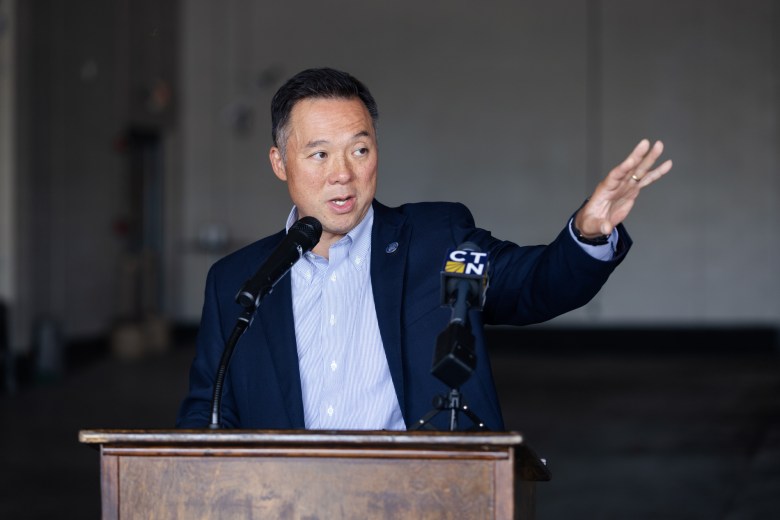
“You cannot play politics with disaster relief. Not with lives and communities on the line. We sued, and this decision is a decisive victory for public safety and our sovereign states,” Connecticut Attorney General William Tong said in a press release Thursday.
“This decision states unequivocally that Donald Trump’s baseless actions were once again arbitrary and capricious … and that he had zero authority to override the will of Congress. We’re going to keep fighting and we’re going to keep winning to stop Trump from defunding our states,” Tong added.
DHS Assistant Secretary Tricia McLaughlin issued a statement Thursday that “the Trump Administration is committed to restoring the rule of law and no lawsuit, not this one or any other, is going to stop us from doing that.”
“Radical sanctuary politicians need to put the safety of the American people first—not criminal illegal aliens. Cities and states who break the law and prevent us from arresting criminal illegal aliens should not receive federal funding,” McLaughlin said.
In February, DHS Secretary Kristi Noem issued a memorandum titled “restricting grant funding for sanctuary jurisdictions.” A FEMA administrator at the time identified only 12 of 53 programs where the government could lawfully withhold funding from sanctuary states, but despite that, DHS revised its policy to include all federal programs covered by FEMA and DHS, according to the lawsuit.
[RELATED: FEMA funding for ‘sanctuary’ areas under review, CT officials warn]
After the lawsuit was filed, the government revised the initial order twice to say only 13 of 53 programs would be under DHS review regarding assistance in immigration cases. In arguing against the summary judgment motion, attorneys for the Department of Justice argued the lawsuit was now “moot” because the order had been rolled back and the remaining 13 programs were still under review.
But Smith ruled the “partial rescission cannot moot the controversy where the government continues to assert the authority to enforce the challenged policy.”
“DHS still asserts it was authorized to impose these immigration-related conditions, continues to publish them in its standard terms, and has not issued amended agreements to plaintiff states reflecting any exemption,” Smith wrote.
“Since 2021, Connecticut has received more than $1.2 billion from FEMA to prevent, protect against and respond to flooding and other natural disasters, terrorism, mass casualty events and other catastrophes,” Tong said in a press release. “These conditions would also damage the carefully built trust between law enforcement and immigrant communities that is critical to promoting public safety.”
Attorneys general from California, Illinois, New Jersey, and Rhode Island, was joined by the attorneys general from Colorado, Connecticut, the District of Columbia, Delaware, Hawaii, Maine, Maryland, Massachusetts, Michigan, Minnesota, Nevada, New Mexico, New York, Oregon, Washington, Wisconsin and Vermont were plaintiffs in the lawsuit.
