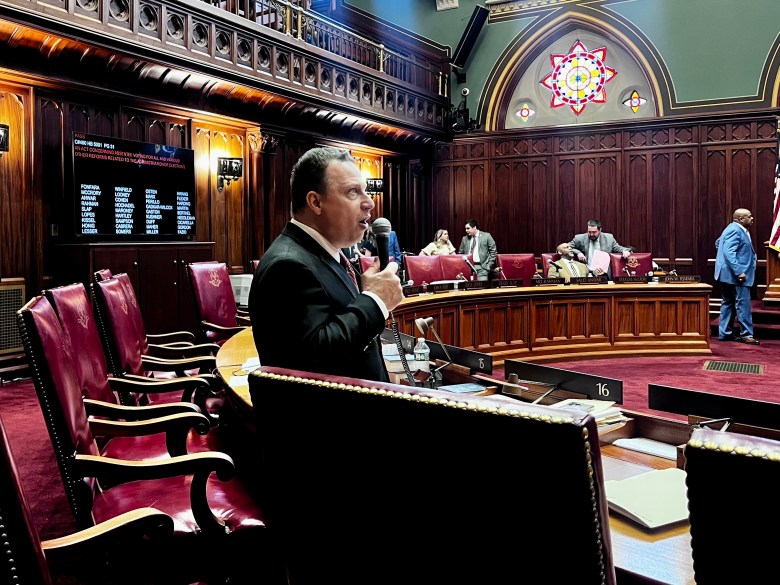
Just days before the end of the legislative session, Sen. Rob Sampson, R-Wolcott, presented his fifth amendment after as many hours of debate to a piece of labor legislation. The amendment failed, but Sampson spoke for two hours and 48 minutes that day.
That time was just a fraction of the 14 hours and 41 minutes Sampson spoke during Senate debates this session — about 18% of the total time the legislative body spent in debate, according to a CT Mirror analysis that employed artificial intelligence.
Sampson has long been known for his lengthy debate strategies, a habit that drew attention early in the session when Senate Democrats took a rare step and called for emergency certification of bills that hadn’t passed last session. They said the bills had failed because of Republican debate tactics.
Some advocates and politicians say Sampson’s debate style is obstructive, a stalling tactic that prevents important bills from being passed. Others think the time-honored tradition of unlimited debate is a vital part of Connecticut’s legislative process.
Following Sampson, seven other GOP Senators each spoke in the ballpark of 3 to 5 hours throughout the session. Senate Majority Leader Bob Duff, D-Norwalk was the most outspoken Democrat, speaking for a total of 2 hours and 44 minutes.
CT Mirror calculated time spoken by tallying the number of seconds each speaker spent talking across the 17 Senate session days. The calculation does not include pauses or responses directed to the speaker.
Senate Republicans talked more than Senate Democrats for all but two days of the session. The 11 GOP Senators spoke 57% of the time, and the 26 Democratic Senators spoke for a combined 32%.
When you can’t vote, talk
Gayle Alberda, associate professor of politics at Fairfield University, was not surprised to hear that the minority party talks so much.
“[Talking] is kind of one of the only mechanisms, because they’re not in positions of leadership when they don’t have control of the chamber,” she said.
“There’s an old political saying … ‘When you have the vote, vote, and when you don’t, talk,'” said Senate President Martin Looney, D-New Haven.
And when it comes to Sampson’s outsized role, he might be the “party designee” called upon by leadership when a filibuster is required, because it is known that he can perform, Alberda said.
But some advocates and politicians are frustrated by what they view as a deliberate attempt to run out the clock.
“It’s not just a question of everybody’s right to have their voices heard, no … it’s deliberately dragging out the time so that it’s harder to get more bills passed,” Lori Brown, the executive director of the Connecticut League of Conservation Voters, said.
She was disappointed not to see the waste management and tire recycling bills, HB 5524 and HB 5157, pass in the constrained time window of the short session.
“You can guarantee that someone like Sampson is just put up there to just chatter, to just say anything and everything, whether it’s related or not,” Brown said.
Sen. Martha Marx, D-New London, was also frustrated by the amount of time Senate Republicans spent posing questions.
“I think they’re wasting people’s time, like 95% of the time” when asking bill questions, Marx said.
Marx also worries about the safety of leaving the state house in the middle of the night after 12 hours of debate to drive home. “Leaving at 2 o’clock in the morning is dangerous,” she said. “It just serves no purpose except to pontificate.”
On the penultimate day of session, Senate Republicans spent 6 hours debating an omnibus transportation bill that passed 32-4 with bipartisan support.
Sen. Christine Cohen, D-Guilford, co-chair of the Transportation Committee who brought the bill, said that after three hours, it became clear the debate was no longer constructive and instead just a “delay tactic.”
“Their strategy, I think, was to try to get us to change our minds on the gun bill by talking that transportation bill far longer than it was justified,” Looney said.
“They kept coming back to us earlier on that day and the day before, saying we can move things a lot quicker if you will agree not to take out the gun bill at all. We said ‘No, that’s an important bill for us, an important bill for the governor, and we are going to do that bill,'” Looney said.
Debate over the gun bill went until 7:22 a.m. on the last morning of session when it passed along party lines.
“That’s part of their job, is to have these deliberations,” Alberda said. “It’s meant to move slowly.”
An exercise in time management
However, Senate Republicans say they cannot be blamed for Democrats’ “poor calendar management.”
“They control the calendar, they can call a bill, and they can fall into session any day they want,” said Senate Minority Leader Stephen Harding, R-Brookfield.
“If a bill was that important to them, they could call us into session on any day in March and get that bill called. We can’t filibuster that until midnight on May 4, and they know that,” Harding said.
Sampson suggested that to get in more debate time, Senators could start their days earlier. The Senate is typically not in session in the morning and often begins much later than planned.
“I speak on these bills because I believe very firmly that my job is to represent my constituents,” Sampson said.
Sampson said strike-all amendments that replace entire bills without giving lawmakers time to read the new language “drive me to speak more.”
Sen. Ryan Fazio, R-Greenwich, the second-biggest talker, agreed. “You’ll get something an hour or two sometimes before it’s actually voted upon as a strike-all amendment or whatever, and you don’t really have an opportunity to understand what’s in the bill before before you vote on it,” he said.
Proposals in years past to mandate a 24-hour notice period for legislation text didn’t go anywhere, said Fazio, who is running for governor.
Republicans say if they are not brought to the negotiating table, their options are limited.
A tradition of unlimited debate
The majority party has the power to “call the question,” a strategy that would immediately end debate, but unlimited debate is a tradition, and as Looney says, a “privilege.”
Cooperation from Republicans has allowed the tradition to continue, even as their representation dwindles, Looney said.
Besides, any effort to call the question would require coordination between the House and the Senate, and House Speaker Matt Ritter, D-Hartford, said he was not aware of any abuses of the legislative ecosystem in 2026.
“We got passed everything we wanted to get passed,” Duff said of this year’s session.
Sampson said he’s sometimes used as a scapegoat when Democratic leadership may not want to call a bill.
“There are many bills [Democratic leadership] do not want to pass that come from their own membership, and they love to use the minority, and particularly me, because of my skill set, as the foil to suggest that I’m the person responsible,” Sampson said.
“They can pass anything they want. The matter of the limitation is only their priorities.”
Looney reinforced that Democrats pass what they want to get done and said Republicans don’t limit them.
Democrats employed one unconventional method this session: two emergency-certification bills that passed priority legislation skirting traditional avenues.
And, if it was really necessary, leadership has the option to call a special session once the clock hits midnight on the last day.
Looney said he’s proposed a rule change that would allow lawmakers to continue bills that passed one chamber in previous years without sending them back through the committee process, thereby bypassing what they deem repetitive debate.
Republicans argue that it’s necessary to get their objections on the record.
“I really believe that if Sen. Sampson, or someone like Sen. Sampson, did not exist, he would have to be invented for the public’s benefit, because there needs to be someone who is a constant intellectual skeptic and a thorough intellectual skeptic of big government in the state Senate,” Fazio said.
Editor’s note: CT Mirror made transcriptions of CT-N recordings of senate sessions using Deepgram, which provided speaker diarisation and timestamps. Speaking time per person was calculated by summing the duration of each of their utterances and excluding silent gaps. Pauses between speakers were not included in the calculations.