


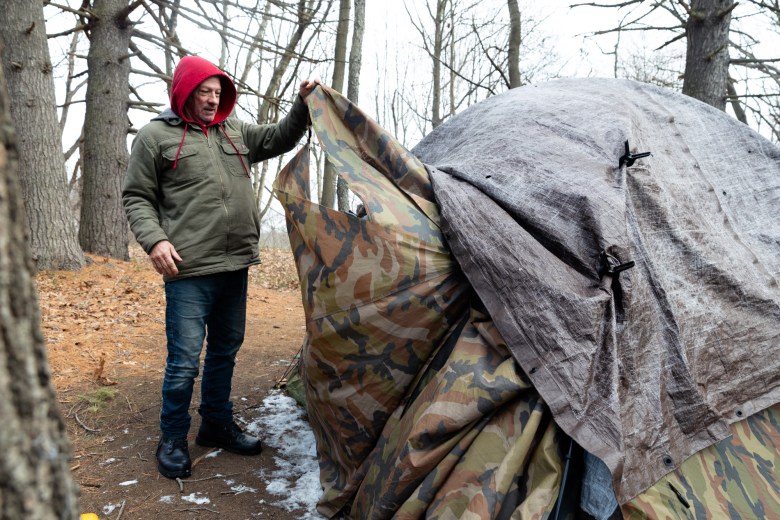
State legislators and homeless service providers are calling for more state funding to address homelessness in Connecticut, directly asking Gov. Ned Lamont on Friday for more spending.
At a press conference at the Legislative Office Building in Hartford, key members of the General Assembly’s Housing Committee and End Homelessness Caucus, alongside advocates with the Connecticut Coalition to End Homelessness, laid out their demands for aid. Funding is needed to prevent rising homelessness and provide housing to the more than 8,000 unhoused people in the state, proponents said.
The legislature’s 2026 session kicked off Wednesday, and legislative leaders and advocates are working quickly to ensure their priorities are addressed. Friday’s was the latest in years of repeated calls from advocates to increase state funding to help people experiencing homelessness statewide.
Rep. Eleni Kavros DeGraw, D-Avon, co-chair of the legislature’s Planning and Development Committee and a member of the End Homelessness Caucus, urged the state to allocate funding to programs that would prevent deaths among people living in unsheltered conditions.
“I am not sure what it is going to take for the executive branch to hear us when we say, ‘Not one more,’” Kavros DeGraw said. “We can do better. We should do better, and this is the year to do better.”
The End Homelessness Caucus formed during the 2025 legislative session. This year its members are asking the Housing Committee to establish a $10 million fund to help people in need with rental and security deposits, utility assistance, transportation and other short term stabilization needs. They’re also seeking $31.6 million in the general fund to provide shelter for the unhoused.
“This is not an agenda, this a statement of need,” said Antonio Felipe D-Bridgeport, the co-chair of the Housing Committee and founder of the caucus. “People are in need right now.”
Rob Blanchard, a spokesman for Lamont, defended the governor’s efforts to address homelessness, saying his administration is investing in programs that provide in-person services. Blanchard said Lamont has tapped $5.2 million of a $500 million emergency fund the legislature established to backfill federal funding cuts under the Trump administration.
That $5.2 million was put toward the Continuum of Care program, including hubs for homelessness, community health workers and Department of Social Services resource centers, Blanchard said.
“These efforts are part of his ongoing commitment to strengthening essential safety nets and increasing affordability for all Connecticut residents,” Blanchard said.
Unsheltered homelessness has been increasing in Connecticut in recent years.
The population of people living outside, in their cars or in other places not meant for human habitation rose by 45% from 2024 to 2025. An annual count, which took place in January last year, showed that 800 people were unsheltered on that night.
“Frontline teams are doing everything possible, but we need predictable — we need life-saving resources in place so that when the next emergency hits, protecting human life is not dependent on extraordinary measures,” said Sarah Fox, CEO of the CT Coalition to End Homelessness.
Bridgeport Councilwoman Eneida Martinez, who has worked with the homeless population for over 20 years, said her city lacks shelter and funding to help those in need, especially during the winter months. Due to increased immigration enforcement under the Trump administration, many unhoused noncitizens are afraid to go to the shelters, she said.
Martinez said she checked in on a homeless man on Jan. 31 who she has regularly helped for the last two years, and she urged him to go to the shelter to avoid frigid temperatures that night. Because he was undocumented, he refused to go out of fear, she said.
The next morning, Martinez said she got a call that the man had died due to the freezing conditions.
“Homelessness is one of America’s most visible yet least understood challenges. It affects people from all walks of life who struggle due to hardship, lack of affordable housing and other barriers,” she said. “Governor, I urge you to please find a way to meet the needs for those that are in need.”