



Gov. Ned Lamont refused Thursday to rule out vetoing portions of the emergency bill speeding through the General Assembly towards his desk, wary over the inclusion of provisions that provide new earmarks or clarify badly written ones already in the budget.
“I have concerns,” Lamont said.
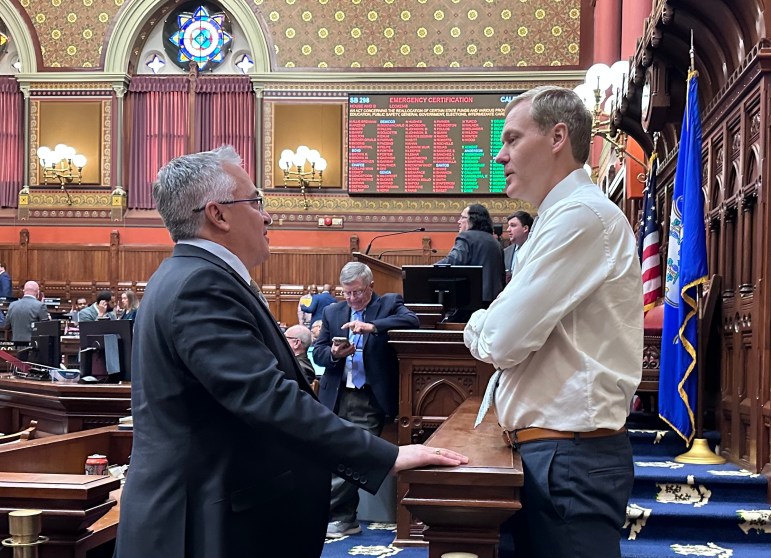
Lamont, a Democrat seeking reelection to a third term, spoke to reporters as the House of Representatives was debating Senate Bill 298, a 98-section emergency-certified bill that cleared the Senate on Wednesday and was on a path to final legislative approval by day’s end Thursday.
It passed on a vote of 96 to 48.
Earmarks are a relatively small piece of the bill, but they have an outsized political profile due to the FBI’s election-year investigation of how a Democratic state senator, Douglas McCrory of Hartford, influenced the delivery of state grants through earmarks.
Republicans highlighted earmarks Thursday, with House Minority Leader Vincent J. Candelora, R-North Branford, publicly pressing Lamont before the House debate for a veto commitment.
“With the potential criminal activity in the building with these earmarks, this bill doubles down on providing more earmarks to organizations,” Candelora said. “I am going to request that the governor exercise his veto power and, at the very least, line-item veto all of the earmarks that are contained in this emergency-certified bill.”
The bill has several million dollars in appropriations, though most involved redirecting state funds. In one case, the bill reduces a $3.25 million recreation grant for Hartford to $2.5 million. But it also dictates new spending of $330,000 for a nonprofit in Hartford, Our Piece of the Pie, and $174,000 for a VFW in New London.
It also makes changes in eligibility rules for school construction to benefit projects in Cheshire and Middlefield.
The Connecticut Constitution allows the governor to remove them with a rarely used line-item veto that allows him to excise any piece of a bill that appropriates money.
For his part, Lamont used questions from the media about a potential veto to pointedly remind Democratic lawmakers that he expects action on his proposed earmarks reforms, House Bill 5039, which was the subject of a public hearing Tuesday. It calls for greater vetting and transparency.
“I have some earmark reform legislation in front of the legislature. I’d like them to look at that,” Lamont said. “I think we got to do a better job of giving people confidence that taxpayers money is going for the purposes for which it’s intended.”
House Speaker Matt Ritter, D-Hartford, already had committed Thursday that the reforms “will very much be a bill that we take up this session.” He said he will hear out the governor’s concerns regarding a possible veto.
He said Democrats explored including a version of Lamont’s bill in the emergency legislation.
“There was an attempt to get it done today,” Ritter said. “I just think it wasn’t quite ready, because there’s a lot of people that have to to look at that thing — staff, non-partisan staff. It’s a big change when you’re talking about directed earmarks in a General Assembly.”
House Republicans tried to force the issue with a proposed amendment offering their version of earmark reform, including a prohibition on grants to any nonprofit that employs a state lawmaker. It failed on a party-line vote, as did a similar effort in the Senate.
“The budgeting process, it seems to be becoming more of a friends and family receiving money, as opposed to public interests receiving money,” Candelora said during the debate. “And to me, it is astounding, and I’ve never seen the level of mismanagement of tax dollars in an administration that I have seen over the last couple of years.”
The vote on the bill was largely party line. Three Republicans joined 93 Democrats in favor: Christie Carpino of Cromwell, Tom Delnicki of South Windsor and Ben McGorty of Shelton. Four Democrats joined 44 Republicans in opposition: Jill Barry of Glastonbury, Stephen Meskers of Greenwich, Chris Poulos of Southington and Jonathan Steinberg of Westport.
Senate Bill 298 would provide millions in earmarks and other grants to select communities and groups, extend a moratorium on addressing racial imbalances in schools, aid a firefighter cancer relief fund and revise election and freedom of information laws, child support enforcement and behavioral health regulations.
It also would increase reimbursement for intermediate care facilities, repeal a building code change meant to make apartment construction cheaper, revise training standards for how police deal with persons with disabilities, tweak the calculation of municipal pensions and set worker-friendly standards on warehouses.
The reimbursements for intermediate care facilities, which serve an intellectually disabled clientele that need more care than a group home but less than a skilled nursing home, would increase by 2% this year, 3% next year and 3.3% in the two following years. It would increase state Medicaid costs by $700,000 this year and $4.9 million in fiscal year 2029.
The warehouse bill is a major labor initiative that passed the House last year on a partisan vote, only to die without a vote on the Senate calendar. It was prompted by labor concerns over Amazon’s use of quotas and biometric surveillance to manage its warehouse workers.
The bill creates a private right of action allowing workers to sue. The new version deletes a pro-business element in last year’s version: the ability of a business to recover legal costs in any case where they prevail.
Senate President Pro Tem Martin M. Looney, D-New Haven, had insisted on deleting that section, arguing that no worker would think of suing if facing a potential order to pay hundreds of thousands in legal fees.
On Thursday, House Republicans complained during the House debate that the new version of the warehouse bill had not been vetted by a public hearing, and they called it anti-business.
“What are we thinking, sending this message?” said Rep. Steve Weir, R-Hebron.
Candelora said it appears targeted to Amazon. The bill applies to warehouses that employ at least 250 or have a warehouse workforce in the state of 1,000.
“So, maybe it only hits Amazon, but maybe it doesn’t. But what I do know is it sends a message to businesses that are looking to located,” Candelora said.
Lamont said he was unconcerned by the changes.
Ritter and Looney, as leaders of the two chambers, have the authority to designate any bill as “emergency-certified,” or e-certs. That bypasses the need for review by committees or a public hearing. Both justified the unusual action this week as a reaction to GOP filibustering or threat of filibustering at the end of last year’s session.
The General Assembly has a tradition of unlimited debate, which shifts power to the minority in the closing days of the session. Ritter said Thursday that the use of emergency powers does not signal a permanent change at limited minority rights.
“There’s always been this delicate balance in the Connecticut General Assembly around the unwritten rules, right?” Ritter said. “And perhaps there’s no more important unwritten rule than the fact that we give everybody a chance to say whatever they want to say for as long as they want to say it.”
Ritter said before the debate that “delicate balance” was upset in the Senate last year, when bills that passed overwhelmingly in the House were blocked from final action in the Senate. He found that abusive.
“To my Republican colleagues, I would say, ‘Play it fair. Play it straight.'”
On the House floor, House Majority Leader Jason Rojas, D-East Hartford, said the ability to move business was as vital as other traditions.
“We have a responsibility to act. I don’t believe that we should do our business this way all the time. I don’t believe the speaker does,” Rojas said.
Republicans were hardly contrite. They accused ther Democratic leaders of abusing their authority. On the House floor, Rep. Doug Dubitsky of Chaplin called it “tyranny.”
Rep. Tracy Marra of Darien offered a milder rebuke: “We are brought here today to vote on things we know are not emergencies.”
