


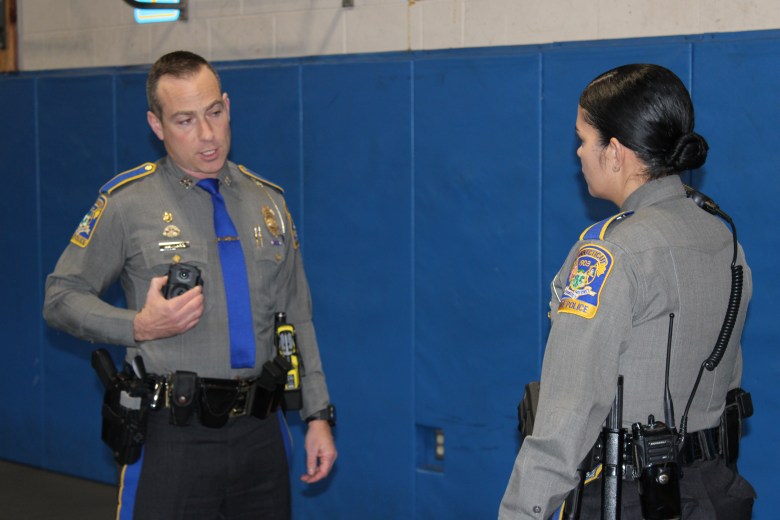
State police troopers on Wednesday demonstrated the first components in a series of new equipment they’re deploying, part of a $120 million package the state legislature approved to upgrade law enforcement technology over the next decade.
Troopers say investment in the new technologies — including new tasers, virtual reality software for training, and body cameras with translation capabilities — will improve safety for community members and enhance officers’ ability to do their jobs.
The package, which begins this year with $10 million in purchases, will cover the cost of tasers, virtual reality, body cameras, a software platform that gathers video and data from across the state, drones that can be deployed in response to 911 calls and technology that can speed up body camera video processing and records management.
According to Gov. Ned Lamont’s 2027 budget proposal, the investment “has replaced outdated, first-generation police technology and equipment and equips the State Police with advanced tools that modernize operations, enhance efficiency and improve safety for both officers and the public.”
At the State Police Academy on Wednesday, State Trooper Dale DeGaetano demonstrated the department’s new tasers, called the TASER 10 or T-10 model, purchased from the company Axon.
Tasers function by firing two probes into the body of the person being targeted, generally one in the lower torso or upper back, and one in the leg or buttocks. A current is then generated that immobilizes the muscles, stopping the person in their tracks.
With earlier-generation tasers, troopers fired two probes simultaneously at a pre-defined angle, and would have only two additional probes if the first attempt didn’t immobilize the person being targeted. In contrast, the new tasers can hold 10 individual probes, which DeGaetano said amounted to five times the opportunity to take someone down by non-lethal force.
“ This is such a smart device [that] it’s going to calculate the best connectivity between probes, decide which one is positive or negative,” said DeGaetano. “And this is split-second. It’s doing all the thinking for us as far as where the volts go, how they go, and all that.”
According to DeGaetano, the new tasers can work at a distance of up to 45 ft., nearly twice that of the old tasers. The new tasers also use less power — 1,000 volts rather than 40,000 or 50,000 volts — which DeGaetano said makes them safer for the person being tased.
The T-10 makes a whooping noise when turned on and uses a green laser point to guide the officer in targeting the probe.
The taser’s battery includes a hard drive that collects data — including timestamps of when it’s drawn from its holster, turned on and fired — and sends the information automatically to the state police’s centralized evidence system. In the past, DeGaetano said, the information would have to be downloaded off the tasers into the system.
The new data collection, DeGaetano said, along with footage from body cameras, will allow people to clearly see after the fact what happened during a particular event.
“ One way or the other, it’s going to paint the most accurate picture and leave very little ambiguity about the time period and the timeframe [in] which something happens,” he said.
According to DeGaetano, the new tasers have been in use for about three months, and all the instances he’s aware of in which they have been deployed have had safe outcomes.
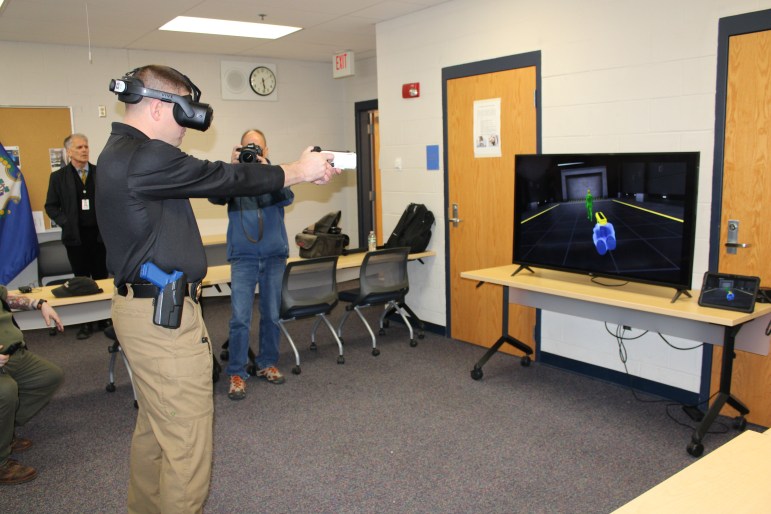
The package also included purchasing of virtual reality headsets and software that troopers use to practice shooting the tasers. DeGaetano said the troopers were able to shoot anywhere from 100 to 200 virtual cartridges per day using the virtual reality software, a prospect that would be more expensive if they were shooting real cartridges.
“We need repetitions in training. This gives us those repetitions,” he said.
The virtual reality software allows troopers to practice shooting at both standing and moving targets. It also places them in lifelike scenarios — for example, a traffic stop in which the person in the car pulls out a knife.
DeGaetano said the department hopes to bring the virtual reality headsets to community events, so that the community can better understand the work the officers are doing. He said the simulators could also be a way to introduce teens to the possibility of a career as a police officer.
Officers also demonstrated body cameras that will automatically activate when a taser is deployed. The body cameras can translate 50 languages using Artificial Intelligence, and can automatically detect the language of the person speaking.
Trooper Ryan Maynard said that right now, officers have to rely on their phones to translate, or they have to call a language line. But using the phone isn’t always practical or safe, and it can divert the officer’s attention from the scene, he said.
“It is incredibly more streamlined [with the new cameras],” said Maynard. “I can speak from experience being on calls where we couldn’t get the phone to work … and unfortunately that person just couldn’t speak English. So this is absolutely enhancing our ability to serve the people of Connecticut,” he said.
“The whole point here is to make these interactions safer,” he added.