


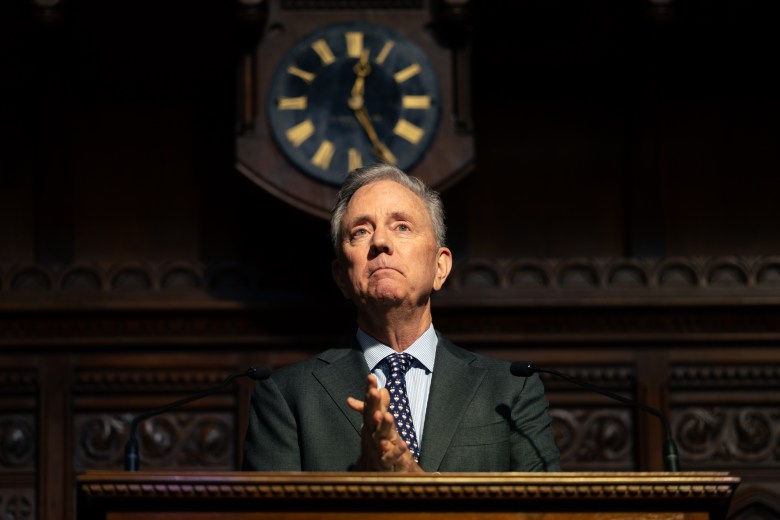
Gov. Ned Lamont has cleared a big political hurdle, having now reached tentative deals on raises with more than 20 additional bargaining units within state government.
The latest agreements, along with 11 the governor announced earlier this year, mean he now can ask lawmakers to approve raises for the bulk of state government’s unionized workforce, about 45,000 employees, before the General Assembly session ends May 6.
According to records filed Friday with legislative clerks, the administration would grant most workers a general, 2.5% wage hike this fiscal year — retroactive to last July 1 — and in each of the next two fiscal years.
Many employees, excluding those at the most senior levels, also would be eligible for an annual step hike. This typically adds roughly 2 percentage points to the raises’ value.
Though the proposed contracts cover raises for three fiscal years, they technically run for four. But they stipulate that wages for the 2028-29 budget cycle would be negotiated shortly before that period begins.
“State residents and businesses depend on our state employees, who keep us safe, maintain our roads, educate students, protect our environment and deliver assistance to our most vulnerable residents,” Lamont said Monday. “This agreement recognizes their dedication, supports retention and recruitment and delivers a fair deal for taxpayers. I urge the General Assembly to act quickly to approve this agreement and deliver these reasonable wage increases to our state employees.”
The Democratic governor, who is seeking reelection this November to a third term, was running out of time to resolve raises for part of his political base.
Wage agreements must be submitted to legislative clerks 10 days in advance of any vote in the House or Senate. There only are 23 days remaining before the legislative session closes and many key issues remain unresolved, including adoption of a revised budget for the fiscal year that begins July 1.
Still, the Democratic-controlled legislature is expected to ratify the pay hikes before the May 6 deadline.
Remote work rules remain largely unchanged
The tentative deals don’t make any major changes to remote-work rules that were expanded in 2020 and 2021 during the coronavirus pandemic, despite a strong push for reform from Lamont.
The governor has been sparring with unions since last spring, saying some agencies could be more productive if more workers returned to the office.
Agreements defining work-from-home policies don’t expire for another year, and labor officials — who say they improve efficiency and should be preserved — declined to revise them.
Despite his battles over work-from-home rules, the governor insisted repeatedly over the past year that all state workers would be getting good raises.
“They’ve had a raise every year from me for the last six, and they’re going to get a raise in years seven and eight,” he said during an April 25 appearance at a labor conference in Mystic.
Lamont and the General Assembly last May awarded a 2.5% cost-of-living raise and a step hike to state police troopers for the 2025-26 fiscal year. The trooper’s union is the one major bargaining unit not in the State Employees Bargaining Agent Coalition.
But the governor didn’t reach any tentative deals on raises with unions within the coalition until January — more than six months after the last wage deal had expired — when he endorsed a 2.5% raise plus a step hike for a 4,000-member maintenance union.
And by mid-March, the administration had tentative agreements on raises with 10 bargaining units.
Labor leaders on Monday praised all of the deals, saying they would help Connecticut recruit workers to many understaffed agencies.
“As recruitment and retention challenges have intensified across the public safety sector, our members have remained unwavering in their commitment. Each day, our members answer the call to serve — standing ready at a moment’s notice to protect the lives, property and well-being of every resident and visitor in Connecticut,” said Dan Starvish, president IAFF Local S-15, State of CT Fire Fighters.
“This contract represents a meaningful investment, and while it marks important progress, it is not the end of the work,” Starvish said. “Addressing ongoing recruitment and retention challenges remains essential to ensuring the long-term strength and effectiveness of Connecticut’s public safety workforce.”
Transportation engineer Travis Woodward, president of CSEA SEIU Local 2001, added “these contracts represent a reasonable step towards the recruitment, retention and reinvestment needs of our public services.”
If the legislature ratifies the proposed raises for unionized workers, equity provisions in a 2021 law would trigger comparable pay hikes for non-union staff.
