


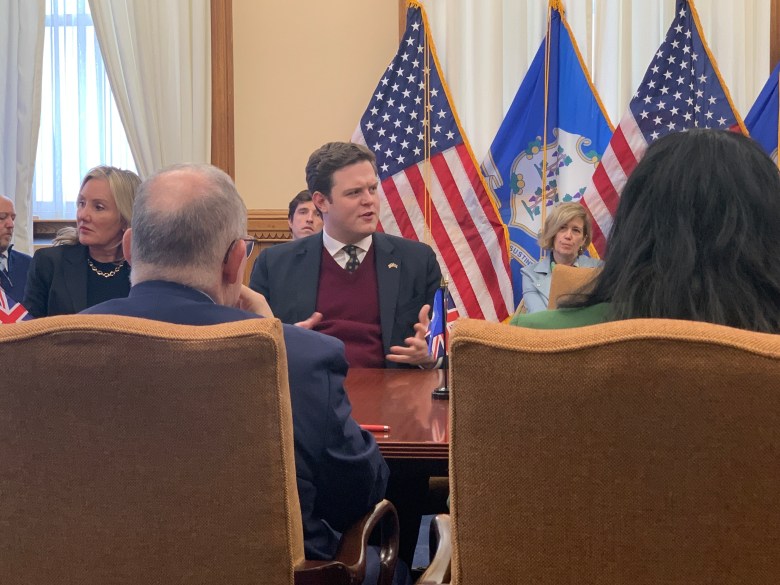
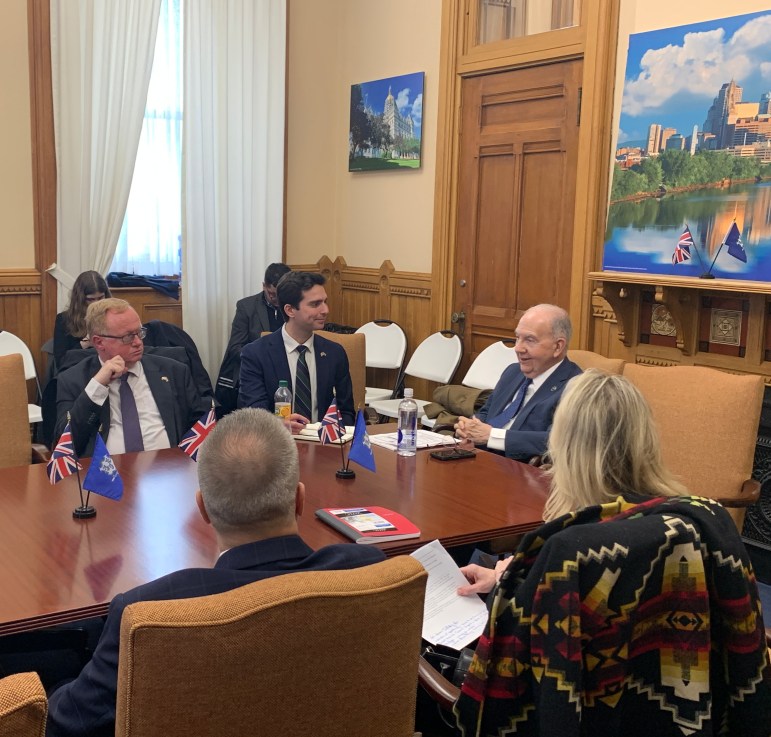
In late March, a group of Connecticut business leaders, politicians and state economic development officials filed into a meeting room at the Capitol to hear from a visiting quintet of British lawmakers.
Organized by the U.K.-CT Friendship Caucus, the gathering brought state legislators together with a delegation from the United Kingdom Parliament to discuss everything from the economy to artificial intelligence, education and potential areas of collaboration between the state and the U.K. following the U.S.-U.K. Economic Prosperity Deal announced last year.
“Visits like this allow us to exchange best practices, learn from each other’s experiences, and develop innovative solutions that can benefit people on both sides of the Atlantic,” said David Clay, the British consul general to New England.
The caucus is just one of a number of ways Connecticut leaders have sought to bolster economic relationships with international partners in recent years — beginning even before President Donald Trump’s second term. But as Trump has moved quickly to overhaul tariff policy, trade relationships built at the state level could help Connecticut to maintain friendly business dynamics with its many trade partners.
In some cases, like the U.K.-CT Friendship Caucus, a collaborative working group is used in tandem with other local economic development programs to encourage collaboration. In other instances, like the Connecticut-Ireland Trade Commission, a legislatively-approved body is tasked with creating a more formal partnership with a nation, opening up new opportunities for trade and business relationships.
This year, state lawmakers are working to add two new groups to the effort. Two bills, Senate Bill 132 and Senate Bill 133, would establish new state trade commissions with Germany and India respectively.
The bills drew strong support as several countries look to establish relationships with U.S. trade partners independent of the federal government. The commissions would initiate trade deals, promote business and academic relationships and encourage “mutual investment” between Connecticut and the two countries.
Both measures cleared the Commerce Committee in unanimous votes. On Wednesday, S.B. 132 was amended to combine the two bills into one piece of legislation. Shortly after, the state Senate voted 36-0 to pass the amended bill.
“These trade commissions will help to send a message that Connecticut is a de-risked environment,” Sen. Joan Hartley, D-Waterbury, said on floor of the Senate Wednesday evening. “That we are stable, reliable business partners.”
Connecticut embraces trade commissions
Proposals aimed at boosting Connecticut’s international profile have largely come out of the legislature’s Commerce Committee, which focuses on the state’s economic well-being.
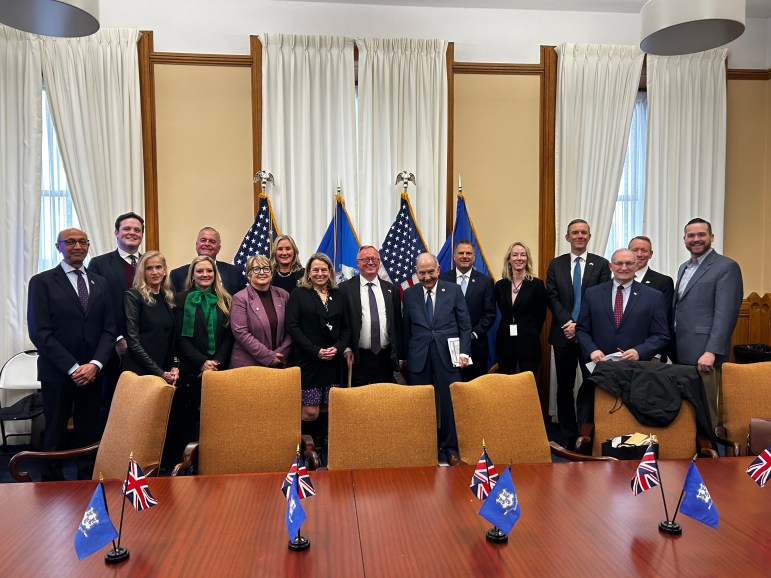
The U.K.-CT Friendship Caucus was established in 2023 to further support partnerships that had already been set up around insurance and advanced manufacturing.
In 2024, the state legislature, inspired by work in New Jersey, approved its first official trade commission, the CT-Ireland Trade Commission. The group’s members are appointed by state leaders, serve for four-year terms and are expected to foster connections with Irish leaders and companies, particularly in fields like the life sciences, technology and financial services.
“Ireland is now the largest English-speaking country left in the European Union,” Mark Daly, a member of the Irish Senate, said when supporting the bill in 2024. “And we are the gateway to a market of 450 million people.”
Last year, the state established its second trade commission, this time with Puerto Rico, in the hopes of boosting economic investment and policy collaboration between the state and the island, a U.S. territory. That commission is largely overseen by the legislature’s Black and Puerto Rican Caucus, which was a strong proponent of the 2025 proposal.
For Hartley, who serves as a co-chair of the Commerce Committee, the trade commissions are intended to raise visibility for Connecticut on the international stage. “We are a very significant part of international and global conversations,” she said. “The model now is that global partners are connecting on a state to state basis. This initiative that we have been working on and scaling is really part of that.”
Building the groundwork for a state trade commission can take years. The Ireland and Puerto Rico commissions drew from established economic relationships, a significant local diaspora and companies from those places that were already operating in the state.
In other cases, proposals for new commissions have come directly from lawmakers.
Hartley said the Germany commission outlined in the original version of S.B. 132 was pitched to her by state Sen. and General Law Committee co-Chair James Maroney, D-Milford, shortly after a visit to Germany last year. Gov. Ned Lamont also led an economic development trip to the country in 2024.
The proposal for the India commission followed a February 2025 trade visit by Lamont to the country, which currently stands as the world’s fastest growing major economy and a key source of students and H-1B workers in Connecticut. S.B. 133 was also supported by state Sen. Sujata Gadkar-Wilcox, D-Trumbull, the legislature’s first senator of Indian-American descent.
“This is particularly a unique time for states to be able to step in,” Gadkar-Wilcox said on Wednesday as she discussed the bill in the Senate. “At the federal level, with trade agreements, we have some uncertainty. We can take a role that maybe states were not able to take before, to promote things like academic partnerships and business partnerships, to promote our strengths.”
Connecticut isn’t the only state building direct relationships with international governments. According to the National Conference of State Legislatures, several states, including California and Illinois are beginning to take “a more active role in international economic engagement.” A database tracking state commitments with foreign governments notes that there are more than 1,200 such agreements between states and other countries.
Establishing a state trade commission is no small task, according to Hartley. It requires investment from the partner nation, as well as the time and expertise of local officials and experts who serve on the commission.
And it’s expected to produce tangible results, Hartley said. “We’re not just trying to paper the walls here with ceremonial bills or, you know, ‘sister city’ kind of things,” she said. “These are working trade groups.”
Global trade is a big factor in the Connecticut economy
International investment plays an important role in the state’s economic health. According to AdvanceCT, the state receives a significant amount of direct investment from other nations, which supports some 115,000 jobs in the state. More than 800 international companies operated in Connecticut in 2022.
“Connecticut’s workforce is among the most productive in the world, with output per worker that competes with, and in many cases exceeds, leading global economies,” AdvanceCT President and CEO John Bourdeaux said in an emailed statement. “That level of productivity is a major draw for international companies.”
Exports also play a major role in the state economy. In 2025, the state exported nearly $18 billion in products, ranking 27th in the country. That number is a record high and followed years of efforts to recover from a previous decline in global exports between 2013 and 2023.
Many of the top export destinations for Connecticut goods — including Germany, the United Kingdom, and Ireland — are the same ones that lawmakers are looking to connect with through trade commissions. The state also exports a high number of products to Canada, Mexico and the Netherlands.
Those international relationships often revolve around Connecticut’s largest industries, including aerospace and other high-skill manufacturing, life sciences, cybersecurity and educational research.
Increased international partnerships can touch other parts of the economy, like transportation. The popularity of Aer Lingus flights between Hartford and Dublin was a supporting factor in the establishment of the CT-Ireland trade commission back in 2024. Bradley International Airport is currently considering establishing a direct flight to London as well.
The InsurTech Corridor, a specialized partnership focused on boosting the insurance industry’s connections in the U.K., has drawn international insurance companies looking to gain a foothold in the U.S. to Hartford.
Gene Goddard, the chief business investment officer for the MetroHartford Alliance said that effort “is designed to be a long term play to help our insurance industry.”
“They may bring one or two people of their own from the U.K., but then they’ll hire one to 10 people as they grow their business,” in the city, he said, noting that the collaboration could ultimately help more local workers. Currently some 20 companies are involved.
AdvanceCT has been closely involved in building Connecticut’s international business relationships. Last year, the organization supported additional trips to India and Germany.
“These international partnerships are translating into sustained growth, innovation, and new opportunities across Connecticut,” Bourdeaux said.
International partnerships draw increased support
The desire for stronger international relationships was on full display in March as the members of Parliament visited the state to learn more about Connecticut’s economy, workforce and history.
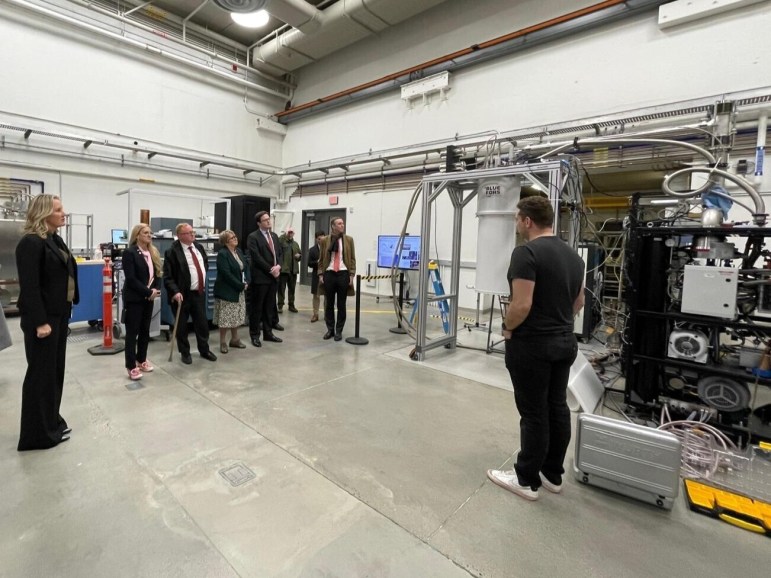
The visit, organized with the support of the British American Parliamentary Group and the British Consulate-General of Boston, included stops in Hartford, New Haven and New London. Visiting members of Parliament also met with various state leaders, including the governor and members of the state’s congressional delegation. The visitors were briefed on Connecticut’s educational infrastructure, its involvement in research breakthroughs in quantum computing, and its manufacturing workforce.
In a sitdown interview with the Connecticut Mirror, the British officials said they appreciated the chance to develop connections in the state.
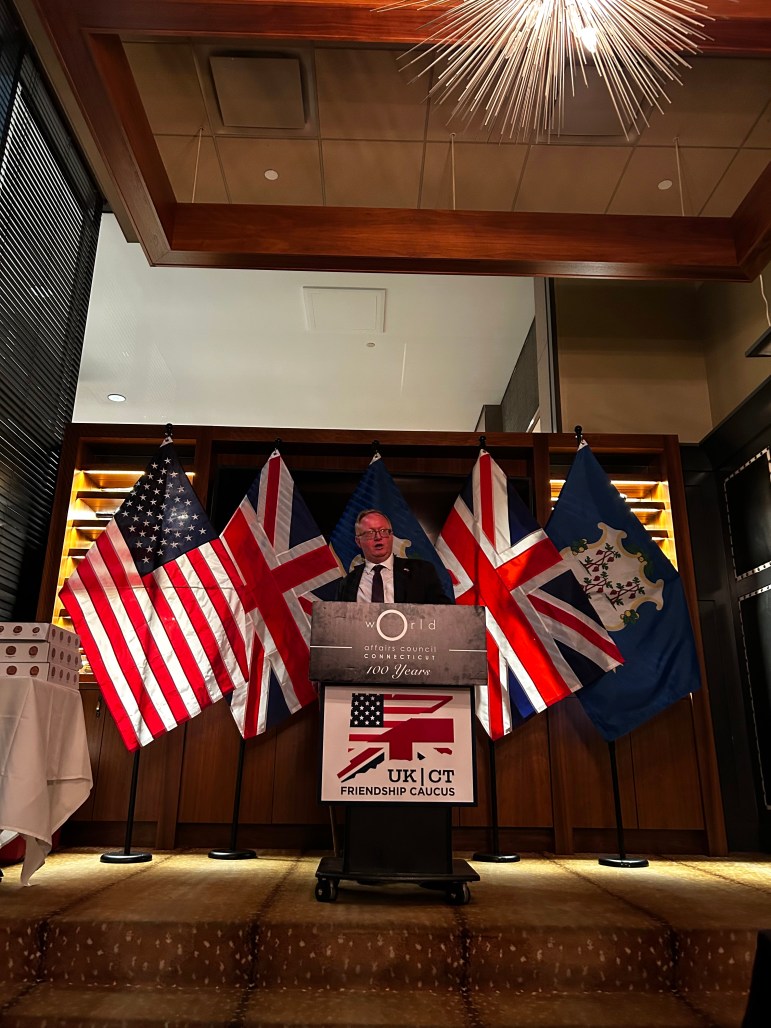
“Increasingly, we felt it’s really important to build relationships at a state level, because that’s where a lot of the key decisions around investment in both directions — U.S. investment in the U.K. and British investment in the U.S. — happen,” said Luke Akehurst, a Labour MP representing North Durham. “We’re picking the ones where we believe that there’s an existing, really strong relationship that we can build on.”
“Connecticut is one of the top priorities for that,” he added.
In some ways, the MPs said, things felt familiar here. “The problems, the concerns, the challenges that we have in all of our constituencies are massively echoed here, with housing, with education, with the workforce, health, all of those elements,” said Amanda Martin, a Labour Party MP for Portsmouth North.
But the visit arrived as both the U.K. and the U.S., as well as other international players, continue to navigate a shifting international landscape.
Since the start of his second term, President Donald Trump has called for tariff increases on more than 100 countries, arguing that the hikes will protect domestic manufacturing and help the U.S. renegotiate trade agreements. That method has faced setbacks in wake of the Supreme Court’s February ruling against the president’s ability to impose tariffs without Congress.
Tariffs also face declining support from the American public, with 63% of respondents to a recent Pew Research Center survey expressing little to no confidence in the president’s handling of tariff policy.
Looking ahead
The commissions proposed this year have been backed by state leaders and agencies, including the Department of Economic and Community Development.
“Establishing a trade commission signals Connecticut’s commitment to global engagement and economic competitiveness,” DECD Commissioner Daniel O’Keefe noted in written testimony supporting the original versions of S.B. 132 and S.B. 133. “It positions the state as a forward-thinking hub for international business, making it more attractive to companies and investors who value strong global connections.”
Still, while the commissions are broadly supported in the legislature, they have faced some criticism from the public, with some residents arguing in written testimony that the state should focus on domestic issues and local workers over making international ties with countries and foreign companies.
That division reflects a deeper difference in opinion that has animated national discussions around international relations, tariffs and trade.
For supporters, the argument overlooks how an increasingly global economy works. “There’s so much to be gained from this,” Hartley said. “It’s about staying competitive.”
The legislation establishing trade commissions with Germany and India, which passed the Senate this week, now goes to the House for consideration.
If passed, the Germany and India commissions will begin their work in the fall. The Ireland commission also continues its work, and some members are considering a visit to the country later this year.
