



Imagine spending 11 years behind bars for killing the man who broke your ribs, burned your skin, and told you that no one would believe you if you screamed.
What type of justice system looks at that woman, knows what she endured, and yet refuses to consider her circumstances when deciding how long she will be imprisoned?

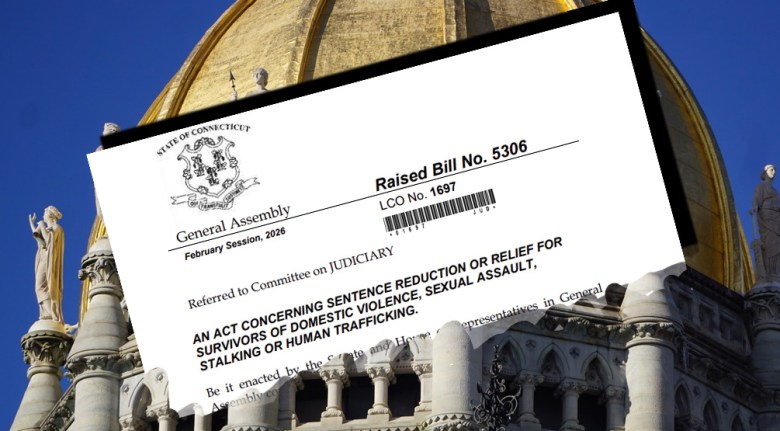
On March 10, the Judiciary Committee of the Connecticut General Assembly heard testimony on House Bill 5306, the Survivors Justice Act, a bill that would allow judges to reduce sentences for survivors of domestic violence, human trafficking, and sexual assault when the abuse they experienced was a direct contributing factor to the crime they committed. The bill is not about softening the consequences. It is about whether Connecticut’s courts will be required to consider mitigating circumstances during sentencing.
This question reaches far beyond the walls of any courtroom. When the law refuses to account for abuse, it does not simply produce an unjust sentence. It sends a message, to every victim still trapped in a dangerous relationship, that the system was not built with them in mind. House Bill 5306 is an opportunity to change that message.
Domestic violence does not operate the way many people assume it does. It is not a single bad incident from which a person simply can walk away. A 2023 resource from the Delaware Coalition Against Domestic Violence titled “Dynamics of Domestic Abuse” explains “that abusers use a cycle of tactics, isolation, financial control, threats, intimidation, and physical harm that are specifically designed to eliminate a victim’s sense of agency and make leaving feel more dangerous than staying.” This is not a claim made only by advocates of the issue. It is documented that courts in multiple states have already accepted this as the basis of sentencing reform.
Research from the New York State Office for the Prevention of Domestic Violence, in its guide “Start the Conversation: Be a Better Ally,” confirms that the period immediately after leaving an abusive relationship is statistically the most dangerous moment for a survivor, the point at which they are most likely to be killed by their abuser. Anyone in this situation is not making free choices from a menu of safe options. They are making desperate calculations inside an environment of constant danger, where every exit has been systematically blocked or weaponized against them.
For some survivors, the abuse reaches a point where the only perceived option is the one that ends with them in a courtroom. The crime is real. The harm caused is real. However, the crime does not exist without what came before it. A 2022 University of Michigan Law Review article titled “Sentencing Survivors” found that self-defense law in the United States was built around the model of stranger violence, a single confrontation between two people of roughly equal power, and that this framework has never accurately fit the reality of survivors who act after years of entrapment. When the law applies a standard that was never designed for someone’s actual situation, the resulting sentence is not proportional. It is a punishment layered on top of an original harm the state had no part in preventing.
The argument that a crime’s circumstances should shape its punishment is not new or radical. It is already embedded throughout the American legal system. Juveniles are sentenced differently than adults because the law recognizes that a minor’s development is not complete and therefore they cannot be held accountable to the same extent as an adult. Mental illness is considered at sentencing because an individual’s state of mind affects moral responsibility. Heat-of-passion doctrine exists in homicide law precisely because extreme emotional disturbance caused by circumstances beyond a person’s control, can change the nature of a crime without eliminating accountability for it.
House Bill 5306 asks for the same reasoning to be applied to a situation the law has historically overlooked. A survivor of years of documented abuse who commits a crime directly connected to that abuse should not be treated the same as someone who commits the same crime without that history.
Anna VanCleave, director of the Criminal Defense Clinic at the University of Connecticut, testified before the Judiciary Committee on March 10, that the bill includes meaningful protections against misuse. Evidence must meet a clear and convincing standard. A judge must determine not only that the abuse occurred, but that it directly contributed to the crime committed. That is a rigorous threshold, designed to ensure that the relief the bill offers reaches the people it was written for and has limited reach.
Connecticut is not being asked to experiment. It is being asked to join a growing number of states that have already passed similar legislation and documented its outcomes. New York’s Domestic Violence Survivors Justice Act, passed in 2019, is the most thoroughly studied. Kate Mogulescu, a professor at Brooklyn Law School who works with the Survivors Justice Project, testified before Connecticut’s Judiciary Committee that nearly 80 people have been resentenced under New York’s law, saving them a combined minimum of 230 years in prison.
Opponents of the Connecticut bill raised concerns at the hearing that the proposed legislation would open the floodgates to a flood of petitions and overwhelm the courts. The New York record does not support that fear and of all petitions filed to date, 79 were granted, over 100 were denied, and 50 remain pending. The system was not overwhelmed. Rather, a carefully screened group of people, people who met a high evidentiary standard, received sentences that reflected the actual truth of their cases.
Oklahoma, Georgia, and Illinois have passed comparable laws. A 2021 Grand Valley State University review titled “Sentencing Reform for Criminalized Survivors” found that among survivors’ justice reforms, regression rates among survivors represented under these laws was exceptionally low. These are not people who return to patterns of violence once released. They are people who were caught in specific, devastating situations, and who once removed from it, did not reoffend. The public safety argument against this bill is not born out of the data from states that have already implemented it.
A 2022 Penal Reform International report titled “Women Who Kill in Response to Domestic Violence” found that justice systems that reformed their sentencing standards to account for abuse context achieved fairer and more accurate outcomes without compromising public safety. Countries with strong rule-of-law traditions have examined this exact question and reached the same conclusion that Connecticut’s legislature is now being asked to reach.
During the March 10 hearing, State Rep. Craig Fishbein raised the concern that the bill creates a “protected class,” giving domestic assault survivors access to sentencing relief unavailable to other coerced defendants, such as gang members. The concern reflects a genuine commitment to equal treatment under the law. However, the premise deserves examination.
Domestic violence is not simply one form of coercion among many. It is a specific, documented psychological and physical condition recognized in legal and medical literature, operating through sustained isolation, financial control, intermittent reinforcement, and constant threat of lethal violence, that is distinct from other forms of coercion. The law already distinguishes between types of duress in other contexts. Recognizing that intimate partner abuse creates a specific form of entrapment is not favoritism. It is accurate.
Fishbein also raised questions about the bill’s evidence standards, specifically whether allowing affidavits from clergy or counselors could open the door to unverifiable claims. This concern is reasonable, and the bill anticipates it. Two pieces of corroborating evidence are required. Acceptable forms include hospital records, law enforcement documentation, protective orders, and sworn statements from professionals with direct knowledge of the abuse. The clear-and-convincing standard is among the highest evidentiary thresholds in civil law.
It is also worth understanding why the evidence standard must be broad enough to include counselors and clergy. Many survivors of domestic violence never report to the police or seek medical treatment. They are afraid of escalating the violence. They are afraid of losing custody of their children. They are afraid of not being believed, a fear that is well documented and not unfounded. A bill that requires only police reports and hospital records would exclude the survivors whose abuse was most severe and hidden on purpose. The broader evidence standard is not a weakness in the bill. It is a recognition of how abuse actually operates.
The case for House Bill 5306 is not only about the individuals it would directly affect. It is about what kind of justice system Connecticut wants to have, and what message that system sends to the people still living inside abusive relationships right now. When a survivor watches another survivor sentenced to decades in prison without consideration of the abuse that shaped the crime, the message received is clear. The law does not see what happened to a person as relevant. That message does not stay inside a courtroom. It travels back into communities, into households, into the calculations that people make about whether to reach out for help or stay silent. Mass incarceration in the United States has long punished the poor, the traumatized, and the vulnerable. Anyone imprisoned for crimes connected to their victimization represents a particular version of that pattern of people whose suffering was used against them twice, first by their abusers, and then by a system that could not see them clearly enough to respond fairly.
Passing this bill would not fix every failure of the justice system. It would not address every way that trauma shapes criminal behavior, and it would not reach every survivor whose abuse was connected to a crime. However, establishing a law in Connecticut that recognizes the connection between abuse and crime is significant and that courts are obligated to weigh it is not a small matter. Legal recognition changes what is possible, for survivors in courtrooms, for attorneys arguing on their behalf, and for judges who currently have no mandate to consider evidence they may already want to consider.
The case for HB 5306 is not unlimited, and it should not be treated that way. The strongest and most defensible application is for survivors of domestic violence, sexual assault, and human trafficking whose abuse can be clearly tied to the offense for which they were sentenced. Abuse does not erase accountability, and not every painful history can or should qualify for sentence reduction. The bill’s force comes partly from the fact that it draws real boundaries.
Those boundaries also mean it will not reach everyone who has been harmed. Some survivors will not have the documentation required to satisfy the legal standard. Others will have experienced abuse that was profound and life-altering but cannot be shown in a way the court would recognize. HB 5306 is not a complete answer to the broader failures in how the legal system treats survivors. However, it is a serious and necessary step toward a more just one.
Betty Hines testified before the Judiciary Committee on March 10. She is the mother of a person who has been incarcerated for six years at York Correctional Institution for killing her abusive husband. Her daughter was originally sentenced to 50 years. Hines told the committee that she had witnessed her daughter’s physical abuse herself, that she had taken her to counseling, and that none of it was considered at sentencing.
Her daughter’s sentence was later reduced to 20 years through separate legal proceedings, and not because any court was required to look at the abuse. House Bill 5306 would change that. It would make consideration of abuse not optional but required, not a matter of a particular judge’s inclination on a particular day, but a legal obligation. The people this bill is intended for are not asking to escape the consequences of what they did. They are asking the courts to see them fully and to consider what happened to them before deciding how long they will be punished for surviving it.
Passing this bill will not fix every failure in the justice system. It will not address every way that trauma shapes criminal behavior, nor will it reach every survivor whose abuse was connected to a crime. Not every painful history can or should automatically qualify a person for sentence reduction. The bill’s force comes partly from the fact that it draws real boundaries as evidence must be corroborated, the standard is clear and convincing, and a judge must find a direct causal link between the abuse and the crime. Those limits are what make the bill defensible, and they are also what make it incomplete. There will be survivors who deserved relief and could not document it. There will be cases where the abuse was real but the connection to the crime was too indirect to satisfy the standard. This bill does not resolve those cases. What it does establish is that the connection between abuse and crime is real, that it matters, and that courts are obligated to consider it.
The evidence from New York, Oklahoma, Georgia, and Illinois is clear. The testimony of survivors, professors, and clinicians is clear. What remains is a straightforward question about what Connecticut’s justice system believes it owes to people who failed before they ever entered a courtroom. The Connecticut legislature should pass the Survivors Justice Act.
Sadie Goldman of Vienna, Va. has family in Southport.