



A protracted debate on a bill that would make voting by absentee ballots a universal option in Connecticut ended without a vote Wednesday night in the House of Representatives.
Republicans prolonged the debate late into the night, a protest against Democrats’ refusal to accept an amendment that would have reduced the current 14-day period of early in-person voting period by half, as some municipalities have requested.
House Speaker Matt Ritter, D-Hartford, said Democrats temporarily ended the debate with a view towards exploring a compromise before calling the bill for a vote, possibly Thursday.
“There was no way of kind of getting this off of the ledge tonight,” Ritter said, as he left the dais. “I just want to take the temperature down for tomorrow.”
House Bill 5001 would repeal a law that now denies absentee ballots to any voter who cannot attest to being unable to vote in person due to sickness, disability, absence, military service, religious conflicts or being an elections worker.
Until the passage of a constitutional amendment in November 2024 by a margin of 58% to 42%, those six conditions were part of a state constitution that was unusually prescriptive on rules for absentee voting.
“For far too long in our state, our laws have been far too restrictive,” said Rep. Matt Blumenthal, D-Stamford, co-chair of the committee overseeing elections legislation. “In fact, they’ve been some of the most restrictive in the country.”
The bill would make Connecticut the 37th state to make voting by mail, using no-excuse absentee ballots, an option for every voter.
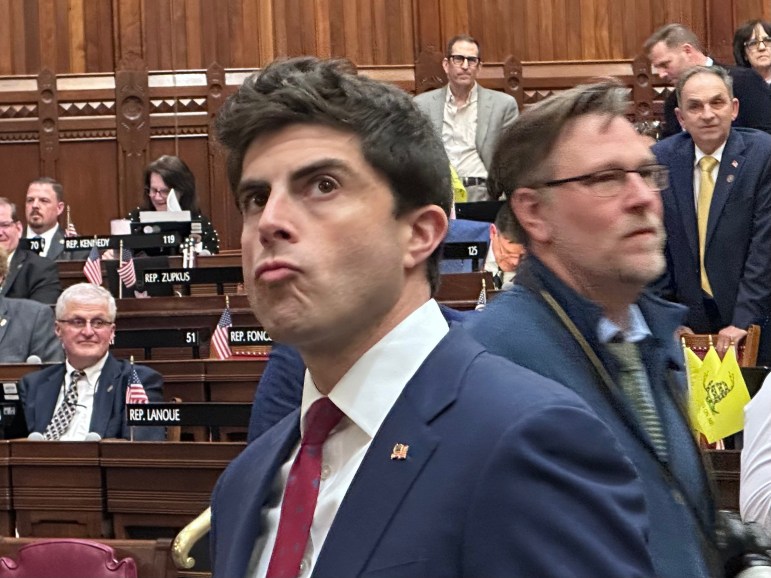
Seven hours later, after defending the bill against Republican criticism and hostile amendments, Blumenthal stood in the House, his jaw clenched after House Majority Leader Jason Rojas, D-East Hartford, made a motion to temporarily end debate.
Absentee voting became a sharply partisan issue in 2020, when Connecticut and many other states promoted voting by mail during the COVID-19 pandemic, raising the ire of President Donald Trump as he sought reelection and repeatedly suggested without evidence he could only lose through fraud.
House Minority Leader Vincent J. Candelora, R-North Branford, said fraud is rare but real. He said he was concerned by several provisions, including one that would allow a voter to seek permanent status as an absentee voter who would automatically be mailed ballots every election.
Local officials would have no way to verify if such a voter still resided in their town, Candelora said.
Republicans objected to what they considered an extraneous provision aimed at federal immigration agents. It bars federal law enforcement from wearing masks or, in many instances, from detaining persons within 250 feet of a polling place.
“Unfortunately, the Democrats have to overstep every time to bring controversy to a bill that should be and could be a bipartisan bill,” Candelora said.
Ritter said the suggestion of curtailing early voting had some support in his caucus. Some local election officials complain, especially in small towns, that 14 days of early voting is unnecessary and expensive.
“We are very sympathetic to our registrars [of voters], who have said, ‘You’ve got to fix this. We’re spending too much money, and people are all exhausted,'” Candelora said.
The option of universal voting by mail would further reduce demand for early in-person voting, Candelora said.
